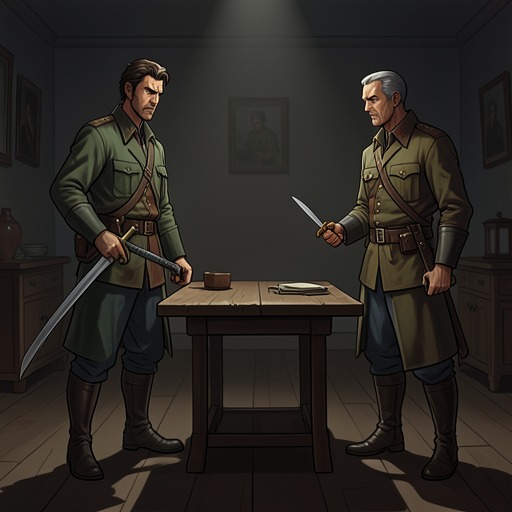
Jean de Carrouges—Jacques Le Gris feud
The Last DuelThe feud between Jean de Carrouges and Jacques Le Gris began as a friendship between fellow squires and became a contest over favor, property, and reputation at Count Pierre of Alençon’s court. Their rupture was not a single quarrel but an accumulating reversal: Le Gris advanced under the count’s patronage as Carrouges lost land and standing, until suspicion replaced trust. A public reconciliation briefly seemed to close the breach; the later accusation concerning Marguerite de Carrouges instead transformed their private hostility into a case before the royal Parlement and a challenge to settle guilt by combat.
Friendship and shared service
Carrouges and Le Gris entered Count Pierre of Alençon’s service in 1377 after the death of their former lord, Count Robert of Perche. Both had served him as vassals, and both arrived at Argentan as men seeking to establish their value to a new patron. They were of similar age, served as chamberlains, and, before their rivalry took hold, were described as old friends whose relations were warm and trusting.
The intimacy between them was marked by a family bond as well as their shared service. When Carrouges’s first wife, Jeanne, gave birth to their son, he chose Le Gris as the child’s godfather. Le Gris held the infant at the baptismal font, taking on the ceremonial duty of a protector. In the noble world of the account, godparenthood approached kinship; later, Carrouges would invoke this trust as part of the betrayal he attributed to his former friend. The loss of Jeanne and the child in the late 1370s deprived Carrouges of his wife and heir, while leaving the earlier bond with Le Gris as a stark reminder of the closeness that had once joined them.
Patronage, land, and rivalry
The two men’s positions at court diverged rapidly. Le Gris, a strong and educated squire from a comparatively recently elevated family, proved useful to Count Pierre and lent him nearly 3,000 francs. In 1378 the count granted him Aunou-le-Faucon, a valuable estate. The gift made Le Gris’s rise visible to the other courtiers and sharpened the contrast with Carrouges, whose family was older and more distinguished but whose influence was not growing at the same pace. Le Gris also commanded the fortress at Exmes, visited the royal court in Paris as the count’s representative, and was appointed a personal squire to the king.
Carrouges’s resentment took shape amid losses that he understood as injuries to both property and status. He sought to recover Aunou-le-Faucon, a former family holding, but the count’s claim was secured by a royal charter. When Carrouges’s father died in 1382, Carrouges expected to inherit the captaincy of Bellême, a prestigious office his father had held for two decades. Count Pierre appointed another man instead. The decision denied Carrouges a position he regarded as part of his inheritance and publicly lowered him beside Le Gris, already captain of another important fortress.
The conflict deepened in 1383, when Carrouges bought Cuigny and Plainville and Count Pierre asserted a prior claim to both estates only twelve days after the sale. Carrouges had to give them up, though the count returned the purchase money. The loss included the land, its future income, and the right to pass it to heirs. Against this sequence of setbacks, Le Gris’s gifts and advancement appeared to Carrouges not as separate court decisions but as evidence of a rival working against him. He came to believe that Le Gris had advised the count to deprive him of Aunou-le-Faucon, Bellême, and then Cuigny and Plainville. The account presents this as Carrouges’s suspicion, not proof that Le Gris had engineered the count’s decisions.
Estrangement and a public reconciliation
The quarrel over Aunou-le-Faucon had already cooled the friendship. Le Gris’s absence from Carrouges’s wedding to Marguerite is a telling sign: although he had once been godfather to Carrouges’s son, he was not among the guests celebrating the marriage. He had not yet met Marguerite. The account allows that Le Gris might have been away on business, but considers it more likely that he was not invited, suggesting how far the old intimacy had receded.
By 1383 Carrouges had become openly resentful, withdrew from Count Pierre’s court, and spent more than a year away from a place only about twelve miles from his castle. He was still nominally a chamberlain, but had become unwelcome in the courtly circle. When called to serve the count in Flanders, he left the campaign after eight days. Meanwhile, Le Gris continued to rise. The contrast—one former friend increasingly favored, the other isolated and nursing a series of grievances—made reconciliation difficult, but not impossible.
At a later gathering in Jean Crespin’s home, the two men greeted one another, clasped hands, and publicly made peace. The watching nobles approved, and Crespin congratulated them. Whatever prompted the encounter, Carrouges then asked Marguerite to kiss Le Gris as a customary sign that friendship had been renewed. She stepped forward and kissed him. This episode made their reconciliation visible to the assembled company, and it was also the first time Le Gris met Marguerite. Its significance would change when Carrouges later described the encounter in court: the gesture presented as peace would become the point from which he said Le Gris’s desire for her began.
The accusation enters the courts
In late January 1386, Count Pierre heard that Carrouges was accusing Le Gris and an alleged accomplice of attacking Marguerite at home while Carrouges was away. The count investigated by questioning Jean Crespin and Sir Bernard de La Tour, Carrouges’s brother-in-law. They reported that Carrouges and Marguerite had spoken of the accusation in different places and wished to bring their complaint to the count. Count Pierre assembled a hearing of prelates, knights, council members, and other experienced men in his great hall at Argentan. Since Le Gris was his favorite and Carrouges a troublesome vassal, the hearing placed their personal hostility inside a dispute over whether a lord could judge his own dependents impartially.
Carrouges’s later account made the broken friendship central to the case. He recalled trusting Le Gris and naming him godfather to his son, then described the meeting at Crespin’s home and the reconciliation that had introduced Le Gris to Marguerite. He accused Le Gris of the alleged attack and also framed it as a betrayal of the bonds between the two men, including the bond established by godparenthood. These were charges made by Carrouges on the basis of Marguerite’s sworn testimony; they should not be confused with a neutral finding about what had occurred. Le Gris denied guilt, and a decision by Count Pierre’s court initially left the accusation unresolved in Le Gris’s favor.
Carrouges appealed to the Parlement of Paris. Le Gris’s lawyer advised him that he might avoid the Parlement’s jurisdiction by claiming clerical privilege, but Le Gris declined that course and had to answer the inquiry. Both men were required to remain available in Paris, each backed by six noble pledges. The twelve guarantors drew a much wider circle of aristocrats into the affair, turning a conflict that had begun at a Norman seigneurial court into a matter of discussion across the royal court and beyond. A second challenge also widened the case: Marguerite’s cousin Thomin du Bois accused Adam Louvel, Le Gris’s alleged accomplice, and threw down a gage of battle. The Parlement later treated the two challenges together while examining additional witnesses and suspects.
From personal feud to judicial combat
The feud thus changed form without ceasing to be personal. At first, the dispute concerned access to Count Pierre’s favor and the unequal distribution of land and office. Carrouges’s appeal then made the former friendship itself part of his case: the more intimate the old trust, the more weight he gave to his allegation of betrayal. The court process, meanwhile, gathered relatives, former associates, legal advisers, and noble guarantors around the two adversaries. Their conflict could no longer be contained within the circle of the count’s household.
When the Parlement authorized combat, the old rivalry became a public test of competing claims. The formalities sought to place the men on equal terms: although Carrouges was a knight and Le Gris a squire, Le Gris was knighted before entering the field. Their circumstances were nevertheless unequal in other respects. Carrouges had survived numerous campaigns, most recently in Scotland; Le Gris was larger and stronger, had greater wealth to equip himself, and was reported to be in better health, while Carrouges was weakened by a prolonged fever. The duel’s rules permitted combat without the protections of a friendly tournament. In that setting, the former friends faced each other not as courtiers seeking reconciliation but as opponents whose allegations, honor, and lives had been bound together by years of rivalry. The available account establishes the feud’s passage into mortal combat, while the significance of the relationship rests in the distance between its beginning in trust and its culmination in this public ordeal.