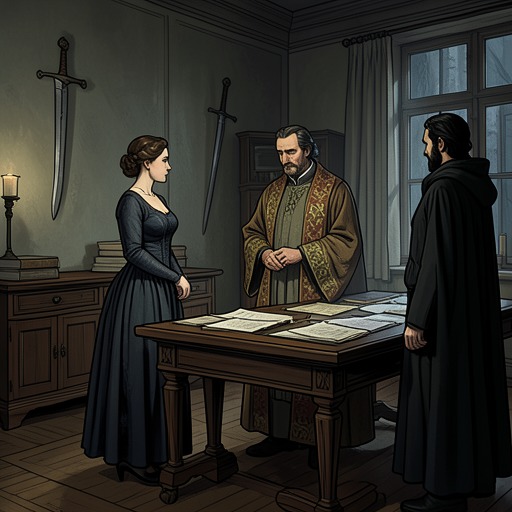
Jean de Carrouges’s appeal before the Parlement of Paris
The Last DuelJean de Carrouges’s appeal before the Parlement of Paris transformed a private quarrel into a test of royal justice. By invoking a legal right to challenge his opponent to trial by combat, Carrouges placed his case before the king and helped produce the last judicial duel authorized by the Parlement of Paris. The appeal’s significance lay not only in the violence it set in motion, but in the way it joined legal procedure, royal authority, and a public claim that God would disclose the truth.
The Appeal as a Legal Remedy
When Carrouges came to Paris to present his case to the king, he intended to make an unusual appeal. French law allowed a nobleman dissatisfied with a judgment to challenge his opponent to judicial combat. This was not a private duel over an insult: it was a formal legal procedure for deciding which party had sworn falsely. The combat’s result was understood as a judgment of God, with divine will determining the truth.
The remedy had a long history, especially in Normandy, but its availability had narrowed over time. Popes condemned judicial combat as an attempt to test God, while kings resisted a practice that could limit their authority over justice. In 1258, Louis IX removed duels from French civil law and substituted the enquête, a formal inquiry based on evidence and testimony. Judicial combat remained a possible last resort in certain criminal appeals by noblemen. Philip IV prohibited it in wartime in 1296 and in peacetime in 1303, then restored it in 1306 for specified criminal cases, including rape, under the king’s direct jurisdiction. Carrouges’s appeal therefore invoked a remedy that survived as a restricted royal exception, not an ordinary means of settling disputes.
From Petition to Royal Decision
The appeal brought Carrouges’s claim into a system in which the king and the Parlement of Paris were central. The surviving references to the case identify lawyers acting for Carrouges, the Parlement’s role in appeals, and a royal communication to the court. The Parlement considered the matter at a session on July 9, 1386; its resulting authorization named pledges who would stand with the combatants. The decision converted Carrouges’s challenge from a proposed contest into a proceeding conducted in the king’s name.
That royal authority shaped the event that followed. The king was not simply a prominent observer: he presided over the duel by law, after the Parlement had authorized it in his name. Charles VI had postponed the combat for a month so he could attend after returning from Flanders, and insisted that proceedings wait until he arrived. In a procedure presented as a divine verdict, the timing and legitimacy of the judgment were thus also controlled by the crown.
The Appeal’s Public Consequence
The court’s decision culminated in a carefully organized public event at Saint-Martin’s field. Thousands came to watch: most were commoners from Paris and its suburbs, while nobles, members of the royal court, and visitors from distant regions occupied assigned stands. Carrouges arrived first, accompanied by pledges, relatives, and attendants carrying his equipment. Marguerite arrived in a black robe and a black-draped carriage; she had recently been confined after childbirth. The crowd’s attention fixed on her as the accuser, though she had not been legally condemned. If her husband died, she faced execution.
The ceremony made the court’s decision visible and enforceable. Officials examined the weapons, and a herald proclaimed rules backed by severe penalties: spectators were not to carry weapons, obstruct others’ view, or speak during the combat. The enforced silence distinguished judicial combat from a noisy entertainment. It also made the crowd part of the proceeding: thousands watched under royal discipline, then answered together when Carrouges, after the fight, asked whether he had done his duty. Their affirmation marked the moment the public learned that the contest had been decided, though not everyone beyond the field yet knew which man had won.
Legal and Historical Aftermath
The appeal’s outcome did not resolve the underlying question of what had happened. The account records enduring disagreement: some chroniclers and later historians doubted Marguerite’s testimony, while others accepted it, and the truth remains uncertain. Nor did the duel’s result settle its legitimacy. The descendants of Le Gris continued for centuries to protest the outcome as a miscarriage of justice.
The proceeding nevertheless marked a historical endpoint for the Parlement of Paris. The fight between Carrouges and Le Gris was the last judicial duel it sanctioned. Later petitions for trial by combat came before the Parlement, but none resulted in authorization. Duels continued in parts of France outside its jurisdiction and elsewhere in Europe, so the practice did not disappear at once. The appeal’s lasting consequence was narrower but decisive: it produced the final duel approved by this court and left a controversial public verdict at the boundary between divine judgment and royal justice.