Legal confession
The Last DuelLegal confession is presented as a changing form of proof whose growing importance did not resolve the problem of establishing guilt. As ordeals and judicial combat gave way to confession in France, authorities increasingly used torture to seek information or admissions; the cases associated with Jacques Le Gris and Adam Louvel, however, show that interrogation did not necessarily produce a confession, and later reports remained contested.
Confession as a Form of Proof
The book places legal confession within a wider shift in French justice. Ordeals and duels had once sought to disclose guilt through a divinely determined outcome. As those methods receded, confession gained importance as proof, while judicial torture increased. The change was therefore not a simple move from force to evidence: the search for an admission could itself involve coercion, and the value of confession depended on how it was obtained and whether it could be trusted.
The book’s reference index distinguishes legal confession from religious confession and separately identifies confession by a genuine felon. This classification suggests that confession could belong to different settings and carry different meanings; it does not, by itself, make every reported admission equivalent or establish how a particular confession was secured.
Interrogation in the Carrouges–Le Gris Case
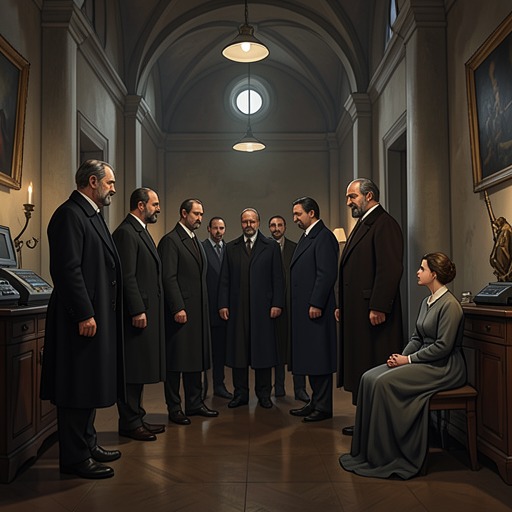
During the inquiry into the accusation against Le Gris, Adam Louvel was held in the Conciergerie, the prison attached to the Palais de Justice, and questioned under torture. Jean Le Coq’s diary also records that a maidservant said to have been at the Carrouges residence that day was questioned. Neither Louvel nor the maidservant confessed. Their interrogation thus illustrates both the authorities’ use of coercive examination and its evidentiary limit: the procedure produced no admission from either witness.
Confession also remained at issue after the judicial combat between Jean de Carrouges and Le Gris. The book’s notes cite accounts in which Le Gris was asked to confess and denied the accusation. They also register reports of a confession attributed to a condemned man and of one attributed to a sick man. These references do not establish a single, uncontested account of an admission; instead, they preserve the uncertainty surrounding what was said and under what circumstances.
Authority and Uncertainty
The contrast between confession and judicial combat exposes a problem of judicial authority. Combat was framed as a judgment through which God would disclose which party had sworn falsely, while confession offered a different kind of proof—one dependent on a person’s words. Yet the increasing reliance on confession coincided with the increased use of torture, and the inquiry in the Carrouges–Le Gris case yielded no confession from the two people questioned under it. Neither a solemn ordeal nor a coerced examination could make the truth equally accessible to all observers.
The book’s account therefore treats confession not as a self-validating answer but as a legally consequential and potentially disputed claim. Its distinctions among legal, religious, and other forms of confession, alongside the conflicting reports tied to the Le Gris affair, underscore that an alleged admission must be considered in relation to its setting, its source, and the circumstances in which it was reported.