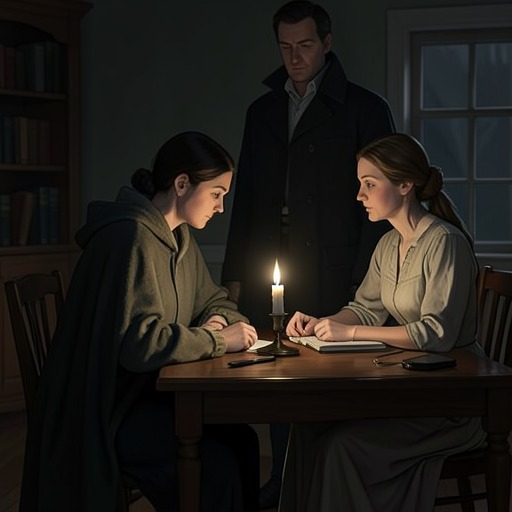
Marguerite de Carrouges—Nicole de Carrouges daughter-in-law relationship
The Last DuelMarguerite de Carrouges and Nicole de Carrouges were daughter-in-law and mother-in-law, bound together by Jean de Carrouges’s marriage and the inheritance of the Carrouges family. Their connection was not a simple household tie: Nicole resented the marriage, while the circumstances of Jean’s departure and Marguerite’s stay at Nicole’s remote château brought the two women into close proximity just before Marguerite accused Jacques Le Gris of assault. The surviving account makes their relationship consequential, but does not record a later reconciliation or a full account of their private dealings.
Marriage, family name, and inheritance
Nicole’s opposition to Marguerite began with the marriage itself. She believed her son had acted rashly by marrying the daughter of Robert de Thibouville, whose betrayals of the French crown had left the family’s reputation under a cloud. In Nicole’s view, Jean had joined the distinguished Carrouges name to a dishonored one. Marguerite’s wealth and the property she might inherit were advantages, but could not outweigh the risk that a politically damaging alliance posed to the standing of a noble family in Normandy. The dispute was sharpened by the family’s material circumstances. Jean was expected to preserve the Carrouges name and pass its estate to an heir. His mother held some lands in her own right and would retain their rents if her husband died before her; the remainder of the inheritance was intended for Jean, apart from smaller legacies to his siblings. Marguerite, meanwhile, brought lands of her own, whose rents could supplement the household’s income. Marriage therefore connected not only two people but also reputations, property, and the future of the family line. Nicole’s resentment was tied to her own loss of status. After her husband died, she lived at Capomesnil rather than the more splendid fortress at Bellême, where she had once been treated as the wife of Sir Jean. The account says she blamed Jean’s headstrong marriage, in part, for Count Pierre’s denial of the captaincy of Bellême that Jean considered his by right. From her modest retreat, Nicole saw Marguerite as mistress of the larger and finer Château de Carrouges, while her own visitors were few. The contrast gave the family disagreement a physical shape: the younger woman occupied the principal household, while the older woman lived apart.
The visit to Capomesnil
In the winter of 1386, Jean and Marguerite travelled to Capomesnil to visit Nicole. The journey followed months of campaigning and a sea crossing; Jean was ill with a chronic fever, and the rough winter roads offered little comfort. Marguerite had been away from Carrouges for much of the preceding year and may have expected a brief visit before returning home. She had also been married for more than five years without bearing an heir, a circumstance that might have exposed her to blame from her mother-in-law. The account presents this as a possible source of apprehension, not as a recorded exchange between the women. Nicole’s home was isolated. Capomesnil was a small hamlet of roughly ten or twelve thatched houses near the river Vie; Nicole’s château stood apart from it, in open country and distant from any fortified place. Its main hall, kitchen, servants’ quarters, upstairs rooms, and sturdy keep formed a modest household, not a bustling court. The setting helps explain the practical weight of the visit: Marguerite was staying in Nicole’s home, dependent on its household arrangements, while Jean planned another journey. Jean left for Paris to seek unpaid wages and other financial assistance. Marguerite consequently remained at Capomesnil for a month or more, seeing more of Nicole than of her husband. On January 18, Nicole was summoned to appear as a witness at Saint-Pierre-sur-Dives. She departed with nearly all the household servants, including the maid whom Jean had instructed to remain with Marguerite. Only one maid reportedly stayed behind, and she made herself scarce. Whatever the reason for Nicole’s arrangements, their practical consequence was that Marguerite spent much of that day virtually alone in the château.
The accusation and the family council
After Nicole returned from Saint-Pierre-sur-Dives, Marguerite did not tell her what she said had happened. She waited for Jean to come back from Paris, probably on January 21 or 22. The account identifies Nicole as the last person Marguerite would have wished to confide in, given their strained relationship. Marguerite kept silent for several days, then told her husband privately. The evidence describes Nicole’s absence on the day in question and Marguerite’s decision to wait for Jean; it does not establish that Nicole knew of the accusation before Jean returned. The following morning, Jean called a secret family council at Capomesnil. Nicole may have attended, along with Marguerite’s cousin Robert de Thibouville and other relatives and friends, but her presence is not certain. Jean asked Marguerite to recount the event in detail before the gathering. The account treats this meeting as a preliminary hearing: accuracy mattered because relatives and friends could later be asked to corroborate what they had heard. If Nicole was present, she would have heard Marguerite’s account alongside the other members of the family; the evidence does not state what she said or whether she believed it. The council urged Jean to take the complaint to Count Pierre, the feudal lord responsible for hearing disputes between his vassals. This advice moved the conflict beyond the household, although Nicole’s earlier disagreement with the marriage formed part of its background. At the same time, Marguerite revealed that she was pregnant, after years in which the couple had been childless. The pregnancy raised questions about inheritance and paternity, but its origin cannot be established from the evidence. Marguerite later gave birth to Robert, her first known child, who was named after her father; two more sons followed. The record does not describe Nicole’s relationship with the children.
Limits of the surviving account
The evidence follows the relationship closely at a few decisive points: Nicole’s opposition to the marriage, the difference in the women’s status and living circumstances, Marguerite’s extended stay at Capomesnil, Nicole’s departure on January 18, and the possibility that she attended the family council. It does not provide a sustained portrait of their everyday interactions, establish whether Nicole deliberately left Marguerite without company, or explain her response to the accusation. Those silences matter. They prevent the household’s painful circumstances from being turned into certainty about Nicole’s motives, while showing how inheritance, family reputation, and household authority shaped the relationship in which the crisis unfolded.