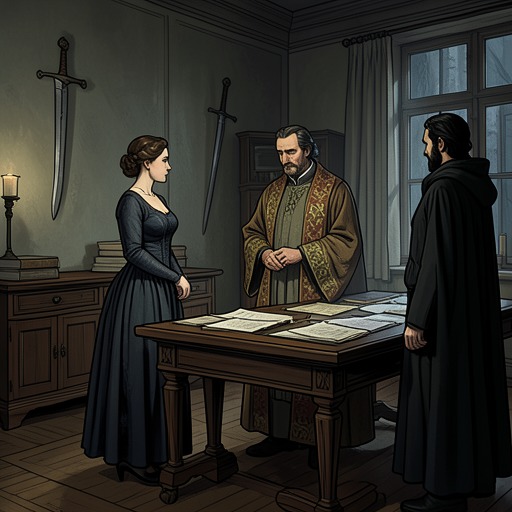
Marguerite de Carrouges’s alleged rape
The Last DuelMarguerite de Carrouges’s alleged rape at Château de Capomesnil on January 18, 1386, became the central accusation in a case that ended in a judicial duel but never produced an uncontested account of what had happened. Marguerite maintained that Jacques Le Gris and Adam Louvel were responsible; the uncertainty that followed made her testimony, the social risks of speaking, and the limits of the legal process inseparable from the event’s legacy.
Background and Stakes
The accusation carried particular danger in a society that tied a noble wife’s reputation to chastity and loyalty. Aristocratic concern about legitimate heirs made a wife’s sexual conduct a matter not only of personal honor but of inheritance. Jean de Carrouges had married Marguerite, who was much younger than he was, in part with the expectation that she would bear legitimate children. Those expectations placed a severe burden on her reputation if her account were rejected or treated as evidence of adultery rather than an assault.
Her position was further complicated by her father’s history. Robert de Thibouville’s treasons had left the family under suspicion, and Marguerite was regarded as a traitor’s daughter. She was also the wife of one of Count Pierre of Alençon’s troublesome vassals, while Le Gris was the count’s favored squire and was well regarded at the royal court. These inequalities did not establish the truth or falsity of the accusation, but they shaped the unequal circumstances in which it had to be heard.
Disclosure and Testimony
After the alleged attack, Le Gris warned Marguerite against telling her husband, suggesting that Jean might suspect her of adultery and harm her. The warning exploited a real vulnerability: accusations of infidelity could expose wives to violence, while a charge against a powerful man could bring scandal and disbelief. Marguerite nevertheless decided to tell Jean when he returned from Paris. She committed the day and time of Le Gris’s visit to memory, anticipating the questions she would face and the demands of a public case.
Marguerite remained silent for the few days before Jean’s return, probably on January 21 or 22. Dame Nicole, her mother-in-law, had returned from a shorter journey to Saint-Pierre-sur-Dives, but Marguerite did not confide in her. Her delay, as the account presents it, was not a withdrawal of the accusation: she waited for her husband and then proceeded despite the dangers attached to disclosure.
In her later sworn account, Marguerite said that she saw both men in daylight, that Louvel named Le Gris before Le Gris appeared, and that she spoke with each before the attack. Her accusation therefore implicated two men, not Le Gris alone. This detail later mattered in evaluating theories of mistaken identity or deliberate fabrication: the book argues that naming Louvel added a further burden of proof rather than making the charge easier to sustain. Marguerite repeatedly maintained her account under oath, including before the highest court in France.
Legal Stakes and Judicial Duel
The prospects for obtaining a hearing were unfavorable. The identity of the attackers and the absence of witnesses in Marguerite’s favor created a difficult problem of proof. Le Gris could expect support in the court at Argentan through his relationship with Count Pierre, and, as a cleric in minor orders, could claim benefit of clergy to seek transfer to an ecclesiastical court. The accusation thus faced obstacles both in establishing what had happened and in reaching a forum that would judge it impartially.
The dispute ultimately led to a judicial duel between Jean de Carrouges and Le Gris, authorized by the Parlement of Paris. The duel’s formal preparations sought to place the men on equal terms: because Carrouges was a knight and Le Gris a squire, Le Gris was knighted before the fight. Their circumstances were not otherwise identical. Carrouges had more military experience, while Le Gris was larger, wealthier, and better equipped; accounts also describe Carrouges as weakened by fever. Once combat began, the ceremonial ideals of chivalry gave way to an unrestricted fight. The procedure made the outcome of a physical contest carry the weight of judgment on the accusation, without resolving the historical uncertainty for every observer.
Contested Memory and Significance
The case remained disputed from the beginning. Jean Froissart reported that the king, court, and crowd welcomed the duel’s outcome, while Jean Le Coq, Le Gris’s lawyer, recorded divided reactions, including the view that Le Gris had been unjustly killed. The Saint-Denis Chronicle later claimed that Marguerite had accused Le Gris mistakenly and in good faith, and that another offender eventually confessed. A version of this story circulated in the 1430s as well. The account of a mistaken accusation and belated confession offered one way to explain the outcome while preserving Marguerite’s honor, but it did not settle the case.
The book challenges both the mistaken-identity story and the alternative claim that Marguerite knowingly lied, whether on her own initiative or under pressure from her husband. It notes that accusing Louvel as well as Le Gris made a fabricated account more vulnerable to contradiction, and that the surviving record includes Le Gris’s alibi but no comparable testimony exonerating Louvel. These considerations are presented as reasons for skepticism toward the later legend, not as proof that the event can now be reconstructed with certainty. The account’s conclusion is that the truth may never be established to everyone’s satisfaction.
The duel was the last judicial duel authorized by the Parlement of Paris. Later appeals there did not result in permission for another, although trial by combat continued elsewhere in France and Europe. The case’s contested outcome became an enduring example in arguments against judicial combat: Enlightenment writers, including Voltaire, invoked it as evidence of the injustice of letting a fight determine a legal dispute. The accusation’s afterlife thus preserved two unresolved questions at once—what happened to Marguerite, and whether the method used to judge her claim could ever reliably answer that question.