Nicopolis
The Last DuelNicopolis was a strongly defended city overlooking the Danube, set high above the river on a bluff in present-day Bulgaria. In September 1396, a European crusading army reached it after a long march through central and southeastern Europe. The city’s defenses resisted an initial assault, while the Ottoman army that came to its relief turned the country south of Nicopolis into a prepared battlefield. The ensuing Battle of Nicopolis ended in a catastrophic defeat for the crusaders and left the fate of Jean de Carrouges, one of the campaign’s Norman knights, uncertain.
Setting and Strategic Importance
The city’s position above the Danube made it a conspicuous and strongly defended objective. When the crusaders arrived on September 12, its Ottoman defenders held a well-fortified settlement overlooking the river. An initial attempt to take it, using mines and scaling ladders, failed for lack of siege engines. The attackers therefore remained before a city they could not readily storm, while the Ottoman ruler Bayezid moved to relieve it.
Nicopolis also stood within a campaign stretched across a great distance and conducted by a coalition without an agreed overall plan. French and Burgundian forces gathered at Dijon in late April 1396 and received four months’ wages in advance. They marched east through Switzerland, Bavaria, Austria, and Hungary, joining other crusaders, including King Sigismund of Germany and Hungary, at Budapest. From there, parts of the coalition advanced south along the Danube, accompanied by supply ships, while others took a more direct overland route north of the river, passing Belgrade and Orsova. The army’s arrival before Nicopolis brought those separate movements to a common target, but not to a common command.
The City and the Ottoman Relief
Before reaching Nicopolis, the crusaders reconvened at Vidin in early September, besieged and captured it, and killed its garrison. Continuing east along the Danube, they encountered supply shortages and plundered several other towns. By the time they reached Nicopolis, the campaign had already mixed military advance with violence against captured communities. The failed assault on the city left the crusaders facing a fortified enemy position without the equipment needed to force an immediate entry.
Bayezid had been besieging Constantinople, about three hundred miles away, when he learned of the Christian attack. He abandoned that siege and ordered a rapid march north. His army joined its Serbian allies at Kazanlak around September 20, then continued toward Nicopolis. On September 24, the Ottoman force arrived and encamped nearby. Messengers were sent into the city by night to encourage its defenders to hold out, assuring them that relief had come.
Rather than attack the crusaders directly, Bayezid selected ground a few miles south of Nicopolis. His position lay on a ridge behind a narrow, wooded ravine, and his troops planted thick rows of sharpened wooden stakes there. The crusaders were now caught between the city and the relief army. They had also taken thousands of prisoners while raiding nearby towns and feared that an attack from Nicopolis might free them. The account records that the crusaders killed those captives and left the bodies unburied as they hurried onward. The episode darkens the setting of the battle: the city was not only the objective of the campaign but the point around which a worsening military and moral crisis tightened.
The Battle South of Nicopolis
On Monday, September 25, the crusaders rode out to meet Bayezid’s army. The French and Burgundian leaders refused to march behind Sigismund’s forces, whom they regarded as peasants, and insisted on taking the lead. Sigismund yielded, but warned them against advancing too far ahead or abandoning a strong defensive position in their eagerness to attack. The division over precedence thus affected the order of battle before the fighting began.
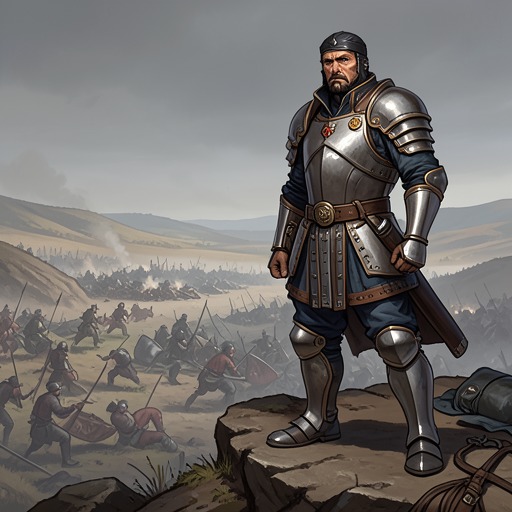
The crusaders climbed toward the Ottoman position under arrow fire. Their plate armor deflected many arrows, and they reached the Ottoman infantry behind the stakes. They pulled up the barriers to get through; once the defenses were broken, the knights killed or routed much of the lightly armed infantry. Ottoman cavalry then entered the fighting. French knights fought on foot and attacked horses with daggers, and the cavalry eventually withdrew. Believing that they had prevailed, the crusaders rested after the climb, the assault through the stakes, and the successive clashes with infantry and cavalry.
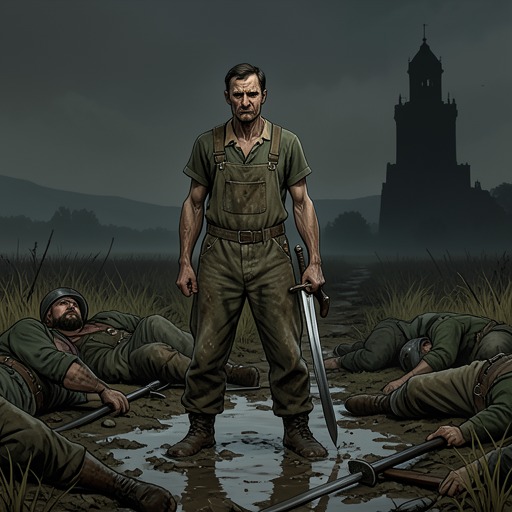
That pause proved disastrous. A cavalry force held in reserve by Bayezid emerged from behind trees and attacked. Some crusaders died in the initial charge; others fled back down the slope and toward the city, with some crossing the Danube to escape. Those who remained fought on as their dead accumulated around them. Jean de Vienne fell with the banner of the Virgin still in his hand, and the forces following the French and Burgundian advance were cut to pieces. Many survivors eventually surrendered in the face of overwhelming numbers. Boucicaut and the Count of Eu, who had led the overhasty French charge, were among the captives.
Defeat, Captivity, and Carrouges’s Uncertain Fate
The Ottoman forces took as many as three thousand prisoners. Some wealthy and high-ranking captives, including Boucicaut and Jean of Nevers, were eventually ransomed. Others were killed in retaliation for the crusaders’ massacre of their captives: on the day after the battle, several hundred crusaders were beheaded before Bayezid, sickened by the slaughter, ordered it stopped. Nicopolis thus meant not simply a lost assault or a broken advance, but a defeat followed by captivity, ransom, and reprisal.
Jean de Carrouges had joined the crusade, which drew nobles and knights from across Europe. Nicopolis was his third campaign with Admiral Jean de Vienne. The two had fought together in Normandy against the English nearly twenty years earlier and had also served on the ill-fated Scottish expedition of 1385. The book cannot establish what happened to Carrouges at the battle. He may have died fighting near his old commander and been buried with him in a mass grave; alternatively, he may have been among the prisoners executed the following day. The account considers flight unlikely, given his bravery and loyalty to his comrades, but does not present his death as certain.
The battle is described as one of the great military debacles of its age and as the end of three centuries of European military ventures in the East. For the story of Carrouges and Marguerite, its consequence was personal as well as military: his failure to return left Marguerite without the champion who had defended her case. The outcome at Nicopolis therefore closes his arc not with a confirmed death scene, but with the loss of a defender and an unresolved historical record. The surviving uncertainty is part of the place’s narrative significance: Nicopolis fixes the end of his known military journey while leaving his final moments unknown.