Parlement authorizes trial by combat
The Last DuelParlement authorizes trial by combat made a disputed accusation answerable through a fight under royal authority. The decision transformed a case that could not readily be settled by ordinary proof into a public ordeal framed as divine judgment; when the combat took place at Saint-Martin’s dueling ground on December 29, 1386, its result carried mortal stakes for Marguerite de Carrouges as well as for the two combatants.
The Decision and Its Stakes
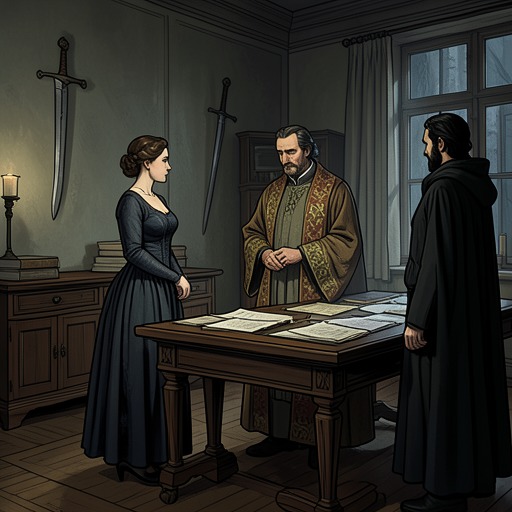
The Parlement of Paris authorized the duel in the king’s name. A record of the court’s arrêt is dated September 15, 1386; the duel had initially been set for November 27, before being postponed. The authorization gave the quarrel an exceptional legal route: instead of ending with an ordinary finding about the accusation, the case would be tested through combat, with the outcome treated as a judgment.
The risks were not confined to Jean de Carrouges and Jacques Le Gris. Marguerite had accused Le Gris, and the account presents her reputation for marital loyalty and chastity as a matter of exceptional importance in noble society. Le Gris had warned that Jean might suspect her of adultery rather than believe her. At the duel, Marguerite was not legally condemned in advance, but if her husband were killed, she faced execution. The court’s decision therefore placed her future under the same stark contingency as the combatants’ fates.
From Authorization to Public Ceremony
The king was both the most exalted spectator and, by law, the presiding judge. The Parlement had authorized the combat in his name, and Charles VI required that the ceremonies wait until he arrived. He had postponed the duel so he could attend after returning from Flanders. Only when he took his place in the royal stand did the proceedings formally begin. Royal presence made the event more than a private contest: the law’s authority was embodied in the king, while the combat was presented as an appeal to a judgment beyond ordinary human knowledge.
The field and its audience were organized to make the proceedings visible while controlling the crowd. Officials watched from wooden towers at the corners of the inner enclosure; guards around the outer wall were to prevent disturbances. Thousands came to witness the duel. Nobles and members of the royal court occupied tiered stands, with separate places for foreign nobles and ladies; burghers and merchants had their own stands, while many commoners watched from the ground through gaps in the timber fencing. The arrangement reproduced social rank in the very act of assembling a public audience for the judgment.
The Combatants and the Ritual of Equality
Jean de Carrouges arrived first, riding a palfrey with his visor open and his sword and dagger at his belt. Attendants brought his armored warhorse, lance, and shield. He also carried a blue-painted pole topped with a silver crucifix and repeatedly made the sign of the cross. His retinue included pledges and relatives, among them Robert de Thibouville, Marguerite’s cousin.
Marguerite arrived in a carriage draped in black, wearing a long black robe. She may have been conveyed this way because she had recently risen from childbed. Her father, Sir Robert de Thibouville, accompanied her. The crowd’s attention fixed on her arrival: she was the accuser at the center of the case, and her clothing marked the danger attached to the day. She was then placed on a black-covered scaffold, where she had to await the outcome in full view of the field.
The preparations sought to make the duel procedurally even. Heralds announced strict rules: unauthorized weapons were forbidden, spectators were required to remain seated and not obstruct others, and the crowd was ordered to keep silent during the battle. The combatants’ weapons were examined to ensure that they conformed to the rules and were of equal length. Because Jean was a knight and Le Gris only a squire, Le Gris was ceremonially knighted before the fighting began. The ritual gave the two men equal formal status, but not equal experience: Jean had fought in numerous campaigns, most recently in Scotland, while Le Gris had seen less military service. Le Gris was larger, stronger, wealthier, and better equipped; Jean, by contrast, was suffering from a prolonged fever that had worsened that day. The ceremony could regulate their equipment and standing, but it could not remove these differences.
Outcome and Public Meaning
Once the combat began, the protections and decorum of the preliminaries no longer governed how the men fought. Unlike a tournament, the judicial duel imposed no rules that guaranteed chivalrous conduct. Its declared possible endings were decisive: one combatant could kill the other, force a confession of false swearing, or drive his opponent from the field. In each case the result would determine guilt and carry a severe consequence. The formal equality established before the fight thus led into an ordeal whose outcome could not be calculated from the rules alone.
After the contest, Carrouges turned toward the royal stand and acknowledged the king and the crowd. He called out to ask whether he had done his duty, and the thousands who had been silent under threat of punishment answered together in affirmation. Their response was the first permitted collective outcry and carried beyond the monastery walls into the surrounding streets. The scene shows how the authorization’s legal and theatrical dimensions converged: the court had sanctioned the combat, the king presided, and the crowd’s response made the victor’s success publicly legible. Yet the spectacle could produce a recognized outcome, not independent proof of what had happened before the trial. The decision resolved the case through a ritual judgment whose authority depended on the institution that permitted it and the audience that witnessed its result.