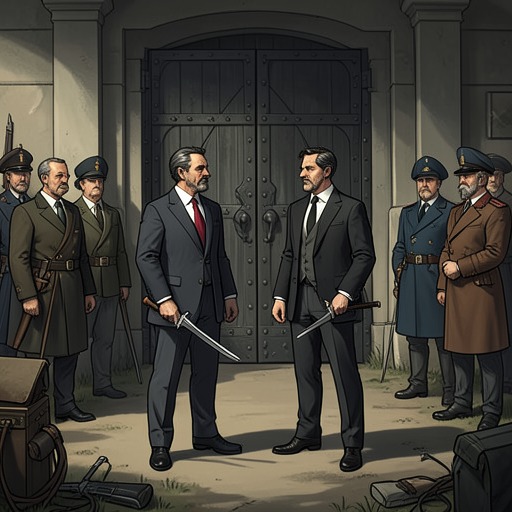
Philip IV’s 1306 decree on judicial combat
The Last DuelPhilip IV’s 1306 decree on judicial combat revived a form of appeal that the French crown had tried to suppress, but only under strict limits and royal control. It treated combat as a formal means of deciding which party had sworn falsely, while surrounding that decision with rules that joined royal authority to the belief that God would reveal the truth.
From suppression to restricted appeal
By the later Middle Ages, judicial duels were increasingly rare. Popes denounced them as a forbidden temptation of God, while French kings opposed a practice that allowed nobles to challenge judgments and threatened to weaken royal control over justice. The duel began disappearing from civil proceedings around 1200. In 1258, Louis IX removed it from French civil law, replacing it with the enquête, a formal inquiry based on evidence and testimony. A limited role remained for criminal cases: a noble dissatisfied with his lord’s verdict could still seek combat as a last resort.
Philip IV first outlawed judicial combat in wartime in 1296, concerned that disputes among nobles would drain manpower needed for the realm’s defense. He prohibited it in peacetime in 1303 as well. Noble resistance to the loss of this long-standing privilege led him to relent three years later. The 1306 decree restored combat as a possible appeal in certain criminal cases, including rape, but placed it under the king’s direct jurisdiction. It did not restore the duel as an unrestricted means of settling disputes.
Eligibility and legal risk
The decree’s limits made combat an exceptional remedy. A qualifying case had to concern a capital crime, such as murder, treason, or rape; the crime had to be certain to have occurred; every other legal remedy had to be exhausted, leaving bodily combat as the sole remaining proof; and the accused had to be strongly suspected. The requirements tied the appeal to both the gravity of the charge and the exhaustion of ordinary proceedings.
The stakes extended beyond the combatants’ lives. An appellant who demanded a duel risked his estate, his family’s reputation, and his soul: the solemn oaths required him to accept spiritual condemnation if the outcome established that he had lied. When a wife’s accusation was at issue, her oath was also at risk. If combat proved that she had sworn falsely about rape, the penalty could be death. Thus the procedure placed the accuser’s credibility and safety within the same perilous legal contest as her champion’s claim.
A prescribed royal procedure
The 1306 decree included a lengthy formulaire governing the appeal, the formal challenge, the oaths, and the ceremonies before combat. In the case of Jean de Carrouges, the initial appeal was made at Château de Vincennes, where Charles VI held court. The later challenge was a separate, formal proceeding: the appellant accused his opponent to his face and offered to prove the charge in combat. Both parties had to bring noble pledges, who swore to secure their attendance when summoned, including at the battlefield if a duel were authorized.
The challenge had to be witnessed by the Parlement of Paris, a body of thirty-two magistrates with jurisdiction over duels and authority to decide whether combat was warranted. Because the king, magistrates, parties, counsel, and pledges all had to be present, the ceremony required advance arrangement. The decree therefore organized more than the fighting itself: it prescribed a sequence of legal appearances and obligations that bound the parties from the moment an appeal was pursued.
The procedure also staged royal and sacred authority together. The Parlement authorized the duel in the king’s name, and Charles VI served as its presiding judge. At the combat, the king’s arrival was required before proceedings could begin. Priests, an altar, a crucifix, and a prayer book framed the oaths as a divine judgment, while rules for the field controlled the weapons, the participants, and the spectators. The combat was presented as a means for God to disclose guilt, yet its authorization, supervision, and public conduct were governed by royal institutions.
Application and legacy
The decree remained in force when Jean de Carrouges appealed Count Pierre’s verdict, some eighty years after its restoration, although judicial duels had by then become extremely rare. The combat between Carrouges and Jacques Le Gris was the last judicial duel sanctioned by the Parlement of Paris. Its disputed result was later credited with hastening the decline of a practice many regarded as among the most barbarous forms of medieval justice.
The Parlement received later appeals for trial by combat, but none resulted in an authorization. Duels continued for a time in regions beyond its jurisdiction, including Brittany and parts of Flanders under Burgundian control, and the practice persisted elsewhere in Europe. The decree’s legacy was therefore not an immediate end to judicial combat, but a narrowing of its lawful place in France: a royal exception that, in its final authorized instance, helped mark the institution’s retreat.