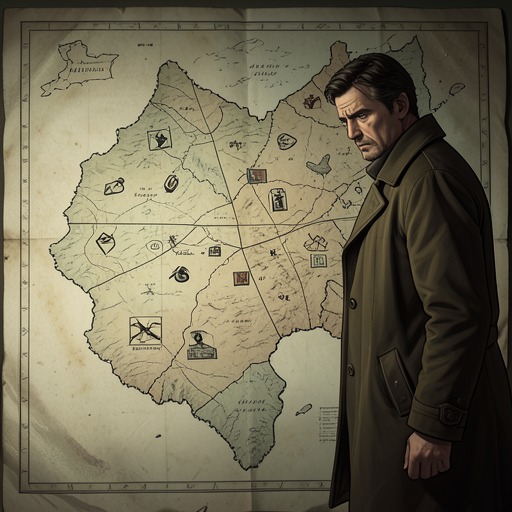
Rules for inheritance and transfer of feudal fiefs
The Last DuelRules for inheritance and transfer of feudal fiefs governed who could hold land, how it passed between generations, and what happened when a line ended without an heir. Because land supplied income, military resources, and family status, these rules were not merely technical limits on ownership: they shaped loyalties and rivalries, and could turn a disputed estate into a lasting political conflict.
Land, inheritance, and obligation
A fief was bound to a relationship of vassalage. Land provided crops and rents, in money or kind, as well as the means to support knights and men-at-arms; it was also a durable inheritance through which a family could preserve its name and standing. The book presents this connection through the principle that lordship and land depended on one another. Its practical consequence was that a hereditary fief held from a lord could not be sold out of the family without that lord’s permission.
Inheritance within a family did not mean that every relative received an equal share. Jean de Carrouges had already received part of his inheritance, including land that produced rents. When his father died, Jean expected to receive the remainder, subject to smaller legacies for his younger brother Robert and his sister Jeanne. Robert entered the priesthood with the prospect of only a small inheritance; Jeanne’s marriage brought a portion of their father’s land as her dowry. Their mother Nicole held some land in her own name and, if widowed, would retain it and its rents. The rest was expected to pass to Jean, whose responsibility was to continue the family line and transmit the estate to an heir.
The value of that inheritance was both familial and financial. The Carrouges estate probably produced 400 or 500 livres a year in rents, while a squire’s campaign pay was half a livre per day. Land therefore represented income that persisted beyond a military campaign, as well as the resources and prestige associated with a family’s name. The possibility of inheriting land also made the survival of an heir consequential: Jean’s first wife and their son died, leaving him without a living heir at that point in his life.
Reversion and reassignment
When a tenant died without an heir, the fief did not simply pass to a more distant relative as a matter of course. Under the rule described in the book, it reverted to the lord, who could grant it to another vassal. The death of Count Robert of Perche in 1377 demonstrates this process at a higher level of the feudal hierarchy. He died without an heir, so his lands and castles reverted to his overlord, King Charles V, who granted Perche to Robert’s older brother, Count Pierre of Alençon.
That change in lordship altered the obligations of those who held land or served in Perche. Jean de Carrouges and his father, previously vassals of Count Robert, became bound to Count Pierre and had to perform homage and swear fealty to him. The transfer thus changed more than the name of the territorial ruler: it redirected the loyalties and military service of the men attached to the domain, placing their fortunes more directly under their new lord’s control.
The rule also left room for lords to distribute land among their vassals. In 1378 Count Pierre gave Aunou-le-Faucon to Jacques Le Gris, rewarding his service and a recent loan of 2,920 gold francs. The grant connected landholding to patronage: a large estate increased Le Gris’s resources and standing, while the gift reinforced his relationship with the count. The royal charter issued on May 29, 1380, confirmed the grant as irrevocable and specified the services and loan cited in its justification. Its public reading at the parish church of Aunou on June 10 made clear who was to be recognized as the estate’s lord.
Disputed claims and the limits of inheritance
Aunou-le-Faucon shows how the rules could constrain a claimant as well as authorize a grant. Jean believed he might have acquired the fief through his marriage to Marguerite, whose family had formerly held it. After the land passed from her family to Count Pierre and then from the count to Le Gris, Jean sued to recover it. Count Pierre sought royal confirmation of his gift; the charter’s guarantee against other claims answered the challenge directly. Jean lost the suit, and the royal confirmation placed the estate beyond his immediate reach.
The ruling had consequences beyond the property itself. Jean had challenged both his former friend Le Gris and Count Pierre, his liege lord and chief source of patronage and protection. The dispute aggravated the decline of their friendship and contributed to the widening gulf between Le Gris’s advancement at court and Jean’s diminishing position there. In this instance, a claim grounded in marriage and family history could not overcome the count’s established authority over the transfer or the king’s confirmation of it.
A separate dispute over Bellême illustrates the difference between inheriting land and inheriting an office. When Jean’s father died in 1382, Jean expected to succeed him as captain of Bellême, a post that often passed from father to son. But Count Pierre held the right to appoint the castle’s captain and chose another man. The appointment was not itself an inheritance of the family estate; it was a position controlled by the lord. Its loss nevertheless reduced Jean’s power and prestige, and he brought another suit against the count. The episode shows how family expectations could meet the limits of a lord’s authority over offices and dependent holdings.
Aftermath and lasting significance
The Aunou-le-Faucon dispute persisted even after Jean killed Le Gris in their judicial duel. Much of Le Gris’s land reverted to Count Pierre at his death, including the contested fief. Jean then tried again to obtain Aunou-le-Faucon, seeking to use part of the 6,000 livres awarded to him from Le Gris’s estate toward its purchase. The award compensated him for expenses and injuries connected with the legal case, but it did not cancel Count Pierre’s prior claim to the land.
After nearly two years of further proceedings, the Parlement of Paris ruled on January 14, 1389, that Aunou-le-Faucon belonged to Count Pierre. Jean therefore failed to secure the estate both before and after the duel, despite the death of his rival and the substantial sum awarded from Le Gris’s property. The fief later passed to Count Pierre’s bastard son. Its successive transfers—from the Thibouville family, to Count Pierre, to Le Gris, back to the count, and eventually to his son—make visible the rules’ central tension: land could sustain family continuity, but its passage remained subject to the rights and decisions of the lord.