Rules of judicial combat
The Last DuelRules of judicial combat combined an appeal procedure with an elaborate public ritual. They determined who could demand a fight, who had to take part, and how the combatants and spectators were controlled; at the 1386 trial of Jean de Carrouges and Jacques Le Gris, the rules also made the king’s authority and the claim of divine judgment visible to a vast audience.
Legal Status and Jurisdiction
A judicial duel was not simply a duel of honor over an insult. It was a formal means of resolving a legal dispute by determining which party had sworn falsely, and its outcome was understood as a judgment of God. For centuries, it also served as an appeal: a litigant dissatisfied with a verdict could challenge witnesses who had testified against him and offer to prove his claim in combat. Even a lord sitting as a judge in a local seigneurial court could risk such a challenge from an aggrieved vassal.
The practice had once been available across social classes, and public combats addressed both felonies and civil disputes. In civil cases, litigants could hire champions. Criminal cases generally required the principals to fight in person, since defeat usually meant death; a champion could stand in only for a woman, an elderly person, or someone infirm. In parts of Europe women could fight men, but by the later Middle Ages French criminal combats were increasingly restricted to noblemen.
The institution contracted as both church and crown opposed it. Popes denounced combat as an attempt to test God, while kings objected that it encroached on royal justice and the consolidation of authority at the throne. By 1200 the duel was receding from French civil proceedings. In 1258 Louis IX removed it from civil law and substituted the Enquête, a formal inquiry based on evidence and testimony, while leaving a narrow avenue for a noble to appeal a lord’s criminal judgment through combat.
Philip IV banned judicial duels during wartime in 1296, arguing that they depleted the manpower needed for defense, and prohibited them in peacetime in 1303. Noble resistance to the loss of this privilege led him to restore the duel in 1306 as an appeal in certain criminal cases, including rape, but only under the king’s direct jurisdiction. Jean de Carrouges’s challenge therefore depended on a specific legal opening: the appeal to the king could authorize a combat that ordinary local proceedings could not.
Procedure and Equal Terms
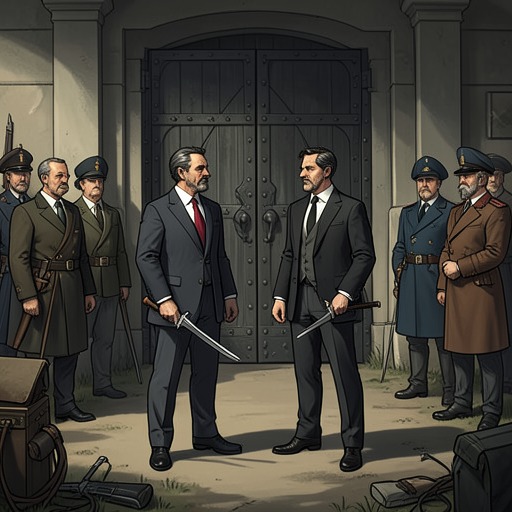
The rules sought to make the fight a controlled test rather than an unregulated brawl. Before combat, the king’s officer responsible for arms and weapons, assisted by witnesses assigned to the combatants, examined their equipment. In the preparations for this duel, the lances, swords, axes, and daggers were checked to ensure that corresponding weapons were of equal length and that neither man had brought an illegal device. The combatants’ unequal rank also had to be addressed: Carrouges was a knight, while Le Gris was a squire, so Le Gris was ceremonially knighted before the fight. Three taps of the marshal’s sword made him a knight for the occasion and placed the men on more nearly equal formal footing.
The law required the principals themselves to fight in a criminal case, and the formal preparations emphasized that obligation. Carrouges arrived first in a procession of pledges, relatives, squires, and attendants. He rode a palfrey with his visor open and a sword and dagger at his belt; a page led his saddled, armored warhorse, while attendants carried his lance and shield. Marguerite de Carrouges arrived in a black-draped carriage wearing a long black robe. Her presence was not incidental: if her husband lost, she faced execution, despite not having been legally condemned.
The rites placed solemn limits on what could happen and when. A duel could last until sunset without resolution and, if necessary, resume the following day. Because people feared that charms or magically prepared weapons might interfere with a divinely ordered verdict, the combatants were forbidden to use magic. The rules thus treated fairness as both a matter of material parity and a matter of preventing any attempt to manipulate the judgment attributed to God.
The Field, the Court, and the Crowd
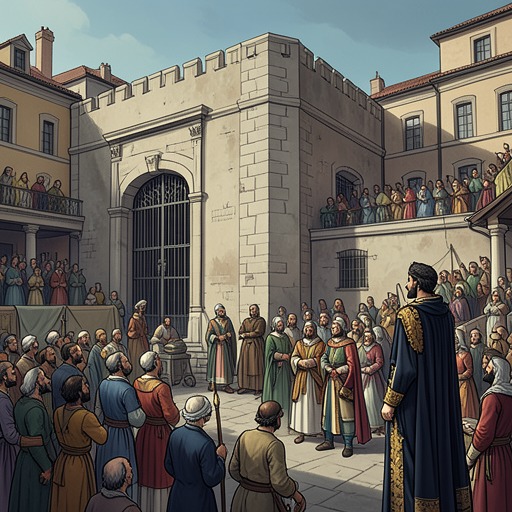
The arrangement of Saint-Martin’s dueling ground extended supervision beyond the combatants. Officials stood in wooden towers at the field’s four corners, close enough to see and hear the proceedings; food and drink could also be supplied to the fighters from there. A guarded outer wall and barred gates kept spectators away from the inner enclosure and were intended to prevent disturbances. The audience itself was stratified: the king and leading nobles had a central stand, other members of the royal court and foreign nobles had separate stands, and additional seats were provided for ladies, burghers, and merchants. Most common spectators watched from the ground outside the timber fencing.
The king was the presiding judge as well as the most important spectator. The Parlement of Paris had authorized the duel in his name, and Charles VI’s role was presented as joining royal judgment to God’s ultimate judgment. He had ordered the combat postponed for a month so that he could attend after returning from Flanders, and nothing was to begin until his arrival. Once he took his place on a cushioned throne warmed by coals and draped in royal blue with golden fleurs-de-lis, the ceremonies could proceed.
A herald announced strict rules for the crowd. No one could carry a weapon without royal permission; spectators had to remain seated or on the ground without blocking others’ view; and speaking, gesturing, coughing, spitting, or crying out during the battle was prohibited. The penalties could include death, loss of property, loss of a horse, an ear, or a hand, depending on the violation and the person who committed it. Chroniclers’ descriptions of silent audiences accord with this regime: the duel was not meant to be interrupted by cheers or catcalls, and even an involuntary outburst could bring severe punishment.
The procession and the seating plan made the combat a public demonstration of jurisdiction as well as a fight. The king’s authority was represented by a Sword of Justice carried before him, while officials, witnesses, guards, heralds, and spectators each had prescribed places or functions. The rules regulated not only the combatants’ conduct but also who could watch, where they could stand, and when they could speak.
Oaths, Judgment, and Afterlife
Before the combat, priests placed an altar at the center of the field. It measured five feet long, three feet wide, and two feet high, and was covered with gold cloth; a silver crucifix and a prayer book opened to an image of Christ’s Passion were placed upon it. The religious setting framed the fight as a divine judgment and recalled Christ’s trial and execution. The combatants swore three formal oaths, kissed the crucifix, and, in the final oath, joined left hands rather than the right hands used in other mutual pledges. Their bond was explicitly hostile, but its terms placed more than their lives and honor at stake: the priest warned that the guilty party risked damnation in both soul and body.
The ceremonies made the duel’s intended logic unmistakable: human institutions arranged the test, but its result was supposed to disclose a verdict beyond human reach. After Carrouges won, he turned toward the royal stand and acknowledged the crowd. Ten thousand voices, silent under threat of punishment since the battle began, answered his cry with a collective affirmation. The public response marked the end of enforced silence and transformed the visible outcome into a shared declaration of victory; it did not, by itself, remove the uncertainty surrounding the underlying accusation.
The Carrouges–Le Gris combat was the last judicial duel authorized by the Parlement of Paris. Later appeals for trial by combat reached the court, but none resulted in an order permitting a duel. The controversial outcome has been credited with hastening the decline of the institution, even as judicial duels continued for another century in places beyond the Parlement’s jurisdiction, including Brittany and parts of Flanders under Burgundian control. Over time, combat ceased to function as a recognized legal procedure and survived in Europe in other forms, increasingly as a private and illegal duel over honor rather than a formal criminal accusation.