Palpatine
The Last JediPalpatine’s power in these episodes is felt less through direct appearances than through the decisions, fears, and schemes he sets in motion. His regime escalates its campaign against Whiplash, while his confidence in his own security becomes a vulnerability that Tuden Sal intends to exploit. The contrast is central to his portrayal: an Emperor able to command the machinery of repression, yet so assured of his strength that he may underestimate what that machinery cannot control.
Rule and the campaign against Whiplash
Over the preceding months, Imperial orders targeting the resistance cell Whiplash have hardened from shooting its members when they obstruct Imperial forces to tracking them down and destroying them. The leader, Thi Xon Yimmon, has been targeted repeatedly. The Empire’s attention suggests that the cell has become more than a local nuisance, perhaps because its activity is being connected to resistance emerging on distant worlds. That interpretation is presented as a possibility, not confirmed knowledge, but the change in orders makes the state’s growing concern plain.
The form of the attacks changes as well. The Emperor no longer relies on Force-sensitive Imperial Inquisitors to hunt Yimmon and his associates; instead, the assaults come from Force-insensitive bounty hunters and battle droids. The shift reads as an adjustment after the Empire’s failure to turn Force-based methods against its targets: Palpatine’s apparatus substitutes ordinary weapons and personnel for an approach that has not worked. It also reveals the breadth of the threat he can deploy. Whiplash faces not one kind of enemy but a ruler willing to vary the instruments of pursuit.
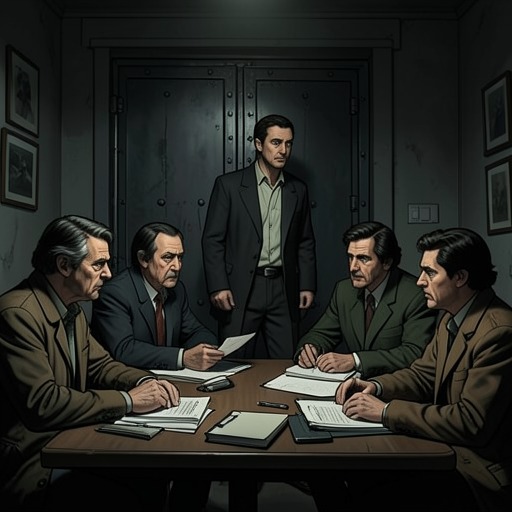
Yet Yimmon cautions against treating these measures as evidence of panic. He has never known Palpatine to panic, though he allows that the apparent absence of the Emperor’s champion, Darth Vader, may have changed the situation. The distinction matters: Imperial violence may indicate that the resistance has become consequential without proving that its ruler has lost control. Palpatine’s capacity to respond and the rebels’ uncertainty about his intentions remain in tension.
Authority and the limits of command
Palpatine’s authority is visible in Vader’s reference to the Emperor’s orders, but that authority does not make Vader a merely obedient instrument. When a stormtrooper invokes those orders, Vader silences him with a raised fist and declares that he will execute them in his own fashion. The exchange places Palpatine at the top of the command structure while exposing the independence of the dangerous subordinate on whom the regime relies. Vader’s power protects the Emperor, but it also gives Vader room to interpret the Emperor’s will.
That dependence shapes the resistance’s calculations. Pol Haus warns that if Jax Pavan and his allies locate Yimmon, Vader could use the captive as a trap for Jax. In Haus’s assessment, Jax himself is the prize Vader wants. Palpatine is not the immediate actor in this exchange, but the warning evokes the wider system: Imperial power reaches the fugitives through Vader’s capacity to capture, threaten, and manipulate them. The Emperor’s champion makes the regime’s authority personal and mobile, even when the Emperor is elsewhere.
The assassination plot
The most concrete threat to Palpatine develops around his villa on the shore of the Western Sea. Haus warns Tuden Sal that Imperial security forces, and possibly Inquisitors, are operating near the villa. Sal suspects that Haus is trying to deter or mislead him; his own coastal informants have reported no such movement. This disagreement leaves Sal to plan on the assumption that the Emperor has not been warned, even though the security picture is uncertain.
Sal chooses a moment when selected Senators are due to gather at the villa for secret meetings. He sees the overlapping responsibilities of Imperial forces, the Senators’ bodyguards, and their administrative staff as potential cover: competing procedures may create gaps and divert attention. The heightened security that might ordinarily discourage an assassination instead becomes part of his calculation. Sal expects the confusion of a crowded, heavily protected event to make an attack more feasible.
His intended operation is designed to leave little room for escape. Explosives supplied by Acer Ash are placed on cleaning droids; a team of Nautolans and Mon Calamari infiltrates resort maintenance crews; aerial teams are prepared to attack survivors of the blast, while armed ground forces wait to stop anyone who reaches the streets. Operatives near the water are also positioned to intercept escapees. Sal knows that the charges could reduce the villa and its nearest neighbors to rubble. Unlike Yimmon, whom Sal imagines would have balked at the collateral damage, Sal accepts it as deserved punishment for Palpatine and the Senators who support him. His plan turns political opposition into an indiscriminate act of vengeance, and its intended victims extend far beyond the Emperor.
Exposure, resistance, and significance
Sal’s confidence is not shared by every observer. A report from Captain Donari Caron says that her contact expects the security situation on Coruscant to change when Palpatine is no longer in power. Xizor recognizes the implication: someone may actually be plotting to kill the Emperor. The exchange establishes that rumors around Palpatine’s vulnerability are moving through channels beyond Sal’s own operation, but it does not establish that the plot has been discovered or that the attack will succeed.
Sal frames the assassination as a collective struggle rather than a private grievance. In confronting Haus, he accuses Palpatine of ruining and murdering many people, taking Yimmon and Laranth from their allies, and bearing direct responsibility for the destruction of the Jedi Order. Those claims express Sal’s argument for why the Emperor must die; they do not erase the personal grief and revenge that also animate his plan. His insistence that the fight belongs to everyone stands beside a scheme willing to kill neighbors and political supporters along with its central target.
Palpatine’s symbolic importance extends beyond Sal’s plot. Jax considers killing Vader because it would deprive Palpatine of his greatest weapon and inspire further resistance; he also connects that act to vengeance for the Jedi and for Laranth. An earlier attempt on Palpatine, recalled by Jax and I-Five, had been proposed by Sal back in their old Coruscant hideout. Together, these references position the Emperor as the political center of a conflict whose immediate violence often falls to others. His confidence and reach make him a target, while the dependence on Vader and the determination of opponents such as Sal expose the risks embedded in his rule.