Pol Haus
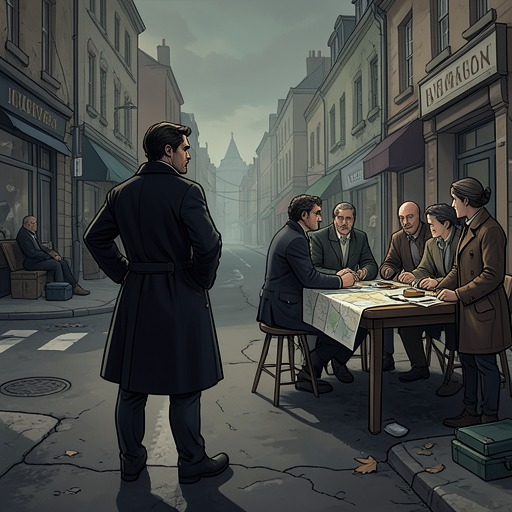
The Last JediPol Haus is a Zabrak sector police prefect who turns his position inside Imperial policing into a crucial channel of support for Whiplash. Though initially an ally rather than a member of the resistance, he helps protect its leaders, develops its intelligence and security structure, and uses both official authority and disguise to act against Imperial power. His role is defined by a tension between visibility and concealment: he can approach the resistance as a trusted officer, but effective action often requires him to hide his identity from the institutions he serves.
Identity and Position
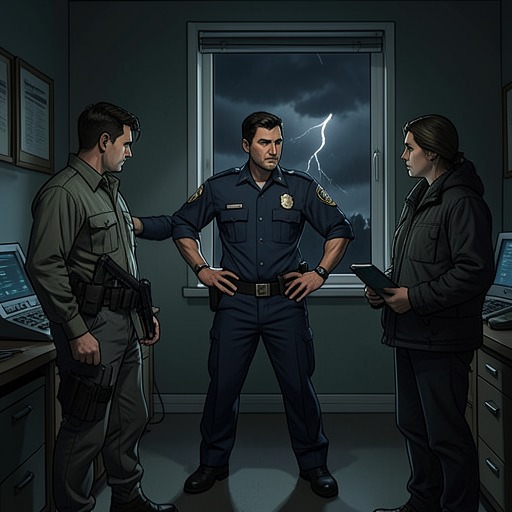
Haus serves as a sector police prefect within the Imperial system. His office gives him insider knowledge of the Imperial Security Bureau and the means to keep resistance members concealed, resources that become especially important as Imperial pursuit of Whiplash intensifies. Jax Pavan’s team has a friend on the police force in Haus; on two occasions, information from that connection gives them time to avoid Imperial threats against Thi Xon Yimmon and the resistance cell he leads.
Haus is not, at first, strictly a member of Whiplash. Yimmon has assured Jax that the prefect can be trusted, but Jax remains unsure how much influence Haus has over Tuden Sal. That distinction matters: Haus is valuable precisely because he bridges the resistance and the state apparatus, yet his formal position and uncertain standing within Whiplash make his loyalty and reach questions to be managed rather than assumed.
From Ally to Resistance Organizer
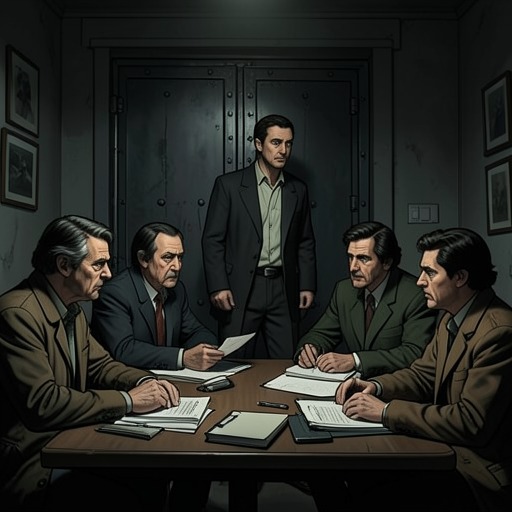
After Yimmon is removed from the group, the surviving resistance members reorganize instead of placing all authority in a single successor. Haus is assigned primary responsibility for intelligence and security, drawing on his knowledge of the ISB and his ability to keep the group hidden. The meeting takes place aboard the Whiplash hovertrain, which Sal identifies as Haus’s work. The train is more than a setting for the new arrangement: it demonstrates that Haus has already put practical security infrastructure in place.
Haus’s commitment becomes explicit when Jax asks whether he is fully involved. Haus confirms that he is. He is even prepared to relinquish his position when Jax arrives, but Jax refuses to take Yimmon’s place, insisting that his own responsibility is to bring Yimmon back. Their exchange leaves Haus as a key organizer without making him the resistance’s sole leader. Sal describes the new structure as distributed: several leaders, separate spheres of responsibility, autonomy, and overlap. Haus’s intelligence role is therefore both specialized and part of a deliberate effort to prevent the organization from depending on one person.
Secrecy, Disguise, and Intervention
Haus’s work repeatedly depends on the management of appearances. When Jax arrives at Westport under the assumed identity of Corran Vigil, Haus meets him at the terminal with two uniformed officers and credentials, presenting the encounter as an official detention for questioning. Jax recognizes him without needing to inspect the credentials. The scene makes Haus’s police authority usable as a cover for contact: the same gesture that might signal arrest to an outsider allows the two allies to meet within a controlled public setting.
The collaboration also runs in the opposite direction. Jax visits Haus’s headquarters disguised as an Ubese merchant, pretending to complain about a Sullustan trading partner. Before approaching Haus, Jax paces the office to locate surveillance devices and positions himself where the cameras cannot see his gloved hands. Haus asks why one of his lieutenants could not handle the complaint, while Jax answers in the mechanically amplified Ubese croak. Their exchange takes place within the risks of the prefect’s own workplace, where even a private conversation has to account for surveillance.
Haus also conducts covert meetings under a disguise of his own. He wears a Togruta skin-suit that makes him resemble a handsome male of Sheel Mafeen’s species; their prearranged recognition signal is a rancor tooth pendant, which he toys with. The pendant allows Mafeen to identify him without exposing the arrangement to everyone around them. Haus’s tactics thus rely not just on disguising his appearance but on coordinating small, legible signals with trusted contacts.
When Haus learns that Jax may be moving toward danger, he weighs how to warn him without exposing the source of the information. He offers to reach Jax himself, trying to make the warning credible and to keep Mafeen out of the risk. If necessary, he considers arresting Jax on fabricated charges or inventing a reason to bring him in for questioning, though he doubts even that would stop the plan already underway. The proposal shows the reach—and the limits—of his authority: a police pretext may buy an opportunity to intervene, but it cannot guarantee control over Jax’s choices.
Plans Against the Conspiracy
Haus receives intelligence from an ISB contact that Darth Vader has returned to Imperial Center without warning. He responds by moving his own timetable forward by two days and assembling a specially selected force of combat-trained officers. He tells them that a dangerous group of criminals is operating along an abandoned mag-lev route and plans to lead them, following an informant, to a prearranged meeting at 1500. The false account gives the officers an official rationale for an operation intended to derail the plot whose timetable Mafeen has also recovered from the Whiplash Express council chamber.
The episode brings Haus’s two kinds of knowledge together. He can draw on an informant and his contacts inside the ISB, but the return of Vader changes the time available to act. His response is not simply to pass on the warning: he mobilizes trained officers and creates a police operation that can intercept the conspirators. In this way, the authority attached to his office becomes an instrument for disrupting a threat, even as the need to misdirect his own force reveals how far his work has diverged from ordinary policing.
The Betrayal and Haus’s Narrative Role
Mafeen later brings Haus a text-only message recovered from Sal’s private correspondence. It is addressed to Lord Vader and reports suspected movement by Jax and other persons of interest through Myto’s Arrow, with a range of dates that includes the period when Jax and his companions were moving Yimmon. Mafeen identifies Sal as the sender and tells Haus that he sold out the group. The message was encrypted and routed through a shadow link across multiple nodes; it gives only minimal location and timing information, despite Sal’s knowledge of the Far Ranger’s itinerary.
For Haus, the disclosure turns the resistance’s security problem inward. He has helped arrange overlapping leadership and built concealment around the group, yet the danger now comes from information supplied by one of its own leaders. Mafeen does not know Sal’s reason, and the message provides no clear evidence that he acted for reward. Haus’s position in the exchange is therefore not that of someone who can immediately explain the betrayal, but of an intelligence officer confronted with proof that the trusted network he has helped protect has been compromised.
Haus’s narrative importance lies in this double capacity: he is both an insider in Imperial enforcement and an organizer of resistance security. His disguises and carefully staged encounters show how authority can be repurposed through controlled appearances; his division of responsibility for Whiplash addresses the vulnerability of concentrated leadership; and Sal’s concealed communication to Vader shows that organizational design cannot eliminate the danger of internal betrayal. Haus operates at the boundary between those possibilities, using access and procedure to protect the resistance while confronting the fact that neither can make its members wholly safe.