Time Manipulation and Time Currents
The Last JediTime Manipulation and Time Currents is the framework Jax Pavan encounters in Darth Ramage’s work: time is pictured not as one continuous stream but as a vast sea of currents carrying points that may be fixed or adrift. Its importance is both conceptual and ethical. The model offers Jax a radically different way to understand temporal movement, but he also realizes that Ramage extracted it from Cephalon victims, severing individuals from their shared consciousness. The knowledge therefore arrives not as a neutral technique but as the trace of a violence built into its acquisition.
Discovery in the Star Temple
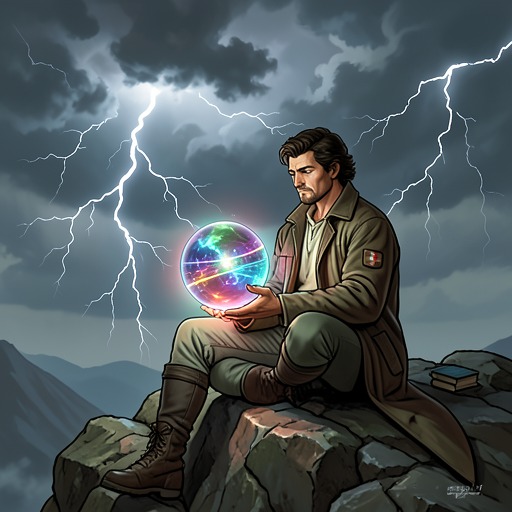
Jax’s first suspicion that time itself might be unstable arises near the heart of the Star Temple. Kneeling on an artificial stone structure that could have been a floor, an altar, or a control matrix, he examines hand-length shards of black rock marked with symbols. Their regular contours suggest deliberate construction rather than natural stone. The setting makes his uncertainty concrete: the Star Temple’s energies are unstable, and Jax wonders whether time might be unstable there too.
Nearby, the Holocron pulses with light. When Jax picks it up, the pulsation deepens atop the stone slab, and he feels its reverberations in the Force. The temple also teems with energy—the same forces that drove the Infinity Gate and were bent to the dark side. This encounter connects the time question to a charged place and artifact, but it does not establish that Jax has already manipulated time or that the temple’s energies have altered it. At this point, instability is his suspicion, not a confirmed mechanism.
A Theory Encountered as Knowledge
The fuller account comes to Jax through an inward, partly conscious search for knowledge. The library in which he seems to move is a chosen metaphor within his own mind, not a surviving physical library: he recognizes that the real library was destroyed in horrific violence and that he is selecting which knowledge to bring into consciousness. Among the material he takes up is a bright datasphere recording Darth Ramage’s experiments with energy, specifically Pyronium. He also gathers teachings on healing, Force cloaking, the nature of the Force, communication through the Force, and Ramage’s method called tunneling, which narrows a user’s focus to a single target.
The red Holocron high on the curved wall holds the central work. Jax has been avoiding it, afraid of what it might tell him and what knowing it might require of him. He nevertheless reaches for it and discovers that it is a treatise on manipulating time. The hesitation matters: Jax wants the knowledge, but fears what he might do with it. He wonders whether Ramage had succeeded and what Jax, as a Jedi, might do with such knowledge. His immediate practical question is whether it could help Yimmon. Because he cannot judge that possibility without understanding the material, he chooses to proceed despite his misgivings.
The Sea, Its Currents, and Its Islands
The treatise first displaces the familiar image of time as a stream. Jax sees a vast ocean, its surface deceptively calm and scattered with islands. These islands are not uniform: some send roots down to the sea floor, while others float freely. The image distinguishes fixed points, described as nexuses, from floating points that drift around them. Time, in this account, is structured by different kinds of stability rather than by a single sequence of equivalent moments.
The islands also do not travel in a straight line, and they are not all carried by the same currents. That difference raises a practical problem within the theory: how can such points be moved, or how can someone move among them, when their relations to the currents vary? The assertion that follows is exact and stark: “Islands move not, unless the currents move them.” Movement belongs not to the islands alone but to the forces carrying them. The model thus makes currents consequential, while leaving the means of directing or navigating them unresolved in the knowledge Jax encounters.
The ocean image also unsettles any simple idea of a universal timeline. Fixed nexuses and drifting points coexist, and the currents do not act uniformly. The text supplies a conceptual map, not a step-by-step procedure: it does not show Jax changing a point in time, choosing a current, or producing a temporal effect. Its central distinction is between the apparent placidity of the surface and the many movements beneath it. What looks like one continuous order may contain multiple, unequal paths of change.
The Cost of Knowing
As Jax absorbs the theory, its ethical source becomes suddenly clear to him. He understands with horrible certainty that Darth Ramage’s knowledge of time manipulation came at the expense of Cephalon lives and minds—perhaps hundreds, perhaps thousands. The scale remains uncertain, but the exploitation does not. Ramage did not merely observe an unfamiliar temporal structure; he took the perception of time in its extended dimensions from victims.
The consequence was separation from the Cephalon network of joined consciousness. Jax feels echoes of agony in the gap between visualization and articulation, and the phrase “Separation destroys us.” gives that injury its concise expression. The disconnection is not an abstract side effect: individuals are left horrifically alone in the very temporal expanse whose structure their minds were made to reveal. Ramage’s achievement, if it can be called one, is therefore bound to a destruction of connection.
Aoloiloa’s mystical pronouncements come to Jax’s mind when he encounters the claim about islands and currents. That echo places the treatise’s strange formulation beside a kind of wisdom he recognizes, but it does not erase the contrast between insight and its source. The concept’s significance lies in that tension: time may be understood through relationships among currents and points, yet this particular understanding was purchased by breaking the relationships that held Cephalon minds together. Jax’s hope that the knowledge might help Yimmon remains a motive for learning; the evidence does not show that the treatise provides a successful rescue method or that Jax acts on its temporal model.