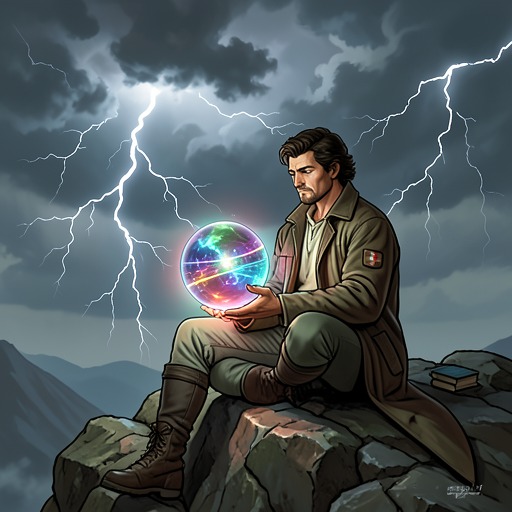
Time currents
The Last JediTime currents are the interconnected flows through which events take shape and can be affected. Jax Pavan arrives at the idea while trying to understand Darth Ramage’s research: events are islands in a sea of time, but those islands are not isolated points. Their currents connect them, and changing even one current can set off consequences throughout the network. The concept gives Jax both a way to understand the Cephalons’ perception of time and a dangerous, limited means of acting on the present.
A model of islands and currents
In meditation, Jax first sees himself at the hub of a great wheel, with separate bodies of knowledge at the ends of its spokes. He must find a way to connect them. The relation between Force projections and time is comparatively clear; Ramage’s proposed manipulation of time is harder to grasp. Jax’s attention shifts to his islands in the ocean of time and to the question of how those floating points might move. He imagines tides and currents forming intricate, almost artistic patterns.
The key insight is that an island cannot simply be shifted independently of its surroundings. To move it, one must change the currents affecting it. And because currents are themselves connected, changing one requires minute changes in the currents around it, especially those that precede it and give rise to it. The sea-and-island image thus makes time not a row of separate moments but a field of relationships: events have positions, yet their possible movement depends on the flows that connect them.
Cascading consequences
Jax distinguishes among currents at different scales. Some are mother currents that spin off child currents; local currents are as numerous as moments. The distinctions suggest both branching and proximity: a local current belongs to a larger pattern, but its immediate effects need not be identical to those of a distant, more encompassing flow. The crucial limit is that no current can be altered alone. Every downstream current—and every island connected to it—is affected in turn.
Jax understands this not as a simple domino sequence or a trickle-down effect, but as a cascade. The distinction matters to the practical and ethical stakes of his discovery. An attempted change cannot be assumed to stop at its intended target; it may propagate through dependent currents and events. The model therefore links power with an expanding field of consequence, even as it leaves open how much of that field a single mind can perceive or control.
The Cephalons and the limits of understanding
Jax recognizes that Ramage must have understood the difficulty: comprehending or manipulating time on this scale would require a network of powerful minds not wholly within the time stream. The Cephalons offer the example. Their sub-brains are linked to different aspects, patterns, or waves of the time sea, and the network formed by those linked minds accounts for their distinctive perception of time. Their understanding is collective rather than the achievement of an isolated observer.
That capacity exposes a contrast with the Sith and the Jedi. Jax judges that the cooperation needed for such work is impossible among dark-side Force-users whose shared atmosphere is one of fear, distrust, and ambition. He is also increasingly convinced that no Jedi remain with whom he could form the necessary cooperative group. The insight is therefore not merely a theory about the Cephalons: it identifies a condition that other Force-users lack, and makes Jax’s individual effort a constrained substitute for a collective intelligence.
Jax’s local intervention
The scale of the problem shapes Jax’s next move. The island bearing the Far Ranger and its crew lies beyond the reach of a single Jedi, but a nearer island in a local current may be accessible. Jax recalls a brute-force projection of himself that briefly fooled Magash: he had cut across the currents without considering them. Near the present, he reasons, the currents are only eddies. If he can affect those eddies without the Cephalons’ network, he will need greater raw power. He identifies Pyronium as the means he needs, though the evidence does not establish that it gives him the Cephalons’ breadth of perception or control.
The idea becomes consequential during Jax’s confrontation with Darth Vader. At a branching corridor, Jax weighs fleeing toward the Delta-7 Aethersprite against turning to face his pursuer. He thinks the local currents may give him an advantage, since Vader cannot know what he can do with them. When a crewman rushes into his path, Jax twists aside; then, with a supreme effort of will, he senses the local currents, stirs them into eddies, and rolls beneath a small shuttle between himself and the starfighter. Vader’s next barrage strikes the place Jax has left behind. The maneuver works, but its cost is immediate: Jax is panting and drained by the energy required. Time currents thus become neither effortless foresight nor unrestricted time travel in this encounter, but a narrow tactical opening bought through exertion—and one whose larger consequences remain implicit in the cascading model.