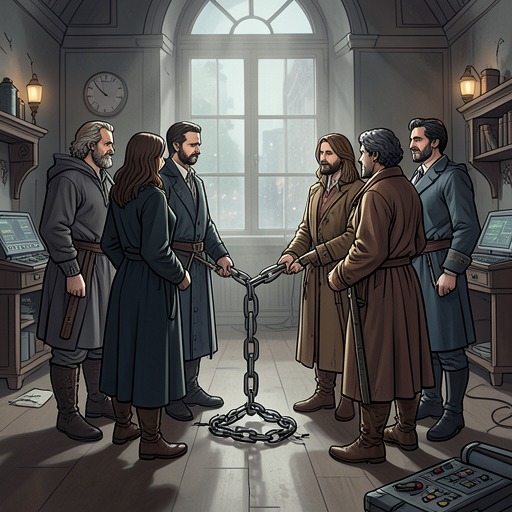
Whiplash’s nonhierarchical leadership principle
The Last JediWhiplash’s nonhierarchical leadership principle is both a political ideal and a vulnerability: its leaders understand authority as shared, while Tuden Sal alone retains an overview of the operation. The resulting gap between collective leadership and centralized knowledge lets Sal direct the resistance without openly repudiating its egalitarian commitments.
Principle and Practice
Whiplash’s council members take the organization’s egalitarian cause at face value. Its leadership is divided among members rather than openly arranged as a hierarchy, and that shared authority is part of how the group understands its politics. The arrangement, however, does not mean that information is shared equally. Sal parcels out separate parts of his plans, giving others authority within narrow domains while keeping the whole scheme to himself.
Pol Haus recognizes this as a method Sal has used before. According to Haus’s review of Sal’s dossier, the same pattern governed Sal’s corporate organization: Sal occupied the controlling position, while subordinates managed discrete areas of business without an overview of the operation. Within Whiplash, therefore, the outward form of shared leadership coexists with Sal’s practical command.
Contrast with Black Sun
Haus’s comparison with Black Sun clarifies why Sal’s method works differently in Whiplash. In Black Sun, subordinates’ ambitions encourage them to seek advancement, stage coups, or develop competing plans. Such rivalry makes centralized secrecy less secure: members have incentives to challenge whoever holds power. Whiplash’s council, by contrast, believes in the egalitarian nature of its cause. Its members are less likely to treat withheld information as a bid for personal control or to devise rival schemes of their own.
The principle thus creates a paradox. Shared authority is meant to resist domination, yet the trust it fosters gives Sal room to dominate information without appearing to dominate the council. Whiplash’s nonhierarchical structure does not itself distribute knowledge or prevent one leader from acquiring decisive control; in Sal’s hands, it helps conceal that control.
Political Meaning and Doubt
The organization’s name carries an explicit reminder of the politics behind its ideal: the Coruscant resistance chose Whiplash ironically, as a constant reference to the Imperial yoke it sought to overthrow. That history gives the leadership principle more than an administrative function. It marks Whiplash as a collective opposition to imposed power, while making Sal’s private command an internal contradiction of the cause.
The contradiction is not resolved in the exchange. Sheel Mafeen allows that Sal may simply be acting carefully, and worries that someone could reveal too much to the wrong person. Her caution keeps open the possibility that secrecy is defensive rather than purely self-serving, but the discrepancy between shared authority and Sal’s exclusive knowledge remains. The principle’s practical weakness is precisely that its members’ trust can make concealed hierarchy harder to recognize.