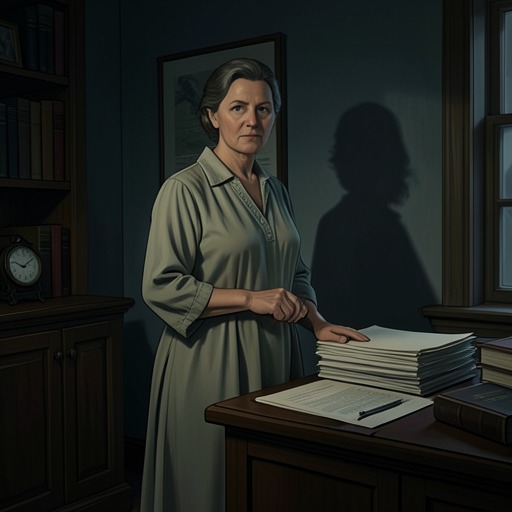
Bailey Michaels
The Last Thing He Told MeBailey Michaels is Owen Michaels’s daughter and the person at the center of the novel’s most intimate question about identity: when the history that shaped someone proves false, what can still be trusted? Raised by Owen in Sausalito, she remembers a loving, dependable father and a settled life, but his disappearance exposes how much of her past she knows through stories he supplied. Her emerging uncertainty about her own name and history makes the search for Owen a reckoning with who she is, not merely where he has gone.
Identity and Early Life
Bailey spends most of her life with Owen in a floating home in Sausalito. Her recollections of the time before their move there are fragmentary: a birthday party featuring a magician, a circus where she cried at the clown, and a wedding somewhere in Austin. The gaps matter because Owen’s accounts had seemed a natural way to fill them. She had little reason to question stories told by the parent who loved and raised her.
The life Bailey believes she shares with her father is shaped by ordinary, repeated acts of attention. Owen does not miss her soccer games or school plays; their Sundays include dinners at restaurants she chooses, and they make weekly trips to the movies. They also visit museums in San Francisco, attend neighborhood potlucks, and hold an annual barbecue. These routines give her a concrete sense of family, even though they do not tell her the truth about the earlier years she cannot remember clearly.
Owen’s Disappearance and Bailey’s Past
When Owen disappears, Bailey is left with uncertainty rather than an explanation. Hannah repeatedly tries to reach him, but her calls go to voicemail. Bailey appears in the kitchen with a large black duffel in her lap, holding it gently; its presence signals how suddenly the household has been unsettled, while Bailey’s response to the unfolding crisis remains guarded and unsure.
The investigation gradually turns that uncertainty toward Bailey’s own identity. Hannah explains that, if Jake’s information is correct, Bailey once went by a different name. Bailey immediately asks whether other details, including her birthday, may have changed too. Her questions show the reach of the revelation: the concern is not limited to whether Owen lied about himself, but extends to the facts by which she recognizes her own life.
A record identifying Ethan Young’s daughter as Kristin supplies a specific link between Bailey and Owen’s concealed past. The name Kristin connects the child Bailey is now to an earlier family identity, while the Sausalito memories remain emotionally real even as their surrounding history comes into doubt. Bailey does not simply exchange one settled account for another; she faces the unsettling possibility that familiar details were constructed without her knowledge.
Relationship with Hannah
Bailey’s bond with Hannah develops under the pressure of Owen’s absence. Hannah is not Bailey’s biological parent, and she worries that she has no legal standing to keep Bailey with her. She fears the state might remove Bailey while authorities determine what has happened to her legal guardian. Grady Bradford tells Hannah that he has contacted a friend who works in California family law to help secure temporary custody if someone seeks it. The practical arrangements make visible how vulnerable their household is, but also how seriously Hannah takes her responsibility for Bailey.
Their connection is not made effortless by danger. During the attempt to follow a lead at a stadium, Bailey stops and asks what going there could possibly reveal. Her resistance punctures the momentum of the investigation: she is not simply a companion to Hannah’s search, but a person with her own doubts about its purpose. At another point, she is exhausted when Hannah returns to the question of what Owen meant by saying that Bailey knows what matters about herself. Bailey’s response makes clear that she has already heard Hannah’s reassurance that her father loves her; repeating it does not resolve the larger problem of what else may have been concealed.
Hannah gradually understands that dependability is not established by being sweet or agreeable. She recognizes that Bailey needs proof of safety in the moments when both are tired and strained, and resolves to do what her own grandfather did for her: whatever is necessary to help Bailey feel safe. That change matters because it replaces the hope that kindness alone will create trust with a commitment expressed through action.
Family, Guardianship, and the Search for Safety
Bailey’s place in the family is secured by more than affection, though affection remains central. Owen’s will names Hannah as Bailey’s primary guardian if Owen dies or becomes unable to care for her. Hannah understands the provision as evidence that Owen had chosen her as the person who should care for Bailey, even before the crisis made that trust visible. The legal designation gives formal shape to a relationship that has grown through shared life rather than blood.
Bailey also enters a wider family history through Owen’s connection to Nicholas Bell. Owen had accepted work connected to his father-in-law out of need and love, and perhaps out of fear that he would have called loyalty instead. After losing his wife, he became angry at her family and at himself for having turned a blind eye to what he had accepted. That history helps explain why Bailey’s safety cannot be separated from the adults’ competing claims, loyalties, and past choices.
In negotiating with Nicholas, Hannah offers a conditional path toward a relationship with Bailey: Bailey herself will decide how much contact she wants and how often she sees him. Hannah also promises not to poison Bailey against him and to help her understand that much of what happened has nothing to do with his feelings for her. The promise gives Bailey, rather than either adult, authority over the shape of that connection. It remains Hannah’s proposed arrangement, not proof that a relationship has already been established.
Change and Narrative Significance
Bailey’s most direct statement of who she is comes when she tells a man connected to the search that Owen is her father. The words are simple, but they interrupt an effort to explain Owen’s identity and force attention back to the relationship Bailey knows through lived experience. His assumed name may be false, and her own name may have changed, yet the bond she asserts is not erased by those discoveries.
Her story holds two kinds of knowledge in tension. Bailey’s childhood memories are incomplete, and the facts that might fill their gaps are compromised by Owen’s deception. At the same time, the repeated care she remembers—games, plays, meals, movies, and trips—cannot be dismissed merely because the account around it was false. The novel therefore makes her uncertainty an emotional as well as factual problem: she must distinguish the reliability of a story from the reality of the love and care she experienced.
Bailey’s movement is not toward instant acceptance of Hannah or an easy recovery of a stable past. She questions the purpose of the search, challenges reassurance that does not answer her questions, and confronts the possibility that even her personal details were altered. What changes is the basis on which safety and family can be understood. Owen’s legal choice of Hannah and Hannah’s commitment to let Bailey decide the terms of contact with Nicholas offer forms of protection that take Bailey’s needs and agency seriously. Her identity remains unsettled, but she is not reduced to the names or stories adults have given her.