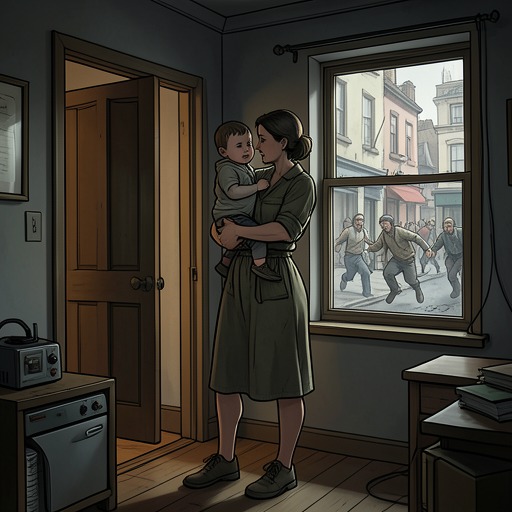
Bailey’s disappearance and discovery in Austin
The Last Thing He Told MeBailey’s disappearance and discovery in Austin turns a hurried escape into a crisis of separation: Hannah returns from the bathroom ready to leave with Bailey, only to find the room empty. The search ends with word that Bailey is safe on campus, but not with an explanation of why she went or a settled plan for what comes next. The episode makes Hannah’s confidence in routine safeguards—locked doors, a nearby phone, the assumption that Bailey will stay—collapse at once.
The Disappearance
Hannah has decided that she and Bailey must leave Austin immediately. She tells Bailey to take only what she has already packed; there is no more time to wait. But the hotel room is empty. Bailey is gone, and Hannah’s first impulse—to call or text—runs into a consequence of her own urgency: she has just smashed her phone. A device that would ordinarily connect her to Bailey is now unusable, so she cannot begin the search from the room or ask Bailey where she has gone.
Hannah runs into the hallway, past a housekeeping cart, and checks the elevator and staircase. She then searches the hotel lobby, its restaurants, and the Starbucks, hoping Bailey may have gone for a snack. Each place fails to produce her. The sweep gives the disappearance a concrete geography: the room where Hannah expected Bailey to be, the corridor and exits, and then the public spaces below. With every failed check, the ordinary hotel setting becomes less a refuge than a set of empty places Hannah must cross without knowing where Bailey is.
Hannah’s Realization and the Search
As Hannah searches, the narration turns from immediate action into self-reproach. She retraces the decisions that seemed harmless: going into the room, bolting the door, then entering the bathroom and trusting a sixteen-year-old to remain on the bed. That expectation rested on the question of where Bailey could go. Hannah now recognizes the answer she failed to reckon with: Bailey was frightened and had said she did not want to leave Austin. The loss of contact is therefore also a failure of assumption. Hannah meant to protect Bailey by controlling the timing of their departure, but had not accounted for Bailey’s own fear or wishes.
Grady redirects Hannah from speculation toward the immediate problem, asking her to help work out why Bailey left. Before he does, he states that WITSEC is the best option for Owen and Bailey. Hannah doubts the certainty behind that assurance: if Grady were sure he could keep Bailey—and all of them—safe, she reasons, Owen would be with them rather than wherever he is. The exchange places the search inside a larger uncertainty. The proposed protection may be the best available choice, but Grady’s confidence cannot make Owen present or settle Hannah’s concern about the danger they face.
When Grady is called into a meeting, U.S. Marshal Sylvia Hernandez takes Hannah to a conference room and permits her to make a phone call. Hannah understands that the call may be taped or traced, and that even this permitted contact takes place under surveillance. She calls her best friend, Jules, who has been trying to reach her for hours and asks whether they are all right. Hannah answers that Bailey is missing and explains that she left the hotel room. Jules responds softly, allowing Hannah to report the crisis without first having to explain everything around it. The call gives Hannah a human connection, but no immediate information about Bailey’s whereabouts.
Bailey Found and the Plan Ahead
Hannah is preparing to demand an update when Grady returns. His manner has softened, and he tells her that Bailey has been found and is safe. Bailey is on campus; authorities are bringing her back to the marshal’s office. The news reverses the immediate movement of the scene from absence to recovery, and Hannah’s relief arrives physically: she lets out a breath, and tears fill her eyes. The reassurance answers the most urgent question—whether Bailey is safe—without explaining how she came to be on campus or why she left.
Grady asks to speak with Hannah before Bailey arrives so that they can be on the same page about the plan. The request shifts the focus from locating Bailey to deciding what will happen after their reunion. The available account does not disclose the plan they settle on, nor Bailey’s explanation for leaving. It therefore ends the search’s immediate suspense while preserving the conflict that produced it: Hannah must protect Bailey in a situation where the safest course is presented as WITSEC, Owen is absent, and Bailey has already shown that she does not simply accept Hannah’s decision to leave Austin.
Narrative Significance
The episode’s central reversal is sharply practical. Hannah believes Bailey is in the locked hotel room; after one trip to the bathroom, that belief is undone. The smashed phone compounds the reversal: the object Hannah might use to restore contact is unavailable precisely when contact becomes essential. The successive searches and their failures make the danger legible through action rather than through an account of what Bailey is thinking. The narrative withholds her location and motive until Grady reports that she is safe, keeping the reader aligned with Hannah’s incomplete knowledge.
That alignment also shapes the episode’s treatment of protection. Hannah’s retrospective questions expose how a reasonable-seeming decision—to leave Bailey alone briefly—was built on an assumption about what a frightened teenager would do. Grady’s appeal to WITSEC offers an institutional answer, while Hannah’s doubt about Owen’s absence prevents that answer from feeling complete. Bailey’s recovery restores her physical safety, but the episode does not equate safety with agreement: the next task is to speak with Bailey about a shared plan, not merely to resume the departure Hannah had already decided upon.