Grady Bradford
The Last Thing He Told MeGrady Bradford is the U.S. marshal who knows why Owen Michaels disappeared and helped him protect Bailey Michaels from the life he left behind. He is both an investigator pressing Hannah Hall for answers and an ally who has spent years trying to keep Owen’s family safe. His commitment is genuine, but his authority and experience do not settle the question that drives his conflict with Hannah: whether protection means accepting the arrangements he recommends, or choosing a different future for Bailey.
Identity and Introduction
Grady first appears outside Hannah’s home while she is carrying two heavy garbage bags. She has to drop them before she can properly take him in: a young man, perhaps in his early thirties, with dark eyes and a strong jaw, whose disarming good looks seem matched by his awareness of them. He knows Hannah’s name before she knows his, introduces himself as Grady, and identifies himself as a U.S. marshal. His badge gives her a physical detail to examine, but not immediate reassurance; she wonders whether it is genuine and tells him he does not look like a marshal. Their exchange establishes the distance between his official identity and her distrust of the person standing in front of her.
At first, Grady presents himself as an investigator looking for information about Owen’s disappearance. He recognizes that Hannah has been left to manage the consequences, including caring for Owen’s daughter, and reads her relative lack of anger as a sign that she knows more than she is saying. His questions are not simply an attempt to reconstruct where Owen went. Grady says he needs to know what Owen told her and why he left so that he can protect him. When Hannah asks whether protecting Owen is his primary concern, Grady confirms that it is.
The Investigation and Its Unanswered Questions
Grady’s position grows less straightforward as Hannah tests the story he gives her. She asks why a marshal based in Austin, Texas, has come to San Francisco to seek someone who is not a suspect. She also challenges his account of Owen contacting him, arguing that Grady is lying about a call, and points out that there are no records of Owen Michaels before he arrived in Sausalito. The questions connect Grady’s official investigation to the larger mystery of Owen’s identity: he has knowledge that Hannah lacks, but his guardedness makes it difficult for her to distinguish protection from concealment.
Before leaving her, Grady warns Hannah that Owen is not who she thinks he is. The revelation does not explain Owen’s past, but it changes the terms of her search. Grady then tells her that he is sending a colleague to check on her. His concern has a practical, watchful form: he does not merely request information but takes steps to monitor Hannah’s safety, even when she has not agreed that his presence is welcome.
The Decision He Helped Owen Make
The history Grady eventually discloses reaches back more than a decade. Owen decided to get his daughter out of a life he could not otherwise protect her from and give her a clean start; Grady helped him do it. This makes Grady more than a marshal assigned to a disappearance. He was part of the arrangement that separated Owen and Bailey from the danger surrounding their earlier lives, and he has carried that responsibility into the present.
Grady clarifies that Owen was not in witness protection in the ordinary or exact sense, despite what Hannah has heard from Jake Bradley Anderson. But the possibility of formal protection remains important. Grady says he has managed to hold the Federal Bureau of Investigation at bay and tamp down its scrutiny, yet he cannot keep doing so much longer unless Hannah and Bailey are officially protected. When Hannah asks whether that means WITSEC, he confirms that it does. His offer is therefore both a protective route and a narrowing choice: without official status, he believes his ability to shield them is running out.
Bailey’s Disappearance and the Conflict over Safety
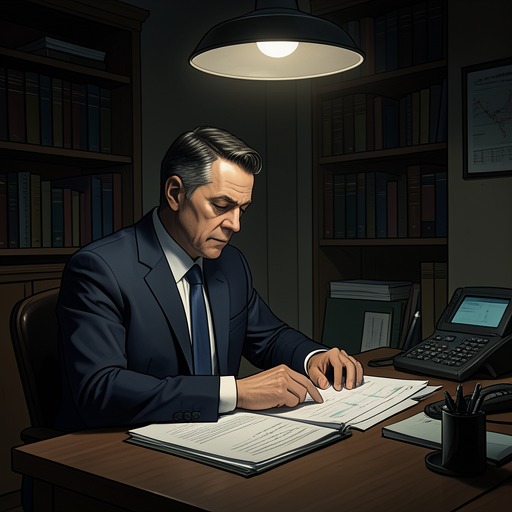
When Bailey goes missing in Austin, the strain between Grady’s professional judgment and Hannah’s urgency becomes immediate. In the brightly lit U.S. Marshals’ office, while colleagues work late around them, Grady asks Hannah to go over events again. Hannah, consumed by Bailey’s absence, rejects the idea that she should lie low, find a lawyer, and let him do his job. She insists that unless he arrests her, she will go out and look for Bailey herself. Grady’s instructions reflect the limits and procedures of his role; to Hannah, they risk substituting official process for the immediate act of searching for a child.
The two later approach a more consequential dispute at Nicholas Bell’s home. Grady arrives at the front gate with a dozen other U.S. marshals while Hannah is inside negotiating with Nicholas. On the drive back toward the marshals’ office, where Bailey is waiting, Grady is unhappy with what Hannah has decided. He pulls over and urges her not to accept Nicholas’s deal, arguing that it was not hers to make and that she must think of Bailey. Hannah answers that Bailey is precisely whom she is thinking of, and that she is trying to do what Owen would want for his daughter. Grady counters that Owen would not want to lose the chance to see Bailey or have a relationship with her again. Their disagreement exposes the emotional cost hidden inside each version of protection: Hannah fears the deal may close off a future with Owen, while Grady fears that her choice will do exactly that.
Grady also challenges Hannah to account for evidence of Owen’s intentions. Owen sent him detailed files and email correspondence intended to help ensure that Avett Thompson would be punished for his crimes; the Federal Bureau of Investigation was already pursuing a plea deal that could put Avett away for twenty years. Grady sees Owen’s preparation of this evidence, and his arrangement to enter witness protection, as signs of a deliberate plan. Hannah believes he acted for another reason. Their exchange does not resolve Owen’s motive; it shows that both are interpreting the same preparations through different loyalties and hopes.
What Grady Can Promise
At the end of the journey, Bailey asks why her father is still running if he knows Grady is the best option. Grady lets out a small, angry laugh, then acknowledges that he cannot give her an answer that will satisfy her. What he can offer is help: he tells Bailey that accepting it is the best, and the only, way to keep her and Hannah safe. Bailey looks down at her hand, with Hannah’s resting on top of it, and asks whether this means her father is not coming back. Grady’s answer does not erase the absence or provide the certainty Bailey wants. It leaves him as the person offering a path toward safety, not as a substitute for Owen.
Grady’s role is shaped by this gap between protection and reunion. He helped Owen make a life-saving decision, sought to keep federal scrutiny at bay, and eventually brought marshals to the gate when events reached a crisis. Yet he cannot compel Hannah to trust his judgment or make Owen return. His authority can organize protection and offer a way forward; it cannot promise the family the life it has lost. That limitation gives his loyalty its weight: he continues to advocate for safety even when the people he is trying to protect question his methods and refuse the outcome he considers safest.