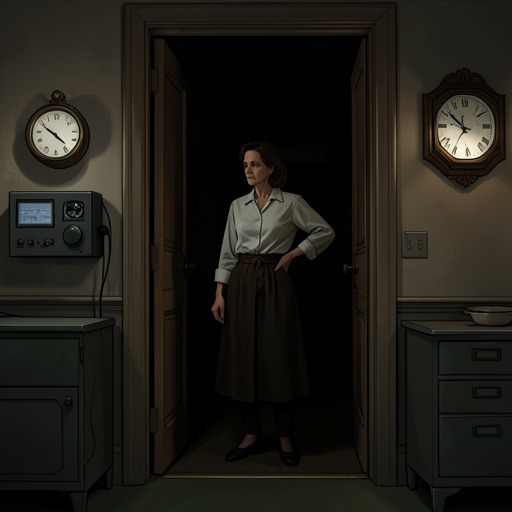
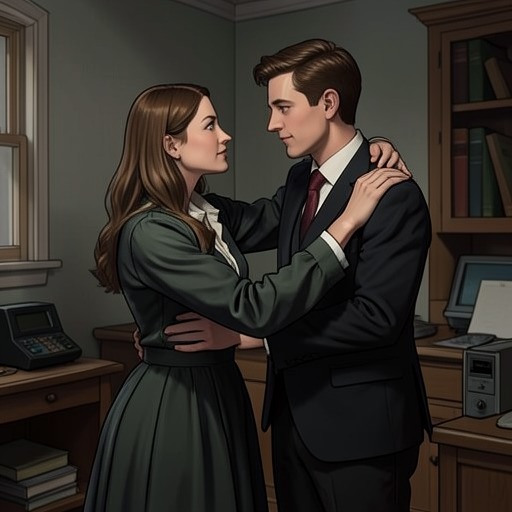
Hannah and Owen’s first meeting
The Last Thing He Told MeHannah and Owen’s first meeting begins as a client visit in Hannah Hall’s New York City workshop and turns, through a shared attention to a rough-edged table, into a tentative invitation. The encounter establishes the mutual curiosity that draws them together, while their jokes about dating policies and Owen’s account of fatherhood show how each tries to make room for attraction without pretending that ordinary boundaries do not matter.
Setting and Circumstances
Hannah Hall has built a livelihood from woodturning and furniture-making, work she once doubted could support her. A feature in Architectural Digest brought her a niche clientele among downtown New York City residents: people who spent heavily to make their homes look as if they had not. Her rustic pieces later found buyers in coastal cities and resort towns, including Los Angeles and San Francisco. Avett Thompson, chief executive of the technology firm where Owen Michaels works, and his wife Belle Thompson became especially loyal clients.
The visit is arranged around a rolled-edge side table Belle commissioned for the couple’s bedroom. Avett and Owen are in New York City for an investor meeting, and Avett has been asked to inspect the piece, although he is unsure what he is meant to assess. His attention is brief: after saying the table looks fine, he heads outside before Hannah can answer. Owen, by contrast, remains in the workshop. That difference—one man treating the visit as a task to finish, the other looking carefully at what Hannah has made—sets the scene’s relational contrast in motion.
The Table and the First Attraction
Owen makes a slow circuit of the workshop, stopping to study each piece. Hannah notices the dissonance in his appearance: shaggy blond hair, sun-darkened skin, and worn Converse sneakers alongside a fine sports jacket and starched shirt. The detail makes him seem difficult to place, but his behavior is more revealing than his clothes. He is not simply browsing for something to buy; he gives the work sustained attention.
He stops at Hannah’s favorite piece, a farm table she uses as a desk. Newspapers, a computer, and small tools cover much of its surface, leaving the table’s construction partly obscured. What remains visible is the stiff redwood she has chiseled down, its corners gently yellowed, with rough metal welded along the edges. Owen bends to examine it as Hannah herself might, tracing the sharp metal with his fingers and holding the table there. He is not the first person to notice the piece, but he is the first to physically explore its edge in the same attentive way Hannah does.
When he looks up and says, “Ouch,” Hannah answers, “Try bumping up against it in the middle of the night.” The exchange makes the table’s sharpness concrete: its beauty comes with the possibility of pain. Owen taps it goodbye before walking over to Hannah, and the distance between them closes until they are standing unusually near each other. Hannah notices her paint-splattered jeans, tank top, and disheveled hair, but what she feels in that moment is not self-consciousness. His attention has changed the encounter from an inspection of furniture into an unmistakably personal exchange.
A Request That Is Not Only About Furniture
Owen asks the asking price, and Hannah tells him the farm table is the one showroom piece not for sale. When she offers to show him other work, he proposes a different arrangement: she could teach him to make a similar table, only with “slightly kinder edges.” He even offers to sign a waiver and accept responsibility for any injuries. The joke carries the scene’s flirtation through the object that first connected them. The table is not merely the backdrop to their meeting; its dangerous edge gives them a playful language for testing closeness.
Hannah recognizes that the lesson may not really be about woodworking. Her uncertainty is shaped by a recent disappointment: she had spent two years engaged to a man she realized she could not marry, and the wedding was only two weeks away. She therefore answers with a boundary rather than accepting the invitation. Addressing Owen by the wrong name, she begins to decline; he corrects her—“Owen”—and she explains that she has a no-dating policy with clients. His reply, that he cannot afford to buy anything she is selling, turns the policy into another joke and gives him a graceful reason to withdraw. He shrugs and heads back toward the door and Avett, who is outside pacing and shouting into his phone.
The Invitation and Its Terms
Before Owen leaves, Hannah offers to make sure Belle receives something. He takes it without meeting her eyes, then reveals that he has a no-dating policy too. His stated reason is practical: he is a single father, and that responsibility comes with the territory. He pauses, however, and adds that his daughter is a theater enthusiast. If he does not see a play while in New York City, he will lose points with her. Avett, still angrily occupied on the sidewalk, is not the person to accompany him to one.
Owen asks whether Hannah would like to come. He does not move closer, but meets her eyes; the invitation is direct even as its framing remains cautious. He proposes that they not consider it a date, calls it a one-time thing, and defines the plan as dinner and a play. Hannah asks whether their policies are the reason. Owen answers yes with an open, generous smile. The exchange does not erase their stated boundaries; it turns those boundaries into a mutually understood pretext for spending time together. His daughter’s interests provide the immediate occasion, while the careful insistence that the outing is not a date lets both adults approach it without naming more than either is ready to promise.
Narrative Significance
The meeting’s decisive movement is from looking at an object to looking at one another. Owen’s close study of the table distinguishes him from Avett and gives Hannah a reason to notice him; the sharp metal then supplies the joke through which Owen asks for more time with her. Hannah’s recent broken engagement makes her refusal to date clients more than a casual rule, while Owen’s single fatherhood makes his own policy part of the way he presents himself. Their attraction takes shape not through a grand declaration but through limits, corrections, and a proposal deliberately reduced to one dinner and one play.
The scene also introduces Owen through an unresolved discrepancy: Hannah calls him Ethan, and he corrects her with “Owen.” At this point, the correction supplies the name by which she knows him, without explaining the mistake. The meeting thus holds a small uncertainty alongside its warmth. Its immediate outcome is only an invitation, not a relationship already secured; its significance lies in how the two make that invitation possible, using a workshop lesson, a daughter’s theater-going, and their matching policies to approach one another while preserving the appearance of restraint.