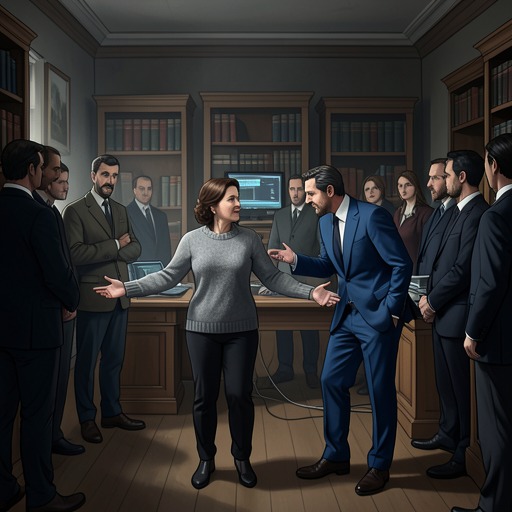
Hannah refuses to let the FBI question Bailey alone
The Last Thing He Told MeHannah’s refusal to let the Federal Bureau of Investigation question Bailey alone is a decisive act of protection in a scene where the agents claim authority over a child’s access while Hannah fears that their interest could put Bailey’s safety and stability at risk. She does not accept the proposed interview as routine: she insists Bailey be left alone, requires the agents to go through a lawyer, and ends the encounter by directing them out of the gate. The scene makes her protection concrete—not a promise that she can control what the agents do, but a boundary she asserts on Bailey’s behalf.
The demand to speak with Bailey
The agents’ request is specific and immediate. O’Mackey tells Hannah, “We will need to talk to Bailey as well,” adding that the agents can do so when Bailey returns from school that day. Hannah answers without qualification: “You will not be talking to her.” She says Bailey knows nothing about her father’s whereabouts and is to be left alone. Her reply does more than dispute the timing of the interview. It rejects the premise that the agents can simply make Bailey available to them, and identifies Hannah’s immediate priority as shielding her from questioning.
Hannah hears an implied threat in the exchange. The agents’ words bring to mind the possibility that Bailey could be taken away, and Hannah wonders whether Grady Bradford’s assurance that they would not do so still holds. That uncertainty helps explain the force of her response: she is trying to preserve the assurance she was given while facing officials whose intentions she cannot safely assume. The scene supplies no proof that the agents intend to remove Bailey, but it shows that Hannah experiences their request against that feared possibility.
O’Mackey answers Hannah’s boundary with a direct challenge: “I’m afraid that’s not up to you.” He offers two alternatives—arrange a time immediately, or have the agents arrive at Hannah’s house later that evening. The options leave Hannah little room to decline the interview altogether. Her next move is therefore procedural rather than conciliatory: she does not agree to a time, but places a lawyer between Bailey and the agents’ demand.
Invoking legal counsel
Hannah tells the agents, “We’ve retained legal counsel,” and says that anyone who wants to speak with Bailey must contact the lawyer first. When Naomi Wu asks who the lawyer is, Hannah names Jake Anderson and says he is based in New York. The answer comes before she lets herself consider what naming him implies. That hesitation gives the disclosure a personal edge: in asserting legal protection for Bailey, Hannah reaches for a particular person from her own life, then recognizes the implication only after the name is spoken.
Naomi accepts the instruction that Jake should contact the agents. Later, after a pointed exchange about what Owen had said concerning the agents, Naomi resets the tone and offers advice: “But, in the future, you might want your lawyer present before you talk to anyone who just shows up at your door.” Her warning confirms the procedural lesson Hannah has already acted on. The encounter began with officials arriving at her home and seeking access to Bailey; by insisting on counsel, Hannah changes the terms of any further conversation, even though she cannot determine whether or when the agents will pursue it.
Hannah answers Naomi’s suggestion, “That’s a great idea. I’m going to start with that right now,” then points toward the gate and waits for the agents to walk through it. The gesture turns the boundary into an action. She does not try to settle the dispute through further argument; she ends the visit and does not let the agents remain at the house while Bailey is expected back from school.
The encounter’s immediate aftermath
Hannah waits until she is certain the agents are gone before leaving her workshop. She then walks toward the docks with Owen’s laptop clasped tightly to her chest, passing the elementary school as the children are being dismissed. The school’s presence brings the timing of the agents’ request back into view: they had wanted to question Bailey when she returned from school that day, while Hannah’s first response had been that Bailey should be left alone. The scene closes not with the matter resolved, but with Hannah moving away from the workshop and toward the docks, still carrying Owen’s laptop and the consequences of the confrontation.
The action’s significance lies in the limits it exposes. Hannah can refuse immediate access, require the agents to contact counsel, and send them through the gate; she cannot make the agents abandon their request or erase her fear that Bailey might be taken from her. Her insistence that Bailey knows nothing about her father’s whereabouts is both a defense of the girl and a reason, in Hannah’s view, that questioning her should not proceed. The scene thus establishes Hannah’s protective position through a sequence of concrete acts: refusal, referral to a lawyer, dismissal of the agents, and a wait until they have left.