Jules
The Last Thing He Told MeJules is Hannah’s oldest friend and, during the crisis following Owen’s disappearance, both a source of personal steadiness and a practical ally. Their friendship began in adolescence, built on years of shared dog-walking and unusually candid conversation. Later, Jules’s ability to notice when someone knows more than they admit helps Hannah make sense of an unexpected response to the raid at The Shop. Her most consequential assistance comes when she retrieves Bailey’s piggy bank and helps uncover the final will that links Owen Michaels to Ethan Young.
Identity and Background
Jules grew up in Peekskill after her family moved there from New York City. Her father was an investigative journalist for the New York Times and had won a Pulitzer Prize. Jules attended a prestigious private school, while Hannah was a freshman at the local public high school; their different schools placed them in separate daily worlds, but did not keep them apart. The evidence identifies Jules by her familiar name and does not otherwise develop her personal history beyond these formative details.
Jules and Hannah first met while applying for after-school work at Lucky’s, a dog-walking service. Both were hired, and they began walking their assigned dogs together each afternoon. They sometimes had fifteen unruly dogs around them. That concrete, shared routine became the foundation of a friendship that lasted beyond the job: their time together was regular, but their school lives remained separate.
Friendship with Hannah
The distance between Jules’s and Hannah’s everyday lives helped create a particular intimacy. Because they were not immersed in the same school community, they could tell each other everything; Jules compared this kind of confidence to talking with a stranger met on an airplane. The image suggests a friendship that offers candor without the immediate demands of each other’s daily social worlds. Hannah describes the pair as safe for one another, with the perspective of people looking down from thirty thousand feet. Their bond is therefore not merely old; it is a practiced way of listening and speaking openly.
When the crisis reaches Hannah and Bailey, Jules arrives in a bright blue Mini Cooper, hurries toward them, and embraces them both. Bailey returns the embrace, although Hannah was the one who first brought Jules into her life. Hannah presents Jules as someone whose comfort extends beyond the person she originally befriended: she is steady and reassuring to those fortunate enough to know her. Later, at the kitchen’s small breakfast table in the sun nook, Jules drinks coffee spiked with bourbon. Her oversized sweatshirt and two low pigtails remind Hannah of the fourteen-year-old Jules she met in high school. The present-day scene folds their long history into an ordinary act of sitting together, while the familiar appearance makes the friendship feel continuous across the years.
Reading the Crisis
Jules works at the San Francisco Chronicle. On the morning she learns of the raid, she senses that something is happening because her colleague Max is giddy, a response she associates with bad news such as murder, impeachment, or a Ponzi scheme. Hannah jokes about Max; Jules’s observation, however, is not just office gossip. She says she could not believe that he was unsurprised when she told him about the raid.
Her reasoning draws on what she learned from her father. In Jules’s account, a source who already knows something can betray that knowledge by failing to ask the obvious questions that an uninformed person would ask. She applies that lesson to Max’s reaction: his lack of surprise and failure to seek basic details raise a question about what he already knew. The evidence does not establish what Max knew or explain his role, but it shows Jules attending to omissions as well as statements. This skill gives her a distinct function in the unfolding mystery: she recognizes that a reaction can disclose information even when nobody openly supplies it.
The Piggy Bank and the Final Will
Jules’s assistance later becomes concrete. Responding to Hannah’s text from the hotel bar, she goes to Hannah’s house to find Bailey’s piggy bank. She confirms that the name Lady Paul is written on its side. That detail matters because Hannah has noticed the same name in a small note at the end of Owen’s will, where it identifies the conservator. The blue piggy bank is not simply an object Owen carried during the evacuation; its inscription connects it to the name in the will and to something he had taken care to keep safe.
Jules discovers that the piggy bank contains a steel safe and cannot open it herself. When Hannah suggests breaking it, Jules explains that the safe is made of steel and that she will need someone able to crack it. Max finds a safecracker in downtown San Francisco. The man, Marty, is described as about ninety-seven years old; he listens to the safe’s mechanism for five minutes and opens it. Jules’s account stresses the contrast between the piggy bank’s small, ordinary appearance and the concealed strongbox inside. Its contents transform a familiar childhood possession into a means of revealing information Owen’s other will only hinted at.
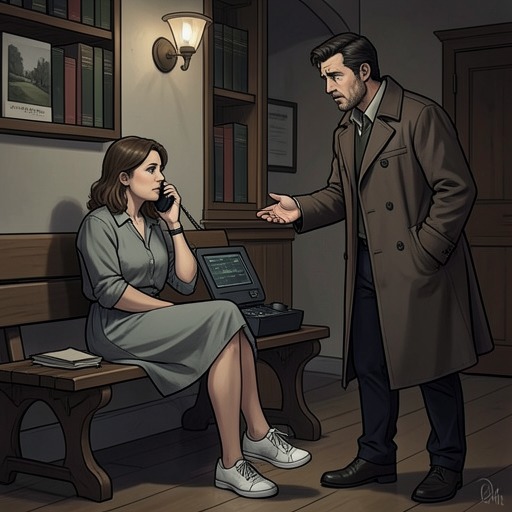
The safe contains the final will, identified as the will of Owen Michaels, née Ethan Young. Jules reports this to Hannah by phone while Hannah is at the marshal’s office. Hannah has been allowed to make a call in a conference room, with a different U.S. marshal, Sylvia Hernandez, waiting outside. The circumstances leave Hannah conscious that the call may be monitored or traced. Jules tells her she is home and has opened the safe, then pauses before offering to read the will. Hannah considers who else might be listening. The passage confirms the document’s identity and its connection to Owen’s concealed past, but does not disclose the will’s contents.
Narrative Role and Limits
Jules’s role links the intimate and investigative strands of the story. Her embrace and shared history establish a dependable friendship; her attention to Max’s lack of surprise turns an observation into a lead; and her response to Hannah’s message brings the hidden will into reach. These contributions arise from different forms of trust: the longstanding confidence between friends, the interpretive habits she learned from her journalist father, and her willingness to act on a request whose significance becomes clearer as she follows it.
The story also keeps Jules’s contribution within defined limits. She retrieves the piggy bank and helps arrange the opening of its safe, but the evidence does not say that she reads the final will aloud or learns everything it contains. Her pause on the monitored phone line leaves that disclosure unresolved. Jules thus helps expose the fact of Owen’s other identity without becoming the source of a complete explanation. The distinction suits her place in the narrative: she can make discovery possible and stand beside Hannah as the stakes sharpen, while the secret itself remains only partly revealed.