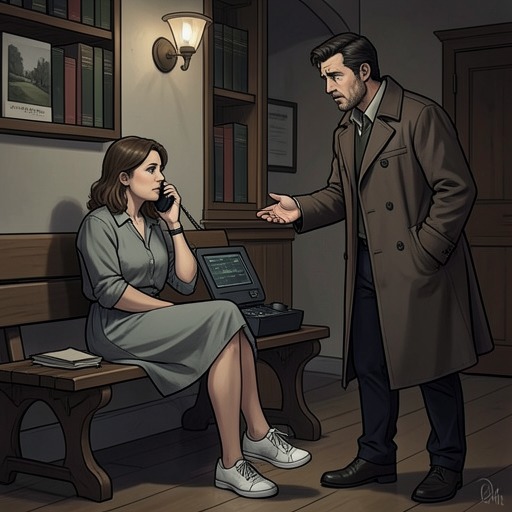
Jules tips Owen off
The Last Thing He Told MeJules tips Owen Michaels off about an impending Federal Bureau of Investigation raid on The Shop, an act of warning that also exposes how much Owen already knows. The call begins as an attempt to give him advance notice; in retrospect, his response turns it into evidence that his connection to the company’s fraud runs deeper than Jules had understood.
The information behind the warning
Jules learns about the raid through Max, who has advance knowledge of the operation. The Federal Bureau of Investigation offers him a deal: if he agrees not to break the story before agents move in, he will receive a two-hour lead on the raid. The arrangement gives the San Francisco Chronicle a head start over The Times, CNN, NBC, and Fox. Max is so pleased with the scoop that he tells Jules about it.
The raid is connected to Avett Thompson’s quiet sale of $260 million worth of stock over a period of months. Jules understands that investigators want to shut The Shop down before Avett disappears. The warning therefore concerns more than an approaching law-enforcement action: it arrives amid the prospect of a major financial scandal and the possible flight of a central figure.
Jules chooses whom to call
Jules says her first instinct was to call Hannah Hall, but she could not reach her. She then called Owen. When Hannah asks whether the purpose was to warn him, Jules confirms that it was. The sequence matters: Jules is not described as helping Owen evade the raid for personal gain, but as responding to the immediate danger she has learned about and trying to alert someone close to her.
That protective impulse carries a cost. Hannah asks whether Jules feels guilty because Owen ran, bringing the consequence of the warning into the conversation. Jules shakes her head at first and says it is nothing, but Hannah presses her to explain. Her unease is not simply about what happened after the call. It comes from what the call revealed about Owen before he left: he was not hearing about the raid as a shocking new development.
Owen’s response becomes a clue
Jules draws on a lesson from her father about sources: people who already know something often fail to ask the obvious questions that an uninformed person would need answered. Applied to Owen, that principle changes the meaning of his reaction. If he had known nothing about The Shop’s fraud, Jules reasons, he would have asked who investigators suspected, whether Avett acted alone or the corruption was more widespread, what had happened, and how much money had been stolen.
Owen asks none of those questions. Jules remembers that he was not surprised when she told him about the raid, and that he wanted only to know how long he had to get out. The contrast between the detailed questions he might have asked and the narrow question he actually asked forms the central evidence in her account. His concern is not understanding the alleged fraud; it is knowing the time available to leave.
The warning changes what Hannah understands
Jules’s account turns an act of loyalty into a revelation. She had called to warn Owen, but his composure and focus on his departure tell her that the raid confirms something he already anticipated. The exchange does not establish precisely what Owen knew about the fraud or when he learned it. It does establish why Jules concludes that he was not in the dark: he sought an exit window, not an explanation.
As Hannah listens, the significance of the warning shifts from the approaching raid to Owen’s concealed knowledge. She looks through the glass at Bailey Michaels, resting against Bobby with her eyes closed, and recalls the instruction to protect her. The juxtaposition places Jules’s disclosure beside the danger and responsibility Hannah associates with Bailey. What sounded like a practical warning now helps Hannah recognize that Owen’s departure was bound up with a past he had not disclosed.