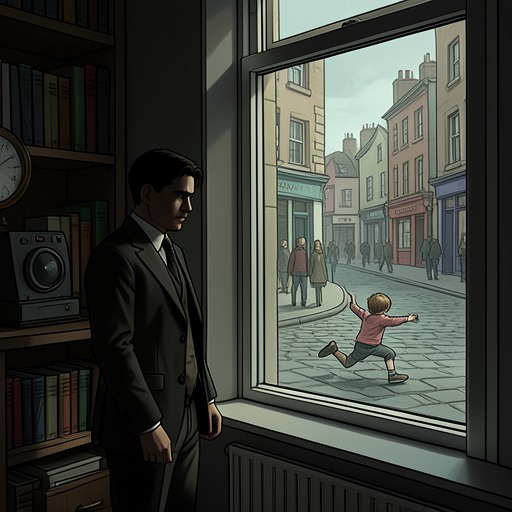
Owen calls Bailey on Signal
The Last Thing He Told MeOwen calls Bailey on Signal at the moment she recognizes him in an old photograph, but the brief exchange gives her no reassurance that he will return. He apologizes, says he has arranged his life to avoid making this call, and tells her that he cannot really come home. The call’s importance lies both in what Owen discloses and in what its twenty-two seconds cannot provide: an explanation of where he is, a promise of another conversation soon, or an answer to Bailey’s question about whether the separation is permanent.
The photograph and Signal
Bailey finds a photograph of Owen in which he looks heavier and has shoulder-length hair, almost a mullet. His appearance seems so different that she nearly laughs, but recognition is not in doubt: she knows that it is him. The photograph first prompts her to turn on her phone to call Hannah and share what she has found. Instead, an incoming call from Owen on Signal interrupts that intended call. The sequence binds an image of the absent father to the sudden sound of his actual contact: Bailey has just encountered evidence of who he was, and now he is speaking to her directly.
Signal is not an arbitrary channel. Bailey recalls that, months earlier, Owen installed the encryption app on her phone while the three of them ate dumplings at the Ferry Building. He explained that nothing on the internet ever disappears and made an awkward joke about using the app for sexy messages. Bailey pretended to be sick at the joke, and Owen agreed not to use the word again. Beneath that teasing exchange, however, he gave her a serious instruction: if she ever had a call or text she wanted to disappear, she should use Signal. He repeated the advice so she would remember it. The app therefore carries two registers of their relationship—the ordinary joking intimacy of father and daughter, and a practical rule for private communication. When Owen later calls through it, that earlier instruction acquires an urgent purpose.
What Owen manages to say
Owen is already talking when Bailey answers. He does not say where he is calling from, and he does not ask whether she is all right. Instead, he tells her that he has only twenty-two seconds. The precise limit shapes the conversation before its contents are known: Bailey can hear that the contact is tightly constrained, while the reader learns that the call will be too short to restore ordinary conversation. Owen uses the time to apologize, saying he is sorrier than he can tell her and that he had organized his life so he would never have to make this phone call.
His apology reveals that the call is not simply an unplanned interruption. Owen describes a life arranged to keep this moment from happening, yet he has called despite that arrangement. He gives Bailey no account of his location or circumstances in the exchange she recounts; what he gives instead is the emotional fact that he is sorry and the practical fact that contact will remain scarce. He says it will be a long time before he can call again. The statement offers no date or measure by which Bailey can wait, only an indefinite delay.
The meaning of not coming home
Bailey struggles to continue as she recounts the call. She does not look toward Grady; she keeps her eyes on Hannah. When Hannah gently asks what Owen said, Bailey reports the sentence that makes his absence newly explicit: he cannot really come home. Until then, the call might have meant that Owen was reaching out across a separation. This disclosure changes its force. Contact has occurred, but it does not mean that the family can resume living together or that Owen is on his way back.
Bailey asks whether he means ever. The question presses beyond Owen’s stated limit: he has said that he cannot come home and that another call is a long way off, but the words as reported do not settle whether the separation will last forever. Hannah recognizes the possibility Bailey is trying to understand. She has suspected it and, in the moment, knows the terrible implication; nevertheless, she does not answer before Bailey moans at the knowledge. Hannah places her hand on Bailey’s hand and wrist and holds her tightly. The response is physical rather than explanatory: the call has supplied no certainty that Hannah can use to soften the news.
A contact that confirms separation
The scene presents Owen’s call through Bailey’s later account to Hannah, so its emotional center is not Owen’s voice alone but the daughter who must repeat his words. The narrative moves from the nearly comic details of the photograph and the earlier joke about Signal to the precise twenty-two-second limit, then to the possibility that Owen will never return. That change in register makes the app’s history matter: a tool once introduced within family banter becomes the means by which Owen delivers a message he had hoped never to give.
The call provides evidence that Owen can still reach Bailey, but the contact also defines the limits imposed on their relationship. He has not disappeared from her emotional life, yet he cannot offer a homecoming or a dependable next conversation. Bailey’s final question remains unanswered in the scene, and Hannah’s gesture cannot resolve it. The exchange therefore functions as both a connection and a farewell: Owen speaks directly to his daughter, while making clear that speaking is not the same as coming back.