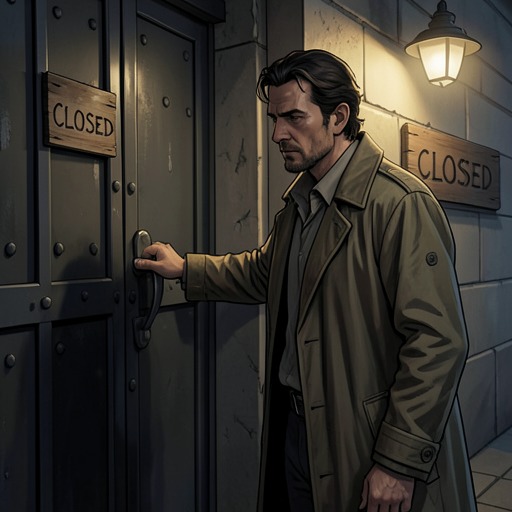
Owen disappears and flees Sausalito
The Last Thing He Told MeOwen’s disappearance and flight from Sausalito turn an initially unexplained absence into evidence of deliberate escape. A note in his handwriting, Hannah’s unanswered calls, and Jules’s account of warning him gradually replace the possibility of a harmless misunderstanding with a harder conclusion: Owen had been preparing to get out, and had given little sign of where he was going.
The note and the first uncertainty
A twelve-year-old girl arrives at Hannah’s door carrying a folded sheet of yellow legal paper. She says Owen asked her to give it to Hannah. Her message makes his absence tangible: this is not simply a missed call, but a communication left behind through someone else. The paper is addressed to Hannah in Owen’s handwriting, a familiar mark attached to an unfamiliar situation.
Hannah takes the note but does not immediately open it. After the girl walks away down the docks, Hannah closes the front door and remains with the folded paper in her hand. She imagines, briefly, that Owen might appear and reveal the whole episode as a joke. No one does. The delay before she unfolds the note holds open that last possibility, even as the note itself signals that something has already begun and may not be stopped. The evidence here does not disclose the note’s contents; its importance lies in the fact that Owen left Hannah a message while absent, and that she must confront the separation before she can know what he wrote.
Calls without a response
At eight that evening, Hannah is in the parking lot at Bailey’s school and tries Owen again. His phone goes directly to voicemail. By then he has been gone for twelve hours since leaving for work; two hours have passed since the visit from the soccer player, and Hannah has already left eighteen messages. The numbers give the silence a measurable duration and make clear that it is not a brief lapse in contact.
Hannah’s message asks Owen to call as soon as he hears it. She tells him she loves him, while also expressing anger that he has not responded. Her hope rests partly on the habits she associates with him: Owen usually has a good explanation and brings calmness and reason to a difficult situation. That expectation persists even as the unanswered calls undermine it. The scene’s tension comes from the widening gap between the reassuring explanation Hannah expects and the possibility that Owen is intentionally beyond her reach.
Jules’s warning and the meaning of flight
The account changes when Hannah speaks with Jules, who confirms that she warned Owen. Hannah names the implication directly: Owen ran, and is still running. Saying it aloud gives shape to what had previously been fear and inference. He is not simply gone in the sense of being unreachable; his absence is an action.
Jules explains why she believes Owen understood the danger surrounding The Shop. If he had known nothing about the fraud, he would have needed to ask her for details: who was suspected, whether Avett had acted alone, how widespread the corruption was, and how much money had been stolen. Instead, Owen did not seek an account of the alleged wrongdoing. His question was about how long he had to get out. That contrast makes his priority legible. The evidence points not to curiosity about the case or an attempt to establish the facts, but to urgency about escape.
Hannah’s conclusion is also bound up with the way she receives this knowledge. She is looking through glass at Bailey, who is resting against Bobby with her eyes closed, when Jules’s account shifts the meaning of Owen’s absence. The words Owen left behind, the calls he does not answer, and the warning Jules admits giving him now belong to one pattern. The flight is no longer just a private rupture in Hannah’s household; it is connected to the fraud investigation and to the time Owen believed he had before he needed to leave.
No traceable trail
A further sign of preparation is the lack of ordinary financial activity. Owen has used no credit card or check for twenty-four hours, and the investigator discussing the absence expects that he will continue to avoid both. The assessment is that Owen is too careful to leave an easy trail and has probably discarded his phone. That detail offers a practical explanation for the direct-to-voicemail calls, while also sharpening their emotional meaning: Hannah’s attempts to reach him may be failing not because he cannot answer, but because he has made himself difficult to locate.
The possibility of other phones remains open. Burner phones or devices that are not readily traceable could still allow Owen to communicate, which is why the search for a call does not end with his apparent disposal of one phone. But the distinction is consequential: no credit-card use, no check, and no dependable phone contact leave no straightforward route from Hannah to him. The episode establishes the shape of Owen’s escape without supplying its destination or resolving when he might return. Its central reversal is the movement from waiting for an explanation to recognizing that the silence itself is part of his flight.