Owen secretly appears at a design exhibition years later
The Last Thing He Told MeOwen’s secret appearance at Hannah’s design exhibition turns a crowded professional event into a brief, unmistakable encounter—and then into another disappearance. Years after he vanished, he arrives disguised and leaves almost at once, offering Hannah only a private phrase that confirms who he is. The scene gives her proof that he is alive and near, but not the explanation, contact, or return she might have hoped for.
Setting and the Long Interval
The encounter takes place at the Pacific Design Center in Los Angeles, where Hannah is one of twenty-two artisans and producers in a First Look exhibition. She is debuting a collection made mostly of white oak furniture, alongside bowls and larger pieces. The showroom is a workplace and a social occasion: colleagues and architects come by to catch up, making the exhibition feel like a reunion as well as an opportunity to meet potential clients. By late afternoon, however, Hannah is tired of the small talk and increasingly watches for Bailey, who is supposed to meet her for dinner.
The section’s heading, “Five Years Later. Or Eight. Or Ten.” refuses to settle on a precise measure of the time that has passed. The uncertainty fits Hannah’s life after Owen’s disappearance: the years have accumulated, but his absence remains active in the present. Even at the exhibition, her attention is divided between the ordinary business of showing her work and the possibility that someone from the past might appear. The scene does not present his arrival as a planned reunion. It enters the flow of a tiring day and disrupts it.
Recognition Through Disguise
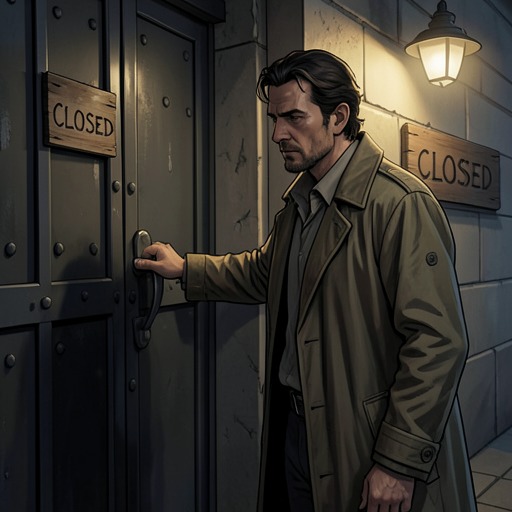
Owen walks into the showroom casually, wearing a backpack. His appearance has changed: his shaggy hair is now buzzed short and darker, his nose is crooked as though it has been broken, and tattoos cover his arm and extend across his hand and fingers. The details make him look unlike the person Hannah remembers, and the concealment is effective enough that she initially questions whether the stranger is really him. His disguise lets him pass among the exhibition’s visitors as just another attendee.
The oak wedding ring defeats that uncertainty. Hannah made the slim ring herself and recognizes its finish, even though she thinks another observer might not notice it. The ring is not merely a remnant of their marriage: because she knows its material and appearance so intimately, it becomes evidence she can trust when his altered face and manner offer no certainty. The object’s significance changes in the moment. What once belonged to their shared life now identifies a man trying to remain unrecognized.
Hannah has thought she saw Owen before, in places such as airport lounges or outside restaurants, and admits that she thinks she sees him everywhere. That history makes recognition both urgent and unreliable: the possibility of his return has been repeatedly raised in her mind without being confirmed. This time, the ring gives her a reason to believe her eyes, but she still wonders whether it might not be him. When she drops the papers she is holding, the disturbance makes her shock visible even as she struggles to understand what she is seeing.
A Private Signal
The encounter provides no extended conversation. Hannah tries to thank him, though she is unsure whether she says the words aloud. He nods, then gets up and starts toward the exit. Only as he is leaving does he say, “The could-have-been boys still love you.” He speaks quietly and does not look at her. The phrase is recognizable not because it explains his present circumstances but because Hannah understands it as something only he would say to her. In that instant, the identity she has doubted is confirmed.
The line works as a private signal between people whose shared history cannot safely or easily be spoken aloud in the showroom. Its indirectness is part of its force: Owen does not explain why he has come, say what will happen next, or ask Hannah to follow him. Instead, a familiar sentence carries the intimacy of their relationship through a meeting that affords neither privacy nor time. Hannah’s cheeks flare red, but she says nothing. There is no time for a response before he shifts his backpack higher on his shoulder and leaves.
Departure and Significance
Owen disappears into the crowd, and Hannah does not dare watch him go or look in his direction. She keeps her eyes down, pretending to organize the fallen papers while the heat in her face lingers. The public setting requires her to conceal her reaction as thoroughly as Owen conceals himself: he can vanish among visitors, while she tries to make the evidence of the encounter invisible to anyone nearby. Her composure is an outward performance, not a sign that the moment has passed without consequence.
The ending deliberately withholds the conventional shape of a reunion. Owen is physically present, unmistakably identified, and gone again within a few moments. Hannah receives confirmation but no account of his life, no explanation for his appearance, and no promise of another meeting. After he leaves, she must return to the exhibition and its ordinary traffic as though he were only another design enthusiast visiting a booth. The scene’s central reversal is therefore also a limit: the man she has imagined seeing everywhere is real, but his presence does not restore their former life. His ring and their private phrase establish connection; his immediate departure preserves the distance that has defined his absence.