United States Marshals Service
The Last Thing He Told MeThe United States Marshals Service enters the story not as a distant institution but as a network of people, offices, records, and protective decisions that increasingly shape Hannah Hall’s effort to find Bailey Michaels and understand Owen Michaels’s disappearance. Its Austin branch is home to Grady Bradford, a U.S. marshal who offers Hannah help while also restricting what she can do; later, his colleagues search for Bailey and keep Hannah under observation. The agency’s presence therefore carries two meanings at once: a possible route to safety and another authority capable of tracking, questioning, and containing the people it means to protect.
Institutional Position and the Fraud Investigation
The United States Marshals Service is not identified as the agency investigating The Shop. Hannah learns that the Federal Bureau of Investigation has been investigating the firm for more than a year after receiving a tip that its public stock listing was fraudulently overstated in connection with its initial public offering. The alleged method involved recording prospective sales of nonfunctional privacy software as future revenue, despite the company’s inability to sell the product; the projected losses to stockholders are described as enormous. This investigation gives the surrounding crisis its financial stakes, but the story distinguishes it from the Marshals Service’s role in the family’s predicament.
The distinction matters because Grady is not introduced as an investigator pursuing Hannah or as an agent who regards Owen as a conventional suspect. Hannah directly questions why a marshal based in Austin has traveled to San Francisco to seek someone who is not a suspect. Her question exposes the gap between the official explanation she has been given and the danger she senses. Grady’s work connects to the case through Owen’s identity, the possibility of protective custody, and the search for Bailey, rather than through a stated role in prosecuting The Shop’s alleged fraud.
Grady Bradford and Practical Protection
Grady identifies himself by name and explains that he is a U.S. marshal, offering Hannah the option of addressing him informally or as Deputy Bradford. His manner makes the institution personal: Hannah’s dealings are with a particular official whose choices determine how much assistance she receives. He advises her to get a lawyer, recognizing that the crisis could become a custody dispute as well as a search for Owen.
Before giving that advice, Grady has already called Thomas Shelton, an old friend who works in family law for the state of California. He asks Shelton to help ensure that Hannah can receive temporary custody of Bailey if someone appears seeking custody during the upheaval. The call is a concrete form of intervention, aimed at preventing the family’s uncertainty from leaving Bailey legally vulnerable. It also shows Grady using a personal connection to address a problem that lies outside the immediate search for Owen.
Grady supplies Hannah with an account of Owen’s recent behavior that helps her understand why conventional attempts to contact him have failed. Owen has not used a credit card or written a check for twenty-four hours, and Grady believes he has discarded his phone. In Grady’s assessment, Owen is too careful to leave those ordinary traces behind. His disappearance is thus framed not as a simple failure to answer calls but as a deliberate evasion of the records by which others might locate him.
Grady’s intervention has limits. He says he has managed to keep Hannah’s friends at the Federal Bureau of Investigation at bay, but cannot continue using his authority indefinitely unless Hannah and the others are formally under protection. That condition makes protection an administrative status as well as a promise of safety: without official inclusion, Grady’s ability to shield them from other investigators is temporary. He also explains that witness-protection decisions can be difficult, and that the files and history associated with Owen help explain why Owen did not expose wrongdoing earlier and felt compelled to remain involved. The agency’s protective function is therefore entangled with judgments about a witness’s record and the timing of his cooperation.
Austin Office and the Search for Bailey
The Marshals Service’s Western Texas branch is located in Austin. When Hannah calls the office number, an automated operator identifies the destination as the Marshals’ office, placing the institution in the same city where she and Bailey are following Owen’s past. The office later appears as a working environment rather than a remote bureaucracy: on a side street in downtown Austin, its windows face other buildings and a parking garage, and, late at night, Grady’s office and those of his colleagues remain lit and busy.
When Bailey is missing, Grady tells Hannah that eight deputies are looking for her. He directs Hannah to go through the events again, explaining that recounting what happened is the way she can help the search. The instruction gives her a role, but one bounded by the agency’s procedure: she is asked to provide information, not to direct the operation. Hannah’s fear and impatience are palpable in the questions she asks about how the marshals found them, while the record does not provide a complete account of the method by which the office located them.
The search culminates in Hannah receiving confirmation that Bailey has been found. Her immediate response is relief and a request to know where Bailey is. The moment marks a consequential success for the marshals’ search, but it does not erase the strain of the preceding process. Hannah has been required to wait, answer questions, and rely on officials while the person she is trying to protect remains out of reach.
Surveillance, Records, and Identity
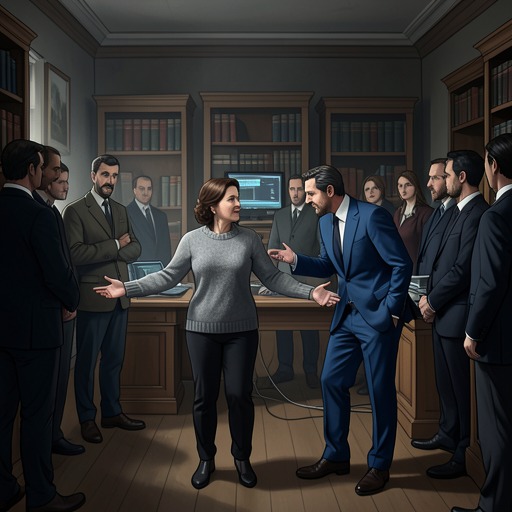
The agency’s protective environment is also experienced as surveillance. When another marshal, Sylvia Hernandez, takes Hannah to a conference room and permits her to make a phone call, Hannah assumes that the call may be recorded or traced. The scene does not establish every technical measure the office uses; it establishes Hannah’s sense that even a permitted action takes place under observation. Later, she sees Sylvia through a glass door, looking at her phone, and understands the marshal’s assignment as connected to the same searches Hannah cannot stop thinking about: finding Owen and finding Bailey.
This tension is sharpened by the way the story treats identity as a matter of records. Grady explains that Owen Michaels has no verifiable history before 2009: no record of that name buying or owning a Seattle home in 2006, enrolling Bailey in preschool that year, or filing an income-tax return before then. The documented version of Owen begins in 2009, after which the family’s home, Bailey’s schooling, and Owen’s work broadly match Hannah’s knowledge. Grady points out that a floating home, unlike a conventional house, left a thinner property trail because Owen did not own the land beneath it.
Owen’s false identity is not merely a biographical secret; it is vulnerable to the mechanisms used to identify people. Grady says that if Owen had been brought in and fingerprinted, as Jordan Maverick was that afternoon, the fingerprints would have disclosed who he really was. Hannah also raises the implication of The Shop’s privacy software, which was designed to alter online history and erase trails, including records connected to universities and housing. In this world, names, fingerprints, financial traces, and digital histories can either establish a person’s identity or expose the construction of one. The marshals’ work makes that administrative legibility part of the family’s immediate danger.
Narrative Role and Institutional Ambivalence
The United States Marshals Service occupies an uneasy position between rescue and control. Its deputies search for Bailey, Grady seeks a custody safeguard for Hannah, and his authority can temporarily keep other federal investigators away. At the same time, the office monitors Hannah’s movements and communications, determines when she can make a call, and asks her to remain within an official process while Bailey’s whereabouts are unknown. The institution can be both the means by which Hannah’s family is protected and the structure that limits her freedom to act on her own.
That ambivalence is visible again when Owen and Bailey’s situation draws a larger force of marshals to a property: Grady arrives at the front gate with a dozen other U.S. marshals behind him. The scene underscores the scale of the institutional presence, even as the account does not specify every deputy’s assignment or the full procedure underway. Elsewhere, Grady says that Owen knew being brought in would lead to fingerprinting and exposure, a danger that helps explain his avoidance of official contact. The marshals’ capacity to locate and process people is therefore a source of both security and risk.
The agency’s importance lies less in a comprehensive portrait of federal law enforcement than in this intimate collision between institutional protection and private loyalty. Its Austin office can search for a missing child, help secure temporary custody, and give Hannah access to a marshal willing to use his judgment on her behalf. Yet safety remains conditional, shaped by formal protection, files, surveillance, and the limits of Grady’s discretion. Through that contradiction, the Marshals Service becomes one of the story’s central instruments for showing how a family in hiding must depend on the same systems whose records and procedures can expose it.