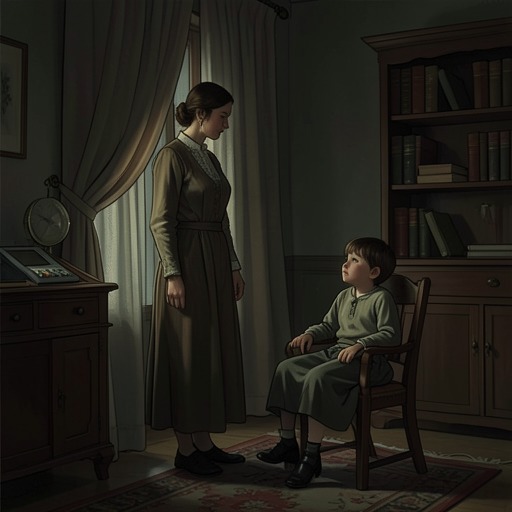
We always have a choice
The Last Thing He Told MeWe always have a choice is a recurring expression whose meaning changes as Hannah Hall confronts Owen’s disappearance and its cost to his family. First offered by Grady Bradford as reassurance, it later returns as a moral counterclaim to Hannah’s attempt to explain Owen’s actions as the product of having no choice. The phrase’s movement from an individual you to a collective we sharpens the question it leaves unresolved: whether choice is a simple fact, or a burden whose meaning depends on the circumstances in which it is made.
Grady’s Reassurance
When Grady asks Hannah for time to question her about Owen, he gives her the phone number for his branch office so she can verify who he is. Hannah asks, “Do I have a choice?” Grady answers, “You always have a choice,” then says he would appreciate her talking to him and suggests they take a walk. The line sounds like an assurance of agency, but its setting complicates that assurance: Hannah feels she has no good choice and is wary of Grady, who is about to ask questions about her husband. The words promise freedom even as the encounter places her under pressure.
Hannah’s Counterclaim
Later, as Hannah faces the question of how anyone could do this to a family, she thinks of Owen as the best father she has ever known. Rather than voice that defense, she says, “Someone without a choice,” and repeats the claim. Her explanation does not settle the question; it exposes the tension between her knowledge of Owen’s loving role in the family and the harm caused by his actions.
The Phrase Reconsidered
Elenor answers Hannah with a changed version of Grady’s words: “We always have a choice.” Hannah recognizes the echo and turns the phrase over in her thoughts. To her, its certainty risks making a complicated situation sound simple and judgmental, as though there were only people who had never made a serious mistake and people who had. The collective we also makes the claim harder to evade: it applies not only to Owen, but to anyone being judged for a consequential decision.
Meaning and Consequence
The expression does not resolve whether Owen acted freely or what Hannah should conclude about him. Instead, its recurrence makes choice itself the point of conflict. Grady uses the idea to invite Hannah into a conversation; Hannah invokes its opposite to defend Owen; Elenor’s reply returns responsibility to the discussion. Hannah’s recollection of Carl saying Owen was struggling, and her thought that he must still be struggling wherever he is, keep the question from becoming an abstract verdict. The phrase holds together two uncomfortable possibilities: that choices carry responsibility, and that judging a person’s choice may obscure the pressures under which it was made.