Ben’s Death
The Legend of William OhBen’s Death is not presented as a witnessed killing but as the discovery of a body abandoned beneath a deserted campsite. For William Oh, the corpse turns an already dangerous Trial into a confrontation with the material consequences of betrayal: Ben is dead, his companions have vanished, and the expensive gear that once marked him as valuable has become a burden to be sorted, carried, or left behind. The event advances William Oh’s survival while making mortality impossible to treat as an abstraction.
Discovery at the Abandoned Camp
A spark of awareness returns to William Oh as he crouches and searches for signs that Kyle Fontaine’s Party is still nearby. The camp contains only a week-old-looking fire pit and the scuffs left by its former occupants. The absence is the first indication that something has gone wrong, but the decisive revelation comes when William Oh takes a cautious step and places his foot on something strangely soft: directly beneath him lies Ben’s corpse.
The body has been left for roughly a week. Ben’s skin is mottled, and the smell has become overpowering, turning the campsite into a physical record of neglect. His death is therefore encountered through decay rather than ceremony. There is no companion to explain what happened, no recovery party, and no immediate memorial language; the corpse itself is the only testimony available to William Oh.
What the Corpse Reveals
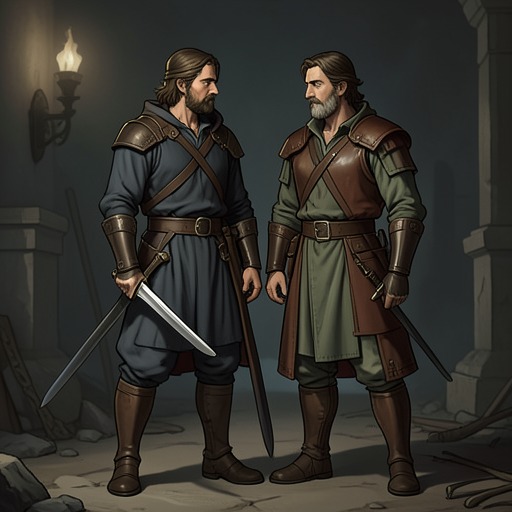
Ben still wears his expensive equipment, including chainmail sleeves that are beginning to rust. His satchel is soaked and scattered across the campsite, suggesting that someone searched it furiously for the payment Ben had promised. His pockets have been turned inside out, their contents spilling onto the forest floor. Yet even the Sting Ring remains on his swollen finger. The Climbers who abandoned the site have not merely failed to bury Ben; they have judged that recovering a ring worth twenty silver is not worth the effort.
That detail gives the death its cruelest social meaning. Ben’s possessions imply that he entered the Trial with resources and expectations, but his corpse demonstrates how quickly those signs of value can become irrelevant. William Oh understands the judgment imposed on him as well as the judgment imposed on Ben: a person who is not worth exploiting may also be ignored in death. His conclusion is practical rather than consoling. He resolves never to present himself as being worth the effort of taking advantage of.
William Oh nevertheless refuses to leave the body where it lies. He muses that the recovery will be unpleasant for both of them, puts his new tomahawk into his belt loop, takes one of Ben’s less-soggy bandages, and wraps his own wounds. Once treated, he strips Ben’s heavy armor from the corpse and hauls the remains over his shoulder. The act is simultaneously salvage, obligation, and evidence. William Oh uses what can keep him alive, but he also takes Ben home instead of allowing the Climbers’ disappearance to erase him completely.
Return, Arrest, and Official Explanation
William Oh carries Ben all the way to Ben’s house, drops the corpse on his father’s doorstep, and knocks on the door. He then spends the night in jail, a predictable consequence of arriving with a decomposing body under such circumstances. Even this indignity contains a small physical contrast: sleeping in an actual bed feels wonderful after the conditions of the Trial.
The following morning, a magistrate questions William Oh closely about how he obtained Ben’s body. William Oh gives the truth. The official account supplied by the missing Climbers is much less demanding: they claim that the two young men entered their Trials and never returned. It is the easiest explanation because it requires no proof, and the Climbers remain in town for three days before leaving abruptly. The magistrate accepts William Oh’s story and releases him later that afternoon, just as the town printer begins putting up wanted posters.
The administrative response converts a private discovery into a public disappearance. Ben’s death is not solved through a full account of the Trial; instead, the town receives a convenient explanation and a set of posters after the responsible Climbers have already gone. The body gives William Oh a fact that the official story lacks, but it does not restore Ben’s companions, recover the promised payment, or provide a complete motive for the abandonment.
Death, Witnessing, and William Oh’s Rising Reputation
After his release, William Oh enters Brenda’s Inn and orders a full bowl of stew, paying with some of the copper he received by selling the maksu’s rusty dagger. There, Jason Salazar slides into the seat opposite him and asks whether he has heard of William Oh. William Oh smiles and denies knowing him, even as he begins eating. The timing makes Ben’s death part of the strange machinery through which William Oh becomes known: while he is privately carrying Ben’s remains and publicly surviving the consequences, Jason Salazar is building the legend of William Oh elsewhere.
Jason’s praise presents William Oh as the smartest, most talented, most formidable, and most stoic individual the town has produced. That exaggerated account contrasts sharply with the corpse at the campsite, the rusting chainmail, the soaked satchel, and the bandage taken from the dead. The legend abstracts William Oh into a heroic identity, whereas Ben’s death forces him to deal with bodies, smell, weight, injury, and legal suspicion. Fame begins not by replacing such realities but by growing beside them.
The event also establishes a recurring pattern in the wider story: death is repeatedly interpreted through different forms of testimony. Ben’s body is the immediate physical witness; William Oh provides a truthful account to the magistrate; the Climbers offer a convenient false explanation; and Jason Salazar turns William Oh’s survival into promotional myth. Ben’s death therefore changes more than the number of living participants in the Trial. It exposes the gap between what happened, what can be proven, what institutions choose to accept, and what a public story is willing to celebrate.