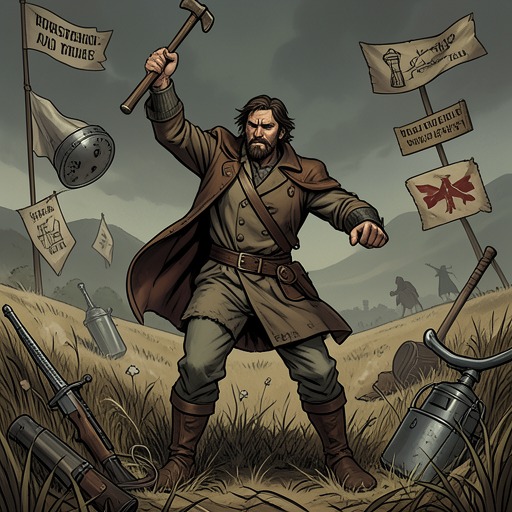
Better to be alive and tapped out than dead and rich
The Legend of William Oh“Better to be alive and tapped out than dead and rich” is a survival expression associated with Will’s practical decision-making. Its decisive claim is that money has value only while a person remains alive to use it; when survival and wealth come into conflict, Will treats exhaustion of his funds as preferable to the loss of his life.
Meaning and Immediate Context
The expression appears when Will and Loth are deciding what to do with the ivory money remaining after sending Ms. Zodiac back to her father. Rather than treating the cash as something to hoard, Will jingles the bag and accepts that spending it may be necessary. His next stated objective is to find fire-resistance equipment, showing that the maxim is not abstract philosophy: it directly authorizes an expenditure intended to make the next climb safer.
The surrounding circumstances give the phrase its economic force. Equipment needed to reach the next level is permanently scarce, and the pair spend hours searching the bazaar before finding an amulet and boots with useful fire resistance. The items are inferior to the loot recovered from the ice caves, but they are adequate to keep the climb from becoming unnecessarily dangerous. Will therefore values survivability and sufficiency over prestige, resale value, or an ideal loadout.
A Repeated Survival Economy
The principle is consistent with Will’s earlier handling of resources. When he buys a spirit turtle Sacrifice for twenty silver, the payment consumes more than half the money he earned by selling a tongue. He recognizes that he cannot obtain retail value without preserving the material himself and establishing a shop, yet he still puts the Sacrifice into his satchel because it advances his immediate objective: he is two-thirds of the way toward the requirement on his first day.
The same resource logic governs his later purchases. Will examines an Endless bag of salt and learns that it produces about a quarter cup per Charge, with a maximum of four Charges each day. The object is valuable not because it is luxurious, but because it converts a limited magical resource into a dependable supply. His choices repeatedly place continued operation above the comfort of retaining cash, even when every purchase narrows his financial margin.
Life, Risk, and Limited Reserves
The maxim also stands against the more severe edge of Will’s survival experience. During a failed trial, he reaches a point at which thirst becomes overwhelming, the remaining ordeal promises two more days of agonizing pain, and he begins considering suicide because he sees no tolerable route forward. The episode makes “alive” a concrete and precarious condition rather than a sentimental ideal: survival can require enduring depletion, pain, and apparent defeat before any future gain becomes possible.
Will’s magical reserves are likewise finite. One recorded status shows Charges at 4/10, alongside the abilities Aspect of the Goat and Phantom Hand. That numerical limit reinforces the expression’s broader accounting system. Cash, Charges, equipment, time, and bodily endurance are all consumable reserves; refusing to spend them can preserve a number while increasing the danger that makes the number irrelevant.
Practical Judgment Rather Than Recklessness
The phrase does not mean that Will spends without calculation. His purchase of fire-resistant equipment follows a deliberate survey of the bazaar, and he accepts equipment that is merely good enough rather than pursuing the best available gear. His judgment is comparative: a reduced purse is an acceptable consequence if it lowers the danger of the next level, while wealth that leaves a Climber dead has no practical use.
That judgment extends to strategic alternatives. In the oil-city crisis, Travis warns that his older siblings may arrive within weeks to reclaim the city, whose infrastructure can produce millions of gold each month by selling crude oil to other floors. Will responds by treating destruction as “plan B,” while Loth reports that the Tangled population has risen from just below nine thousand to thirteen thousand in three days and is growing by 14.28 percent per day. The expression’s logic operates here at a larger scale: resources and infrastructure matter, but not enough to justify ignoring an escalating threat that could make possession meaningless.
Narrative and Thematic Significance
As an expression, “Better to be alive and tapped out than dead and rich” condenses the book’s survival economy into a memorable reversal of ordinary treasure-seeking logic. Wealth is not the final measure of success; it is an instrument whose worth depends on continued life, movement, and future choice. The phrase also gives Will’s pragmatism a clear ethical hierarchy: spend what must be spent, accept scarcity, and preserve the person who can still act.
Its force comes from the contrast between “tapped out” and “dead.” The first condition implies temporary poverty but leaves open recovery, trade, climbing, and reinvention. The second closes every possibility, regardless of how much gold remains. In that sense, the expression is both a financial rule and a statement about agency: a depleted survivor still possesses options, while a wealthy corpse possesses none.