Build
The Legend of William OhBuild is the organized configuration of a Climber’s Class, Abilities, Relics, equipment, and tactical interactions. It is not merely a list of individually strong choices. A Build determines what a character can do reliably, which dangers they can answer, how quickly their abilities develop, and whether apparently unrelated parts of their kit reinforce one another. The story repeatedly presents advancement as an exercise in construction: characters gain power by choosing a direction, accepting its weaknesses, and finding combinations that make the whole greater than its parts.
Definition and Development
A Build begins within the system of Class generation and Ability selection. When Will offers pemmican at the Class Trial Altars, the sacrifice is judged suboptimal and fails to generate a Class Seed, showing that advancement is governed by formal requirements rather than desire alone. Once Will later receives a Class, the System presents Primary Abilities for him to choose, and he pauses instead of selecting immediately because he wants to understand what a Resourceful Climber is and how its abilities might develop. Build-making therefore starts with interpretation: the Climber must understand the role implied by a Class before committing scarce choices to it.
The System makes this construction process measurable. It displays Charges, Free Points, Primary Abilities, and upgrade opportunities, while quests and level thresholds open further choices. Reaching level five grants Will access to a new stage of advancement but also reduces experience gain in the Hunting Grounds and the 1st Floor, forcing him toward the 2nd Floor if he wants to continue accumulating power. The choice of an established route or a dangerous Key Site consequently becomes part of Build development as well as travel. The Build is formed through a sequence of constrained decisions, each made under rules that regulate timing, scarcity, and risk.
Synergy Rather Than Isolated Strength
The clearest distinction between a strong ability and a strong Build appears in the discussion of Alicia Zodiac. Steve explains that she possessed a Ranger Build with such overwhelming damage and synergy that nothing reached her until a claustrophobic spawning ground disrupted the conditions on which the configuration depended. Her shots killed with extraordinary efficiency, but separation from the Tank exposed a weakness that raw damage could not solve. The account presents synergy as conditional power: a configuration may dominate when its parts operate together and collapse when the environment removes one of those parts.
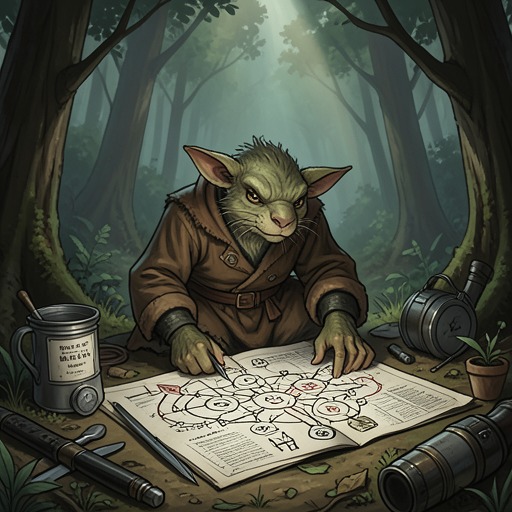
Loth’s Saboteur Class demonstrates a different form of synergy. Saboteur is rare among humans because humans do not possess the trap-lust associated with kobolds, making it difficult for observers to judge the Class’s strength. Loth can place half a dozen traps within a few breaths, and the traps annihilate their intended targets. Other people misread this performance as evidence that Loth is simply a high-level Climber. In practice, the effect comes from a specialized configuration whose value lies in preparation, placement, and interaction rather than straightforward combat statistics. The Build conceals its own logic from outsiders while making Loth exceptionally dangerous within the situations it is designed to control.
The same principle governs equipment. Loth considers the Ring of Arcane Endurance, which grants five points of Acuity, but judges it merely good rather than synergistic with her Build. Will likewise studies a mutated Ring of Accuracy with a Manhunter effect that draws a struck creature toward the shooter along the projectile’s path. For an ordinary Scout, pulling a target closer would be undesirable; for Will, the effect could drag an enemy through the fire curtain created by his sling’s tracers. The item’s value changes according to the configuration receiving it. A relic is not powerful in the abstract: its usefulness depends on what the rest of the Build allows it to do.
Will’s Configuration and the Body It Must Serve
Will’s developing Build is shaped by both tactical ambition and the loss of his left hand. His displayed kit includes Gravity Charge, increased Charge and Kick potency, increased movement speed, Fire Tracers, Acid Bolt with greater acid damage, Homefield Advantage for ice, and twenty percent fire resistance. His Primary Abilities include Aspect of the Goat and Phantom Hand, with another upgrade available. These elements suggest a configuration built around movement, ranged pressure, environmental advantage, and an ability that compensates for bodily absence rather than pretending that absence does not matter.
At level ten, after fighting bandits in Oilton, Will considers choosing a direct-damage Ability because Loth’s attack had devastated another Climber. He rejects the impulse, recognizing that Loth’s attack belongs to a specific Build and that copying its visible result would not make it appropriate for his own. This is one of the concept’s central disciplines: Will learns to distinguish admiration from fit. A direct-damage option might look impressive, but selecting it without regard for his existing interactions would weaken the coherence he is trying to build.
His two leading alternatives reveal the competing directions available to him. Sourdough appeals because Phantom Hand already participates in Relic synergies, and Will hopes eventually to improve that network through a Relic Worm Sacrifice. Because Sourdough works with Relics, he imagines creating a strong interaction and perhaps looping the Ability into the wider system. Titan’s Grasp attracts him for a more personal reason: it could partly offset his disability, and future Sacrifices might link its passive to Phantom Hand. Will even imagines a long-term possibility in which an Ability could give him a left hand again. The choice is therefore simultaneously mechanical and bodily. One path deepens an existing Relic engine; the other addresses the physical condition that shapes every practical decision.
Will also examines an Ability that extends debuffs, including poison, burning, bleeding, mind control, fear, curses, and stat drains such as the effect produced by Serpent Tomahawk. He decides that he does not want to divert his entire Build toward debuff synergy. The refusal matters because the option is not dismissed as weak; it is rejected as a demand that would reorganize everything else around it. Build identity is preserved not only through selected abilities but through disciplined refusal of attractive alternatives.
Tactical Builds in Action
Builds become most visible when the party must solve a problem that direct force cannot safely answer. During the Establishing Quest to destroy Kaith supply lines, Nathan explains that the objective is to find and destroy the routes carrying food through an extensive cave system, not to engage the Kaith in a direct battle. The mission assigns value to scouting, navigation, sabotage, and withdrawal. Loth’s bucket-sized barrel of soil and food scraps houses dozens of insect species under his control, while glowbug juice marks arrows at every branch so the group can retrace its route. These tools turn a fragile expedition into an organized search network.
The cave’s physical hazards expose the importance of complementary abilities. When Will falls across a gap and catches the ledge, Loth throws him a rope and directs him to hold it against the wall while Loth works from the darkness. The solution is not a single spectacular power but an interaction between climbing skill, equipment, communication, and trust. Later, when the party discovers that Nathan must hold the bridge as its spearhead, the group’s task changes from immediate destruction to retreat and reassembly. The Build operates at the level of logistics as much as combat: it determines who scouts, who anchors a position, who carries information, and who makes survival possible.
The same logic appears in the later plan involving the Tangled. Will, Loth, and their allies decide to send Travis to lure the fire-motes away while the other three descend into the water tanks and rig them to explode, exploiting the fact that the Tangled sleep there at night. The operation combines bait, timing, terrain, explosives, and enemy behavior. Its effectiveness comes from assigning each participant a role that suits the overall design rather than asking everyone to perform the same kind of attack.
Rules, Limits, and Significance
Build is also a response to the System’s impersonal governance. Quests arrive as commands, advancement is tied to levels, and new floors impose different conditions. The New Quest ordering Will to ascend to the 2nd Floor does not simply offer adventure; it declares that his current sources of experience have been weakened and that further growth requires movement into greater danger. The System’s routes, Key Sites, level thresholds, and Ability screens transform personal development into a regulated progression, while the Climber’s ingenuity lies in exploiting the connections those rules leave available.
The concept also clarifies why expertise cannot be separated from self-knowledge. Steve’s Charlatan configuration is judged extremely subpar: at level thirty-five, Steve’s Class is ill-suited for battle, his healing Ability is secondary and therefore grows slowly if at all, his sole debuff is also secondary, and he has neither buffs nor offensive abilities. He is told that he will gain no levels until the party passes the 7th Floor, leaving him increasingly weak beside native monsters. The diagnosis is harsh because it identifies a structural failure rather than a momentary mistake. A Build can become obsolete when its growth rules, role, and environment no longer align.
Across the story, Build is therefore the language of deliberate adaptation. It links a Class to its Abilities, equipment to terrain, bodily limitation to invention, and individual action to party logistics. It explains why Loth’s traps, Will’s Phantom Hand, a mutated Ring of Accuracy, a water-tank demolition, or a debuff option cannot be judged independently of context. Survival depends not on collecting the strongest parts, but on making choices that remain mutually intelligible when the next bridge, monster, floor, or system restriction removes the assumptions on which earlier strength depended.