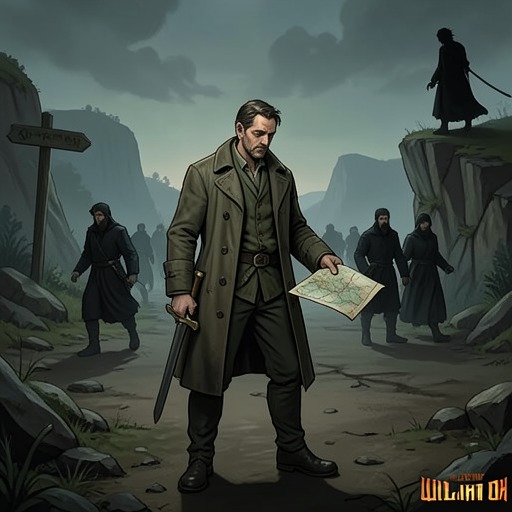
Class Trial
The Legend of William OhThe Class Trial is the system-governed ordeal that transforms Will from an Aspirant without a class into a qualified Climber. It first appears as a glowing archway opened from empty air after Will acquires the required Sacrifices, then becomes a deadly canyon test whose rules define both his objective and his future. The trial is therefore more than a combat encounter: it is a selection mechanism that turns uncertain resources, bodily risk, and tactical interpretation into a permanent identity.
Opening the Trial
The Class Trial presents itself only when an Aspirant has acquired all the Sacrifices needed to invoke it. After Will and Ben are already exhausted, a pale yellow sliver of light catches their attention, opens out of thin air, and forms a glowing archway. The phenomenon is unfamiliar in direct experience but known by reputation, marking the moment when the abstract promise of class creation becomes an available passage.
The opening is also a material test. The system does not respond merely to desire or readiness; it responds to possession. In Will’s case, the third required piece is a dried Uru Drake kept in his satchel. The appearance of the archway thus ties advancement to inventory, while the setting emphasizes the abruptness of the transition: the doorway is not built, discovered, or unlocked by ordinary means, but manifested by a system that recognizes a completed requirement.
Sacrifice and Class-Seed Generation
The trial’s rules are unforgiving because the Door to The Trial normally opens only when three Sacrifices are in an Aspirant’s possession. The Class Creation Room offers no ordinary escape from failure. Its walls resist every force an Aspirant can bring against them, including Relic weapons supplied by high-level Climbers, leaving a person who lacks the necessary materials vulnerable to dying there from dehydration. The three-Sacrifice requirement is consequently both a ritual condition and a survival barrier.
Will reaches this stage without the normal set of three Sacrifices, forcing him to improvise. He places a thumb-sized piece of pemmican on one Altar, and a beam of light descends upon it, intensifies, and erases it completely. The system identifies it as a suboptimal Sacrifice and fails to generate a Class Seed. The failed offering establishes that the Altars do not simply accept any expendable object; they evaluate quality and can reject an attempt after consuming the material.
The Uru Drake scale succeeds where the pemmican fails. Will places the scale in the center of the rightmost Altar, and the system confirms that the Sacrifice has successfully generated a seed named Uru Drake Primogenitor. A later Sacrifice also produces a successful result, and the process ends with Will crowing in victory before passing out from the pain. The class is born through a sequence of consumption, judgment, and bodily consequence rather than through a clean menu selection, making advancement feel like an ordeal even before the physical trial begins.
The Canyon and Its Rules
When Will awakens inside the Class Trial, sheer cliffs enclose him. Below him are jagged crags, narrow footholds, and occasional flat patches overwhelmed by plant life. The terrain makes movement itself hazardous, while the cliffs establish the trial as a sealed environment from which the system, rather than Will, controls the exit.
The system’s announcement gives the objective with unusual clarity: somewhere in the canyon lies a portal leading back to the Hunting Grounds. The portal is guarded by a wicked tribe of Maksu led by Sezz’kenal, described as a vicious caravan raider who has developed a taste for human flesh. Will is not explicitly ordered to kill the tribe or its leader. He is told to make it back to the Hunting Grounds, and success in doing so qualifies him to join The Climb.
That wording creates the trial’s central tactical gap. Will initially assumes that the ordeal is a fighting Trial, but then recognizes that the stated requirement is escape, not victory in battle. Avoiding the Maksu may be difficult, yet the possibility matters because it turns the objective from simple strength into interpretation. The system supplies a destination and a qualification condition; Will must determine how much violence is necessary to satisfy them.
Ability Selection and Qualification
Before entering the canyon’s full danger, Will receives two Charges and one Free Point and is instructed to choose his Primary Abilities. Rather than selecting immediately, he interrupts the display to study his class again, asking what a Resourceful Climber is and seeking the context that might reveal how its abilities will develop. His hesitation is strategic rather than passive: the class name is not merely descriptive, but a clue to the build he is expected to construct.
The orphanage has provided basic instruction in choosing Primaries and in understanding what different Classes do, but the trial places that limited education under pressure. Will must make an irreversible or consequential choice while the environment is already threatening his life. The system presents advancement as a formal interface, yet the interface does not remove uncertainty; it relocates uncertainty into the relationship between a class’s designation, its possible development, and the abilities available at the moment of selection.
The trial’s ultimate pass condition is equally procedural. Will must reach the portal and return to the Hunting Grounds, where completing the requirement qualifies him to join The Climb. The result is a threshold status change: the Class Trial does not simply reward survival with power, but grants institutional eligibility within the larger climbing system.
Narrative Consequences and Systemic Significance
The Class Trial establishes the governing pattern of Will’s advancement. Progress is never freely given. It is gated by Sacrifices, mediated by Altars and system messages, shaped by ability menus, and verified through a dangerous practical test. The failed pemmican offering demonstrates the cost of misunderstanding the rules; the successful Uru Drake sacrifice demonstrates that scarce biological remnants can be more valuable than ordinary food; and the later canyon objective demonstrates that the rules can be exploited through careful reading rather than brute force alone.
The event also changes the meaning of Will’s earlier struggle. The archway appears only after he has assembled the required materials, but assembling them does not make him a Climber. The system still demands that he endure its terrain, confront the threat around the portal, and return alive. Class acquisition and Climber qualification are therefore distinct stages, joined by the Class Trial as the mechanism that tests whether a new class can function in the world it is meant to inhabit.
Its logic recurs beyond the canyon. Later system messages announce an Establishing Quest and then a new quest to ascend to the 2nd Floor, showing that Will’s passage through the trial becomes the foundation for subsequent progression. The Class Trial is the first major demonstration that the system governs not only combat power but movement between social and geographic levels. Even much later, when Will collapses into the ash while carrying Brianna on the 3rd Floor, the contrast recalls the trial’s original demand: advancement remains inseparable from physical endurance, tactical judgment, and the ability to keep moving after the body has reached its limit.