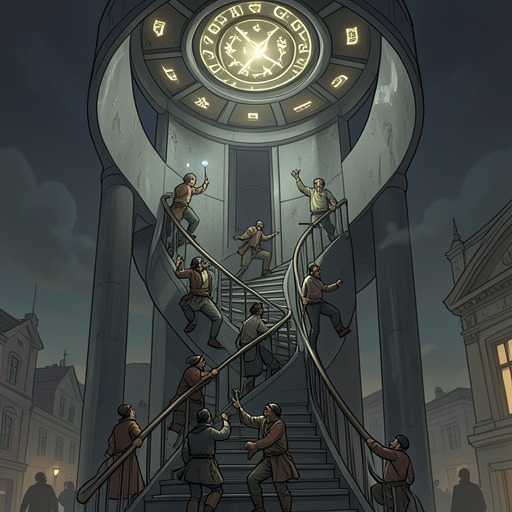
Demesne
The Legend of William OhDemesne is the territorial foundation of Lordship in The Tower. It is not merely a piece of land acquired at the end of a climb: it is the promised destination that gives ascent a political purpose, the place where money and Relics can be accumulated and redirected, and the institutional space through which a Climber becomes a ruler. The concept therefore binds personal ambition to conquest, administration, and the Tower’s larger system of recognized authority.
Definition and Political Function
A Demesne is a territory petitioned for and established by a qualified Climber after the system permits that person to subjugate land. Completion of the Trial grants Aspirants the ability to travel between floors at Key Locations, receive Quests, form Parties, and petition to subjugate land; the Demesne is the territorial consequence of that last privilege. Advancement is thus spatial as well as numerical. Levels and floors measure progress, but a Demesne gives progress a permanent political address.
Will’s stated life goal makes this structure explicit. He intends to reach the Tenth Floor and carve out a Lordship there, then push upward while funneling money and Relics back down to his Demesne. His plan is not to seize one isolated stronghold and stop. He imagines pacifying an entire floor, repeating the process until the whole Tower belongs to him. In this formulation, the Demesne is both headquarters and destination: a secure base that can finance further expansion and the first concrete unit in a project of total dominion.
Territory, Access, and the Tower’s Spaces
The Tower’s geography repeatedly makes territory unstable and access conditional. Will is trapped in the Class Creation Room, a plain white room containing three Altars and no exit, while other threshold spaces take the form of sudden doorways. When he accepts the Establishing Quest, a doorway opens in front of him, identical to the one that had previously confined him in a featureless box for two days. The contrast matters to the idea of a Demesne: movement between territories is enabled by the system, but the same system can also imprison, redirect, or expose a person without warning.
The floors themselves resist ordinary assumptions about land. On the Second Floor, Will and Loth find that what first appears to be a mountain peak is actually a floating mountain, separated from surrounding land by sheer cliffs and hundreds of feet of open air. On the Fourth Floor, the yeti spawning ground begins beyond switchbacks and opens into an extensive network of ice caves formed beneath a mountain where the sun’s warmth never reaches. These spaces demonstrate that claiming territory in The Tower is never equivalent to simply possessing familiar ground. A Demesne must be established within a world of disconnected, hostile, and often physically impossible environments.
The same tension appears at a Stronghold whose walls are lit by man-sized beacons. As darkness closes around the city, only small pools of light remain at its edge, including a shadowed section at the base of the wall where an enterprising climber could begin an ascent without being seen. Territory is consequently shaped by surveillance, routes, illumination, and concealment. A future Demesne is not just bounded acreage; it is a controlled arrangement of entrances, defenses, resources, and blind spots.
Claims, Lords, and Vassals
The system’s recognition of a Demesne depends on social as well as territorial conditions. When Climbers kneel and pledge their lives as Vassals, the system announces that the minimum number of Vassals required to be considered a Lord has been reached. It then scans the local Territory, confirms that there is no prior claim or resident population, and asks whether the location should be established as a Demesne. The claim is therefore not valid merely because someone occupies a place. It requires a recognized Lord, sufficient followers, and territory not already claimed or inhabited according to the system’s criteria.
Mark accepts the prompt and walks up the stairs to a throne overlooking his new responsibility. The system immediately acknowledges him as a Lord and instructs him to rule with courage and dignity. The scene presents the Demesne as a transformation of space into office: the territory becomes a responsibility, the followers become the political basis of rule, and the throne gives the claim a visible center. Yet the moment also carries an absurdly material interruption. Mark notices what may be bread crumbs on the throne’s arm just before it clicks, puncturing the grandeur of institutional recognition with the domestic debris of an imperfect world.
The requirement for Vassals also distinguishes Will’s projected Lordship from solitary achievement. His ambition begins as a personal promise to climb, but a Demesne can exist only within relations of allegiance and administration. Lordship is not simply the strongest person standing in a location; it is a status ratified through followers, unclaimed territory, and the system’s formal acknowledgment.
Conflict and Reclamation
Because a Demesne represents wealth, legitimacy, and a platform for further ascent, territorial claims invite strategic conflict. Loth observes that the deliberate weakness of the Tangled causes all of them to die with their originator. That weakness makes a city reclaimable by a single assassin and creates an opportunity for a Lord to stage a glorious recovery of a seemingly pristine city from mysterious monsters. The expected perpetrator would arrive with an army once the Tangled had multiplied sufficiently, turning the city’s destruction into a political performance and a route to prestige.
This episode reveals how Demesnes can be manufactured through spectacle. A Lord need not merely defend an inherited territory; a ruler can arrange a crisis, allow monsters to occupy a city, and then return as its apparent savior. Reclamation becomes a means of acquiring glory, and glory can strengthen a territorial claim. Will wants someone punished for the crime, but as Party leader he recognizes that he cannot yet challenge a Lord directly. The authority attached to a Demesne therefore protects its holder even when the circumstances behind its acquisition are morally suspect.
Narrative Significance
Demesne is the concept that converts the book’s climbing structure into a theory of power. The Tower promises movement, Classes, Quests, levels, and Relics, but the destination of that movement is rule over a place and the capacity to make that place fund further expansion. Will’s plan to send wealth downward while he continues upward makes the Demesne an economic engine; Mark’s recognition makes it a legal and social institution; the Stronghold and the Tangled city show that it is also a battlefield of visibility, legitimacy, and controlled violence.
The concept finally exposes the difference between reaching a place and owning its future. A territory becomes a Demesne only when the system recognizes a claim, followers accept service, and the claimant assumes the burden of rule. That threshold gives the Tower’s vertical adventure a horizontal consequence: every ascent creates the possibility of enclosing others within a political domain, while every domain becomes a platform from which the next ascent can be financed and justified.