Exchange Hall
The Legend of William OhExchange Hall is the largest and most consequential public building in Ashwood, a place where the System’s abstract judgments become physical rewards, public rankings, and new obligations. It is both a marketplace of achievement and a bureaucratic threshold: Climbers enter carrying the risks of the Climb and leave with gold, recognition, or the next demand placed upon them. For William Oh, the hall converts survival into status and establishes his performance as exceptional.
Architecture and Civic Function
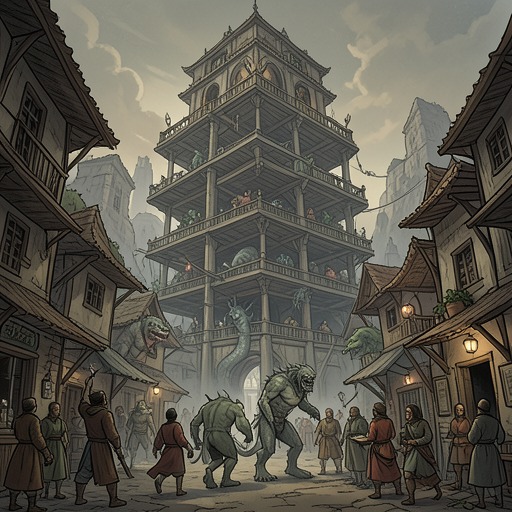
Exchange Hall dominates Ashwood physically as well as institutionally. It is described as the biggest building in the town, a regulation-sized structure in an otherwise undersized mudhole, equipped with regulation-sized marble pillars so large that one could crush the nearby inn. The contrast makes the hall feel imported from a more significant world than the town around it. Ashwood may be a rough settlement, but inside Exchange Hall the Climb receives an official architecture: standardized, monumental, and large enough to make individual adventurers appear temporary.
The hall is also a controlled point of passage between danger and compensation. William Oh goes there intending to collect the money attached to his Establishing Quest, pantomiming the rubbing together of two gold coins as he explains that he needs the quest payment. The gesture is comic because he has never actually possessed the imagined wealth, but it also identifies the hall’s practical purpose. Whatever ideals or dangers surround the Climb, Exchange Hall is where labor becomes currency.
The Establishing Quest and the Reward Line
The hall’s public role is made explicit by the kiosk and its blackboard. The notice announces the Establishing Quest: Break the supply lines!, linking the building directly to the campaign against the Kaith presence on the First Floor. The quest is not merely an individual errand; it is an organized response to a wider threat, and the hall provides the place where participants gather to claim its results.
When William Oh and Loth arrive, dozens of familiar Climbers are already present. Those who have collected their rewards remain in the hall rather than dispersing, waiting to see who will be named the MVP. The reward line therefore becomes an audience as much as a queue. Participation is transformed into comparison, and the hall’s administrative process becomes a public contest over whose contribution mattered most.
Mason Lanover receives an early commendation. The receptionist calls his showing excellent before handing him a box containing what is presumably gold, and William Oh’s immediate reaction is hunger for the money. The scene places Mason’s recognized success beside William’s anticipation, establishing Exchange Hall as a venue where rival achievements are displayed side by side rather than judged in private.
William Oh’s Recognition
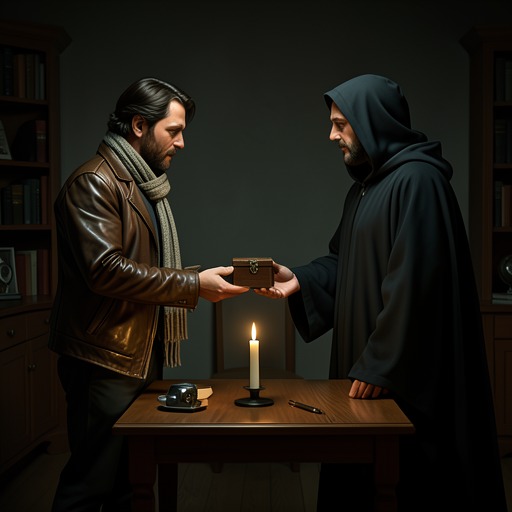
At the front of the line, William Oh learns that the System has rated his performance as exceptional. The clerk has to verify his identity because five other people have already attempted to claim his quest reward under the name William Oh; he is the sixth claimant to appear, but the clerk’s magical comparison confirms that he is the correct one. The attempted thefts add a specifically bureaucratic danger to the quest: even after surviving the work, a Climber must still prove ownership of the result.
The clerk then gives William Oh a bag of gold roughly equivalent to Mason Lanover’s reward. The payment is not only financial. It certifies that the System has distinguished his actions from the ordinary mass of participants and places him within the hall’s competitive economy of performance. His exceptional rating makes the reward a public verdict, and the gathered Climbers become witnesses to his sudden elevation.
Loth’s reward exposes another feature of the hall’s hierarchy. When Loth asks what about his own payment, the clerk reacts with surprise that he can speak and admits that she had mistaken him for a Tamer or something similar. The exchange shows how the institution classifies people through appearance and expectation before it recognizes their actual identity. Loth is a Saboteur, a rare human archetype, but the hall’s clerk initially reads him through a more familiar category. Administrative recognition is therefore powerful but not infallible.
Payment, Weight, and Material Value
The hall’s compensation system has its own practical rules. When William Oh receives two bags of gold with Loth, he complains that the payment feels light. The clerk explains that amounts over five hundred gold are paid in ivory to save weight. The rule converts wealth into a logistical problem: successful Climbers cannot simply carry unlimited metal away from the counter, so the institution changes the material form of payment while preserving its value.
That detail captures the hall’s characteristic mixture of grandeur and mundanity. Monumental marble pillars and System-issued judgments coexist with the clerk’s tired dismissal of recipients who have been paid. Even extraordinary rewards are processed through weight limits, containers, queues, and routine instructions. Exchange Hall does not romanticize success; it packages it.
A Threshold in the Climb
Exchange Hall repeatedly stands at the point where one phase of William Oh’s progress closes and another begins. After the quest, he is Charged, his stitches are out, and he is eager to return to the Climb. A new quest then appears, ordering him to ascend to the 2nd Floor. The System congratulates him for reaching level five on his first Establishing Quest while assigning him a rank of 1053rd among that year’s Aspirants. The hall thus belongs to a cycle rather than a single transaction: quest, reward, ranking, recovery, and renewed ascent.
Its importance extends beyond the scenes in which William Oh personally collects payment. The hall is the institutional language of the tower made visible. Altars can erase a sacrifice and fail to generate a Class Seed; quests can open a doorway; abilities can alter survival; but Exchange Hall is where those invisible mechanisms acquire civic consequences. It confirms who performed well, determines what can be collected, and sends Climbers back toward the next floor with their progress publicly measured.
For William Oh and Loth, the hall also serves as a social threshold. They arrive together, with William Oh using a wheelchair and crutch after losing a hand, and they leave recognized as participants whose work has earned substantial rewards. The building does not erase the bodily cost of the Climb, but it translates that cost into gold, rank, and momentum. Exchange Hall’s decisive narrative function is therefore to make advancement legible: danger becomes achievement only when an institution names it, pays it, and directs the survivor onward.