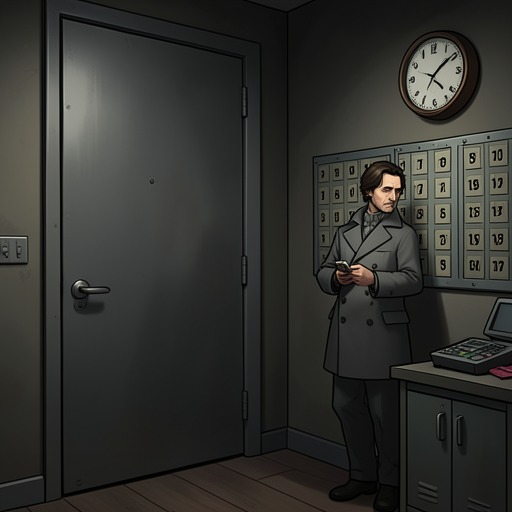
Floor Door
The Legend of William OhThe Floor Door is the Tower’s mechanism for crossing between floors, but it is never merely an architectural opening. It is a threshold controlled by the system, a possible prison, and a recurring test of whether a Climber can move forward despite terror. When Will finally steps through one after clearing a Key Site, the Door carries him into the ash-choked environment of the 3rd Floor and transforms advancement from an abstract reward into an immediate bodily ordeal.
Definition and Threshold Function
The Floor Door appears as an interdimensional doorway rather than an ordinary passage. After Will receives permission to advance to the 3rd Floor, an extra-large Door appears for the entire group, allowing the bus to pass through. Its scale reflects the practical demands of group advancement: it is not only a personal portal but also a route capable of accommodating a large party and its equipment. The Door is already being used by the bus when Will approaches, making the transition a collective movement even though his fear remains intensely personal.
The system’s language gives the Door an administrative function. Clearing the Key Site grants permission to advance, awards 300 XP, and leaves the timing of ascent to the Climbers’ discretion. The Door thus marks the boundary between achievement and consequence. It does not itself guarantee safety; it simply makes the next floor available. The system also warns that ascending or descending before the three-day Miasma Acclimation period can produce fever, bloodshot eyes, coughing, pustules, necrosis of the extremities, parasitic twin growths, and death. Crossing the Door opens access, but survival still depends on respecting the conditions of the floor beyond it.
The Door as Prison
Before Will uses the Door as a route upward, he experiences it as confinement. In the Class Creation Room, he is trapped inside a plain white room containing three Altars and no exit, a featureless cube from which there is no escape. Previous Aspirants have tried to break out, but the walls resist every force available to an Aspirant, including Relic weapons given to them by high-level Climbers. The possibility that bad luck could leave someone in the Class Creation Room until starvation exposes the Door’s threshold system as dangerously indifferent: advancement depends not only on courage or strength but also on whether an exit becomes available.
The memory remains attached to the Door even after Will escapes. When the system asks whether he accepts, a doorway opens in front of him, identical to the one that trapped him for two days. Will recognizes that, without luck, his corpse might still be inside that featureless box. The later Door is therefore physically similar to the earlier one but emotionally transformed by context. What appears to be an opportunity to advance also resembles the entrance to a space where a person can disappear, starve, and become unreachable.
Crossing into the 3rd Floor
The Door’s most important witnessed crossing occurs after the group clears the Key Site. Travis worries about the loot from the defeated Boss, whose corpse is still decomposing into neon-blue Miasma, but Will chooses to continue. He tells Travis that he may stay if he wishes, since Travis is not technically under Will’s command. The Decoy then runs after the others, and the group proceeds together. The Door organizes this decision: it separates those willing to leave from anything that remains behind, including unresolved treasure and the decomposing Boss.
Will’s body reacts before his judgment can settle the matter. He screeches to a halt, his heartbeat spiking, and remembers that he has already fallen backward through Doors three times. He attempts to reason himself past the fear by insisting that this Door is larger and therefore not the same thing, while psychologically distancing himself from the moment as though watching from the end of a long tunnel. The distinction is rationally weak but emotionally necessary. More dangerous monsters and terrain await beyond the threshold, yet remaining behind is no longer a viable answer. When Loth asks whether he is all right, Will says yes, swallows the animalistic terror in his throat, and steps through.
The crossing immediately replaces anticipation with sensory danger. Hot air slams into Will’s face, ash crunches beneath his feet, and caustic fumes fill the air. The sun hangs dim and blood-red overhead, tinting the landscape red. The system announces the 3rd Floor and imposes its acclimation period, so the Door’s promise of advancement arrives together with environmental hostility. The portal does not soften the transition between floors; it concentrates the contrast, carrying the group from the conditions of the cleared Key Site into a world whose atmosphere itself threatens the body.
Repeated Forms of Passage
The Door’s significance becomes clearer through the other spaces it separates. A cliff later reveals that Will and Loth are not standing on an ordinary mountain peak but on a floating mountain in the sky, isolated from surrounding land by open air and far above any recognizable ground. Such terrain makes ordinary travel impossible and heightens the importance of controlled thresholds. Elsewhere, the yeti spawning ground begins farther down a trail that turns inward toward a cavernous entrance to an extensive network of ice caves. The entrance functions as another kind of boundary, shifting movement from exposed mountain paths into a cold subterranean system formed beneath a mountain’s permanently shaded underside.
At the Stronghold, darkness presses against the settlement until only small pools of light remain at the city’s edge, maintained by man-sized beacons on the walls. A nearby patch of shadow offers an approach to the base of the wall, where an enterprising climber could begin ascending without being seen. Against this backdrop, the Floor Door belongs to a larger pattern of routes that regulate exposure, concealment, elevation, and access. The Tower’s geography is not continuous wilderness; it is a sequence of controlled or perilous thresholds in which every passage changes the rules of survival.
Narrative and Psychological Significance
The Floor Door turns progression into a confrontation with memory. Its repeated appearance makes it a recurring material reminder that the next stage may resemble the site of an earlier catastrophe. Will’s fear is not presented as a simple belief that the Door is dangerous; it is a bodily surge that arrives before language, producing panic, a racing heartbeat, and dissociation. His eventual movement is consequently not the absence of fear but a decision made while fear remains active.
The Door also exposes the Tower’s indifference to human scale. A system can award experience, authorize ascent, and generate a portal without guaranteeing that the person using it understands what lies beyond. The same mechanism can be a locked white cube, a group-sized passage, or the boundary of a toxic floor. Its meaning depends on whether it is encountered as exclusion, opportunity, or forced continuation. For Will, crossing the Floor Door into the 3rd Floor is both a concrete advancement and a psychological victory: he cannot make the threshold safe, so he must learn to pass through it anyway.