Greater Sting Ring
The Legend of William OhThe Greater Sting Ring is a high-tier combat relic whose value lies in the scale and immediacy of its offensive enhancement. It is presented as the hundred-gold alternative to lesser Sting Ring models, granting two points of Strength and a “great” amount of bonus acid damage. Its importance is therefore both mechanical and narrative: it is an object of conspicuous power that Will cannot afford, yet one that becomes central to the violent efficiency of his later fighting style.
Description and Capabilities
The Greater Sting Ring belongs to the same commercial line as the ordinary Sting Ring, but its price and effects place it well above the cheaper versions. Leon explains that a fifteen-gold model would increase Kinesthetics by one and add a “moderate” amount of acid damage, whereas the hundred-gold model grants two Strength and a “great” amount of acid damage. The distinction makes the ring more than a minor equipment upgrade. It represents a sharp trade between economic scarcity and combat potential: the stronger ring offers precisely the kind of improvement Will desires, but its cost places it beyond his means.
The relic’s offensive effect is not limited to a single conventional strike. When Will later uses the Tomahawk of the Serpent together with both Sting Rings, the Greater Sting Ring contributes an acid-damage buff that stacks with the other ring’s effect and the tomahawk’s psychic-damage area of effect. That stacking behavior is the ring’s decisive tactical property. It allows several independent sources of damage to reinforce one another rather than merely adding a small improvement to an isolated attack.
Acquisition and Transfer
Will first encounters the Greater Sting Ring as an object of frustrated desire. After Leon describes its hundred-gold price and superior Strength and acid-damage benefits, Will admits that he cannot afford it, even while openly yearning for what it could do. The scene establishes the ring as a luxury beyond Will’s immediate purchasing power and places its acquisition within the social economy of the climbing party rather than treating it as an ordinary shop purchase.
Loth resolves the impasse by sliding another ivory coin across the table and ordering the Greater Sting Ring from Leon. Her stated reason is that her Scout’s Strength is pitiful, but Leon hands the ring to Loth, who immediately offers it to Will instead. The transfer is therefore more significant than a simple transaction. Loth pays for the relic, yet chooses Will as its recipient, turning equipment into an expression of practical confidence, generosity, and leverage within their partnership.
Will accepts the ring with thanks and slips it onto his finger, feeling tingles spread through his body. The physical sensation marks the transition from merchandise to active equipment: the ring is no longer merely an expensive possibility displayed in a shop, but an incorporated part of Will’s combat body. Loth then jokes that the purchase means she owns him, while Will rejects the literal implication. The exchange preserves the material fact of her investment while making clear that the ring does not formally create ownership over him.
Use in Combat
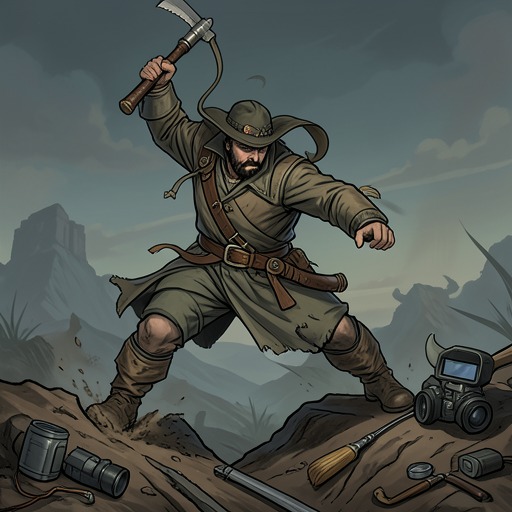
The Greater Sting Ring proves its worth during Will’s confrontation with the Kaith and Reaper. Will simultaneously triggers the Tomahawk of the Serpent and both Sting Rings, combining the ring’s acid damage with the tomahawk’s psychic area attack. The surrounding Kaith writhe in pain and burst into smoke as the effects stack, killing more than a dozen monsters with a single swing. The ring thus changes the scale of the encounter: what might have been a prolonged melee becomes a concentrated burst of area destruction.
The relic also operates within Will’s unusual use of the Phantom Hand. In the same broader combat pattern, Will can send the Phantom Hand to deliver ranged attacks, and his other equipment demonstrates that this remote extension benefits from relic-based enhancements. When the Greater Sting Ring is activated alongside the tomahawk and the second Sting Ring, its acid contribution becomes part of a layered attack system in which Will’s body, weapons, and Phantom Hand cooperate rather than remain separate tools.
Against Reaper, the ring’s power is potent but not absolute. Reaper avoids the point-blank attack from the Greater Sting Ring, showing that the relic does not guarantee a hit against a capable opponent. Nevertheless, another attack launched by the Phantom Hand strikes Reaper directly in the Achilles tendon, while Will keeps himself inside the scythe’s lethal range and continues swinging. The ring therefore belongs to a larger tactical arrangement: it creates overwhelming pressure, but Will must still manage distance, timing, evasion, and bodily risk.
Tactical and Narrative Significance
The Greater Sting Ring embodies the book’s recurring conversion of money into survival capacity. Will cannot purchase it himself, and his reaction to its price emphasizes the gap between the equipment he needs and the resources he possesses. Loth’s intervention closes that gap, but it also makes the relic a visible reminder that Will’s effectiveness can depend on other people’s resources and decisions. The ring’s power is personal once worn, yet its origin remains relational.
Its later deployment gives material form to the difference between ordinary equipment and a build-defining relic. The Greater Sting Ring does not merely make Will slightly stronger; paired with the other Sting Ring and the Tomahawk of the Serpent, it enables a compound attack that kills over a dozen Kaith in one swing and contributes to the pressure placed on Reaper. The ring’s narrative function is consequently twofold: it rewards Loth’s costly choice with demonstrable battlefield results, and it dramatizes how Will’s combat identity is assembled through combinations of abilities, weapons, and remote control rather than through raw strength alone.