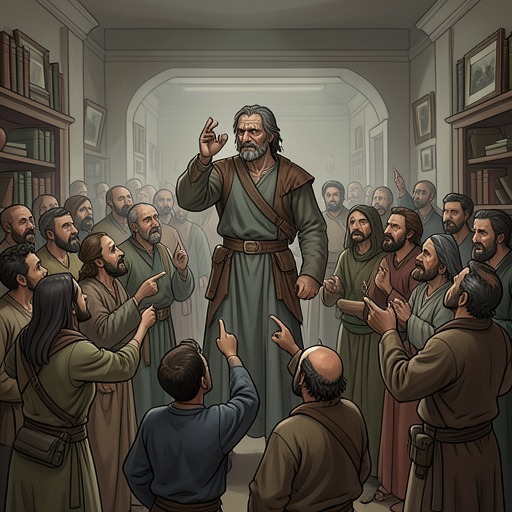
Have you heard of William Oh
The Legend of William Oh“Have you heard of William Oh?” is more than a question in the novel: it is Jason Salazar’s first tool for turning William Oh into a legend. Repeated in orphanage arrangements, tavern performances, public encounters, and later rumor, the phrase converts a living Climber’s deeds into portable publicity. Its apparent request for information is usually an invitation to hear a carefully shaped story, and its success depends less on factual accuracy than on the listener’s willingness to imagine who William Oh might be.
Origin as a Hype Man
Jason Salazar develops the expression as part of his agreement with William Oh, using his verbal talent to recruit attention and build William’s reputation. William gives Jason money with only a twenty percent expectation that the boy will spend it on becoming “big and strong,” but that small chance is also a chance of gaining a reliable team member. Jason’s value is not physical power alone: William specifically recognizes that he is good with words and has already demonstrated persuasive ability by obtaining five silver from a fellow orphan.
The arrangement therefore gives the phrase a practical foundation. Jason is not simply praising William for amusement; he is performing a job whose intended return is social capital. William even reflects on the usefulness of having a good hype man, while worrying that Jason might inherit his father’s tendency to disappear. The phrase begins as a transaction, but it also becomes an early experiment in whether reputation can create real companionship and opportunity.
The Formula in Performance
Jason’s pitch appears in an inn while he eats thick stew and searches for an audience. He first presents William as “the smartest, most talented, badass, stoic individual that this town has ever produced, bar none,” an extravagant chain of superlatives that leaves no room for modest comparison. When a priestess admits that she has never heard of William, Jason asks, “Have you heard about William Oh?” and lowers his voice before supplying a conspiratorial account.
The performance relies on escalation. Jason claims that some people say William descends from the gods, because nothing human could have accomplished the same feats. In another telling, he says that William was born on the Hundredth Floor and bathed in lethal Miasma, gaining abilities beyond human comprehension. The surrounding listeners challenge the literal plausibility of these claims, but their objections only give Jason another opening to continue. The story is designed to make William seem impossible before the audience has any reliable basis for judging him.
Jason repeats the exact question to another traveler in a leather hood, sliding into the empty seat and whispering conspiratorially. The recurrence reveals the phrase’s structure: it is a reusable opening, not a spontaneous remark. Each new listener is treated as an uninitiated audience, and each telling allows Jason to adapt the legend while preserving its central name.
From Publicity to Public Reality
The phrase eventually returns to William in a reversal that exposes how thoroughly Jason’s campaign has entered public circulation. After William has been released by the magistrate and believes that the Climbers associated with the incident will never return to the small village, he enters Brenda’s Inn, orders stew, and hears a voice ask the question as Jason Salazar slides into the seat opposite him. William smiles and answers that he honestly has not heard of William Oh.
The exchange is comic because William is the person being advertised, yet he temporarily plays the role of an uninformed customer. It also marks a shift in ownership. Jason began by asking strangers whether they knew William; now the phrase can introduce Jason’s own appearance to William, turning the publicity routine into a recognizable signature. William’s response acknowledges the absurdity without openly interrupting it.
The name has also become vulnerable to duplication. When William later identifies himself to a clerk, she says that he is the sixth William Oh to appear, then checks her records and determines that he seems to be the correct one before granting his quest reward. The joke depends on a reputation so visible that impostors can attempt to exploit it. The phrase has helped create a public figure whose name carries value independently of the person who bears it.
Rumor, Exaggeration, and Residual Truth
As William’s adventures accumulate, the promotional question no longer belongs only to Jason. In another inn, men trade competing claims about William’s abilities: one insists that William can turn into lightning through an Ability that creates a thundercloud, another says that he lost one hand to a witch’s curse and that the severed hand became a talisman bringing ill fortune to his enemies, and a third claims that William once ate a lightning bolt fired into his face by a Nuker. These stories are plainly exaggerated, but they are not random. They magnify recognizable elements of William’s public image into tavern mythology.
The rumor system therefore separates William from his own biography. A real feat becomes a transformation into lightning; a visible amputation becomes a cursed roaming talisman; survival in battle becomes the consumption of a lightning strike. Each retelling adds spectacle while preserving a fragment of the underlying reputation. The phrase functions as the threshold through which those inventions enter circulation: first comes the question, then the audience, then the legend.
Jason’s early story about William’s impossible ancestry and Miasma-born abilities follows the same pattern. The claims do not need to be verified to perform their social function. They make William memorable, give strangers a reason to keep listening, and create an expectation that his actions should exceed ordinary standards.
The Phrase as a Narrative Device
The recurring question establishes an unreliable public narrative around William Oh without making the novel’s central narration itself unreliable. Readers can distinguish between William’s actual experiences and the stories told about him, while still seeing how the stories affect his status. The phrase is thus both a comic refrain and a mechanism of world-building: it shows fame being manufactured in real time, passed from mouth to mouth, and detached from its source.
Its meaning changes through repetition. At first, it asks whether William is known. Then it becomes a summons to hear Jason’s sales pitch, a test of whether a traveler is a suitable audience, a greeting that identifies Jason’s presence, and finally evidence that William’s name has become valuable enough for others to counterfeit. The question’s grammatical openness is part of its power. It does not declare that William is famous; it invites the listener to discover that he supposedly is, while quietly assuming that the discovery deserves attention.
By the time strangers recount impossible stories about lightning, curses, and divine ancestry, “Have you heard of William Oh?” has outgrown its original speaker. Jason starts the legend with words, but the wider community sustains it through repetition, embellishment, skepticism, and imitation. The phrase’s decisive significance lies in that transition: it turns William’s reputation from a private promotional project into a social force capable of shaping how other people recognize, misrecognize, and evaluate him.