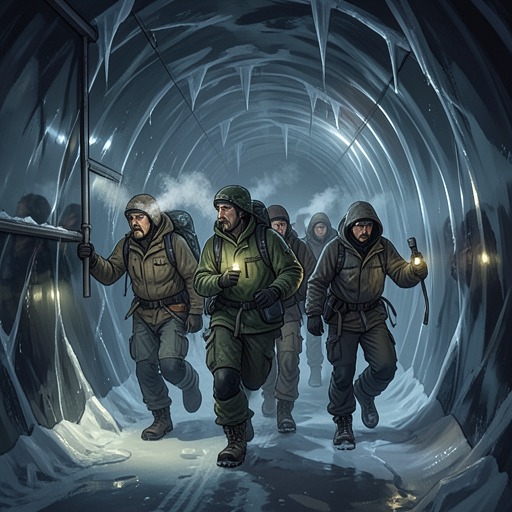
Ice Cave Hunting and Body Recovery
The Legend of William OhThe Ice Caves expedition is both a military-style clearance operation and a recovery mission. William Oh and Loth advance through territory defended by intelligent yetis, using traps, controlled retreat routes, and repeated ambushes rather than relying on brute force. The expedition’s most consequential discovery is the frozen body of Alicia Zodiac, a young Ranger and daughter of Lord Zodiac, whose preserved corpse is surrounded by valuable Relics but separated from its missing head. The event therefore joins survival, logistics, and salvage: progress depends as much on controlling space and securing a route home as on killing enemies.
Causes and Background
The expedition takes place within the wider upward movement through The Tower. After reaching level 5, Climbers receive reduced experience in the Hunting Grounds and the 1st Floor, making further advancement dependent on reaching the 2nd Floor. The System identifies established routes as slow but reliable, while clearing a Key Site offers a faster, more dangerous, and more rewarding ascent. That rule gives exploration a practical pressure: every difficult route can also be an investment in future progression.
The expedition inherits the logic of earlier missions. Nathan’s supply-line Quest had required new Climbers to enter a cave system used to move food toward the front lines, while emphasizing that the objective was destruction of the supply route rather than direct combat with the kaith. Later, when Nathan was expected to hold a bridge as a spearhead, the other Parties were ordered to withdraw, rest, and return with greater strength. These precedents establish the expedition’s central discipline: information, positioning, and the preservation of combat capacity matter more than an impulsive advance.
The route is also shaped by the infrastructure of The Tower. Strongholds can be built into floating mountains, protected by ballistae and patrolling soldiers, while mines expose layered deposits of quartz or salt. Elsewhere, the blank grey ceiling of The Tower reflects sunlight through ancient surfaces installed by Climbers thousands of years earlier. Such details make the Ice Caves part of a world where natural hazards, old engineering, military defenses, and supernatural systems overlap; the expedition is never simply a journey through wilderness.
Yeti Tactics and the Expedition’s Method
The yetis have basic intelligence and repeatedly arrange ambushes around expensive equipment left behind by an earlier group. Their behavior initially makes every promising discovery dangerous, because valuable gear functions as bait. Yet the pattern becomes predictable. William Oh and Loth respond by turning the enemy’s repeated method against it: they trap a location, push deeper, empty it of threats, establish a new trap, and continue forward while making certain that their retreat is protected against pursuit.
This rhythm changes the expedition from a sequence of isolated fights into a controlled advance. The yetis remain dangerous, but their intelligence becomes legible, and legibility creates an advantage. The pair’s success comes from repeatedly converting the same threat into usable information. Corpses of yetis caught in snares hang along the route, slowly decomposing into pale-blue Miasma, marking the physical cost of the operation and the extent to which the cleared path has become a managed corridor.
The expedition’s value is measured not only by what it kills but by what it allows others to do afterward. Several hours into the operation, the group has recovered four of the six corpses on its list and turns back. Because Loth has secured the return route, the journey to the surface is fast and comparatively simple. Mason Lanover and June, who had worried about the Charge required to fight their way out, are astonished by the ease of the departure; most yetis encountered on the way back are already dead or severely injured. The retreat demonstrates that preparation has altered the meaning of the battlefield: the same Ice Caves that threatened to consume the expedition now contain a route the party can traverse with confidence.
Alicia Zodiac’s Recovery
The expedition’s most consequential discovery begins when Steve Holland finds the faintest shadow in the ice and asks for heat. Loth hangs one of his personal heaters from a chain beside the obstruction, and as the hoarfrost melts, a crystal-clear surface of pure ice reveals a perfectly preserved young woman in Ranger gear. Her bow remains suspended beside her, and Relics cover nearly every part of her body; only her head is absent. Steve identifies her as Alicia Zodiac, the daughter of the famed Lord Zodiac, transforming an apparently valuable find into the remains of a politically significant Climber.
The recovery immediately becomes an engineering task conducted under threat. Steve chips at the unnaturally sturdy ice for half an hour while William Oh and Loth watch for approaching yetis. The bow, positioned several yards from the body, enlarges the area that must be freed, and the missing head is eventually located roughly three meters away, also bearing a Relic. After an exhausting amount of chipping, the main corpse is separated from the wall as a single stiff block of ice. Loth slides Alicia Zodiac out into the sunlight and begins the detailed work of freeing her, while William Oh works toward the head and Steve retrieves the bow.
The scene’s salvage logic is inseparable from its unease. Alicia Zodiac is preserved almost as an inventory of valuable equipment, yet the missing head resists any simple interpretation of the body as merely recoverable loot. The party’s decision to continue through the Ice Caves after securing the remains keeps the expedition’s practical objective in view: several hours later, four of the six corpses on their list have been recovered, and the group turns back along the route Loth has made safe. The return converts the recovery from an isolated discovery into part of a larger retrieval operation, while the separation of Alicia Zodiac’s body, head, and bow leaves the expedition carrying both material gains and an unresolved mystery.
Operational Significance
The Ice Caves expedition also clarifies how advancement in The Tower turns exploration into a problem of logistics. Once level 5 is reached, experience in the Hunting Grounds and the 1st Floor is reduced, and Climbers must seek the 2nd Floor either by following established routes or by clearing a Key Site to open an inter-floor Door. The former is slow, safe, and reliable; the latter is quick, dangerous, and rewarding. That contrast gives the expedition a strategic context beyond corpse recovery. A route through hostile territory can become an investment in ascent, provided the party can survive the initial danger and preserve a usable line of retreat. The operation’s repeated cycle of trapping, advancing, clearing, and securing the way back therefore resembles a campaign of controlled territorial acquisition rather than a simple hunt.
The same principle governs earlier and later operations in the surrounding narrative. Nathan’s supply-line mission separates its objective from direct combat, directing new Climbers toward the destruction of food movement rather than a confrontation with kaith forces at the front. At the bridge, Nathan is expected to serve as the spearhead while the remaining Parties withdraw, rest, and return with greater strength. At the Stronghold, military infrastructure appears as a practical extension of terrain: ballistae guard the edge of a floating mountain, soldiers watch for kaith invasion forces and flying threats, and exposed quartz or salt gives the fortified mine economic value. Even the later plan against the fire-mote swarm depends on assigning separate roles, with Travis drawing the swarm away while the others rig the water tanks to explode. Against this background, the Ice Caves method represents a recurring doctrine: assign the danger, control the route, exploit the environment, and make the return part of the mission from the beginning.
The expedition also shows how knowledge is produced through repetition. The yetis’ ambushes around abandoned equipment first make every valuable object suspect, but their predictability allows William Oh and Loth to read hostile behavior as a pattern. Each cleared location becomes both a safer position and a source of information about what the enemy will do next. The snares containing decomposing yeti bodies, already dissolving into pale-blue Miasma, make that knowledge visible. They are not merely evidence of victory; they mark the route as transformed by deliberate action, a temporary corridor cut through an intelligent defense system. Loth’s earlier use of controlled insects and luminous glowbug markings in the kaith caves belongs to the same practical imagination: small, manageable systems can map darkness, reveal danger, and substitute for force where force is costly.
In this sense, the recovery of Alicia Zodiac is the expedition’s sharpest reversal. The party enters an environment where expensive gear is used as bait, expecting every discovery to conceal a threat, and instead finds a valuable body whose preservation is itself an obstacle. Heat, chains, tools, watchfulness, and coordinated labor are required to expose and remove what the ice has held intact. The operation does not resolve the circumstances of Alicia’s death or explain why her head was separated from her body. It does, however, place her remains within the party’s wider system of retrieval: the expedition ultimately has four of the six listed corpses and can carry them toward the surface because the route has been engineered in advance. Survival and salvage thus become inseparable. The dead are recoverable only when the living have made the path home secure.
Narrative Significance
The Ice Caves expedition is a rescue-and-clearance episode in which victory depends on making hostile space intelligible. Its most revealing contrast is between the apparent wildness of the caves and the precision of the party’s response: yeti ambushes, deep ice, missing remains, and unstable routes are met with traps, heaters, cutting tools, marked passages, and an organized withdrawal. The event therefore extends a larger pattern in The Tower, where ancient infrastructure and present-day Climbers constantly reshape one another. A plain satchel may conceal a subtle enchantment that keeps its balance and weight, a ceiling may be an engineered reflector installed thousands of years earlier, and an emergency hatch may survive after an iron ladder has dissolved; in the Ice Caves, the same world makes preservation itself into an obstacle. Alicia Zodiac’s body is not simply found. It must be technologically and tactically recovered from a medium that has protected it, divided it, and surrounded it with the danger of renewed attack.
The expedition’s dominant plot forms are discovery, rescue, pursuit, and escape, but none operates in isolation. Discovery reveals Alicia Zodiac’s identity and the valuable Relics encasing her; rescue requires freeing her body, head, and bow; pursuit remains an ever-present possibility because the yetis defend their territory with intelligence; and escape succeeds only because the return route has been secured before the party turns back. The result is a reversal of ordinary adventure logic. Progress does not culminate in reaching the deepest point. It culminates when the party can leave with what it came for. Four of the six listed corpses are recovered, and the journey home becomes fast and comparatively simple because Loth has already converted the route from a threat into a passage. In that sense, the expedition defines advancement not as distance traveled but as danger successfully reorganized.
Alicia Zodiac’s preserved remains also widen the event beyond immediate survival. Identified as the daughter of Lord Zodiac, she connects a dangerous salvage operation to the social and political world surrounding the Climbing system. Yet the recovery offers no complete explanation: her head lies roughly three meters from her body, and the narrative leaves the circumstances of her death unresolved. That incompleteness gives the expedition a lasting afterimage. The party secures bodies, equipment, and a route to the surface, but not the knowledge that would make the dead fully legible. The Ice Caves therefore function as both battlefield and archive: they yield practical resources and partial historical evidence, while reminding the living that every successful retrieval may expose another question.