Indentured Servitude
The Legend of William OhIndentured Servitude is the condition created when a person accepts a Lord’s investment in exchange for a fixed term of labor. In the climbing economy of The Tower, it can provide access to a valuable non-combat Class and rapid advancement, but it also binds the beneficiary to the Stronghold that financed the arrangement. The system presents service as a route to expertise and eventual independence while exposing the worker to the same dangers that make the contract profitable for the Lord.
Definition and Contractual Structure
Indentured Servitude is described through the practice Will observes at Skyhold. A person supplies rare Sacrifices, receives a valuable non-combat Class through a Class Trial, and is then advanced by veteran Climbers until reaching the floor occupied by the sponsoring Stronghold. In return, the person works for the Lord for ten, fifteen, or twenty years. The arrangement therefore joins three transactions that might otherwise remain separate: the purchase of a Class, the purchase of accelerated leveling, and the later extraction of labor.
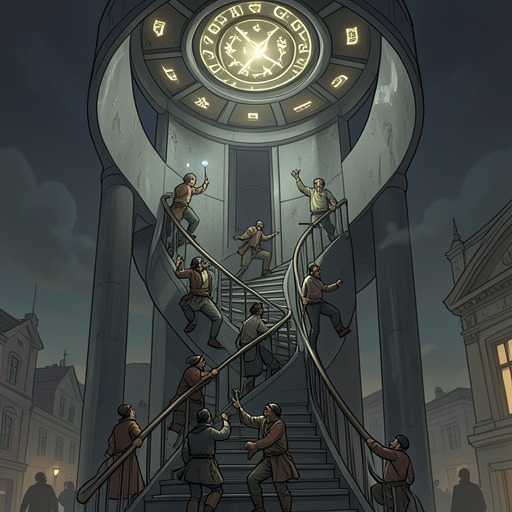
The advancement component is known as a Bus. Will explains that a Lord’s veterans can bus a newly created specialist upward, allowing someone with little combat experience to reach a Stronghold’s level quickly. The benefit is substantial because ordinary advancement becomes less efficient after level five: The System reduces experience gain in the Hunting Grounds and the 1st Floor, making a journey to the 2nd Floor necessary for continued growth. Established routes offer a slow, safe, reliable ascent, whereas clearing a Key Site offers a dangerous but faster route. A sponsored worker can bypass much of that difficulty through the Lord’s organized resources, but the resulting speed is purchased with future labor.
Dependence and the Promise of Freedom
Will presents the arrangement as indentured servitude rather than softening its coercive character. He also notes that its defenders describe a more favorable long-term outcome. After the term ends, a non-combat Class may possess highly valued skills and be able to charge independent Strongholds whatever it wants. In that optimistic account, service is an apprenticeship: the Lord supplies the rare opportunity and logistical support, while the worker eventually emerges with expertise powerful enough to command a high price.
The promise is weakened by the worker’s physical and economic dependence on the sponsoring Stronghold. Non-combat Classes are placed far outside their recommended Floor when they are bused upward, and some of them are killed because they are not suited to the dangers of the level where they have been assigned. Even survival does not guarantee practical freedom. Loth argues that such workers may struggle to leave after their terms expire because descending through The Tower is also hazardous and their Classes are poorly adapted to climbing back down. Their inability to relocate leaves them in an unfavorable bargaining position, so the formal end of the contract may not produce genuine independence.
Strongholds, Logistics, and Risk Transfer
The arrangement depends on the material infrastructure of Strongholds. Skyhold is built into a floating mountain and includes a salt mine, ballistae along the exposed edge, and soldiers watching for kaith invasion forces or flying threats. Its resources make it a plausible sponsor for laborers who can manage production, administration, or other non-combat work, even though the salt mine itself is not on a high enough floor to require a Lord. The Stronghold’s defenses and elevation are therefore not merely scenery: they are part of the package that gives the contract its value and makes departure difficult.
The same logistical system distributes danger unevenly. A Lord can use veteran Climbers to transport a specialist upward, while the specialist bears the risk of functioning in an environment beyond the Class’s recommended level. The contract makes this risk appear manageable by converting it into a schedule of service and a promised future wage, but the worker remains the party most exposed when the arrangement fails. Will’s casual admission that some specialists are “squished” punctures the idea that the Bus is simply an efficient career path.
This broader economy is visible in the organization of quests as well. Nathan serves as the babysitter for a group of new Climbers assigned to destroy kaith supply lines, while the veterans are expected to hold dangerous positions and less experienced participants are directed away from direct combat. Later, Will and Loth plan an attack on the Tangled by sending Travis to lure the fire-motes while the others rig water tanks to explode. These operations show why logistics, transport, engineering, and specialized labor become increasingly important as parties grow larger. Indentured Servitude is one institutional answer to that need: it supplies scarce expertise by making access to advancement conditional on long-term obedience.
Political Interpretation and Significance
Will initially repeats the explanation that powerful non-combat Classes eventually take over the leadership of lower-floor Strongholds, allowing Lords to continue climbing higher and helping humanity advance through The Tower. Loth rejects this as propaganda produced by people who want slaves to pledge themselves willingly. His objection shifts attention from the contract’s stated benefits to the structure that produces consent: a Lord controls access to rare Sacrifices, Class creation, veteran transport, and a defensible Stronghold, while the worker must accept years of service to obtain them.
The concept is closely connected to the story’s wider treatment of sacrifice and institutional pricing. A thumb-sized piece of pemmican is consumed by the Class Trial altar as an insufficient Sacrifice, producing no Class Seed. At the Temple of Andover, restoration of Will’s limb requires an agreed sacrifice of fifteen hundred gold, while a priest’s stated retail value can reach fifteen thousand gold at level thirty-five. Contracts are sealed as enforceable obligations, with twelve active Contracts displayed after one agreement and the warning that breaking one will cause the signatory to die. Against this background, Indentured Servitude is not an isolated labor custom; it belongs to a world where advancement, healing, religious service, and bodily survival are all converted into priced obligations.
Indentured Servitude consequently exposes the contradiction at the heart of The Tower’s progress. The system may genuinely create skilled specialists and help Strongholds function at higher levels, yet it advances the collective enterprise by transferring danger and dependence onto people whose access to power is already limited. Its language promises mobility, expertise, and eventual bargaining strength. Its actual conditions bind workers to the infrastructure that made them valuable, making freedom a future claim that can be delayed, priced, or rendered impractical by the very ascent the contract was meant to enable.