June
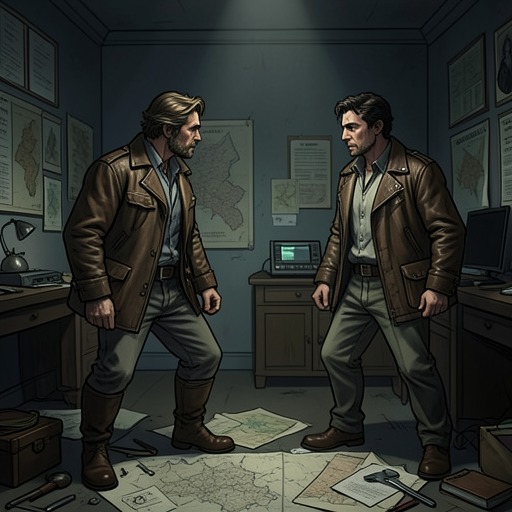
The Legend of William OhJune is the Scout whose vigilance and field judgment give her Party an indispensable tactical edge. She is introduced not through abstract description but through movement, observation, and command: she notices danger before the others, controls the group’s pace, crosses difficult terrain with practiced skill, and makes hard decisions when hesitation would cost lives. Her role is therefore larger than reconnaissance. June is the person who converts information into action, and her presence repeatedly changes whether the group advances, retreats, or survives.
Identity and Introduction
June’s formal role is Scout, a Class centered on awareness and mobility. When the expedition reaches a dangerous underground passage, she raises a hand and peers ahead before asking whether the lantern should be covered. Her caution is practical rather than timid. A bell proves to be an alert rather than an immediate attack, but June insists that the group assume its approach has been detected; she then creeps into the darkness to investigate before returning with information for the others.
Her introduction also establishes a contrast between expertise and bravado. June remarks that a man may have been attractive while still being someone she would beat for the right price, a dry comment that presents her as unsentimental about charm, danger, and violence. She later explains that Peggy was less interested in the truth than in having an excuse to admire someone. June’s social judgments are as brisk as her tactical ones, and both are expressed through a refusal to indulge foolishness.
Fieldcraft and Tactical Authority
June’s competence becomes visible in the expedition’s physical obstacles. After Loth throws a rope across a gap, June is the last person to cross and does so with significantly greater skill than the first two travelers. The sequence makes her Scout identity material: she does not merely possess information about the route; she can move through the route efficiently and safely. She subsequently agrees to watch the group’s backs while Loth and William Oh take the front, accepting responsibility for the vulnerable direction without needing to claim the most conspicuous position.
Her judgment is especially clear when the expedition encounters a pit and a dangerous enemy beyond it. June helps organize the recovery of a fallen companion, proposes hauling him up, and orders that the route behind him be burned. When Mason Lanover is endangered, she recognizes that the threat cannot be met directly and pulls him backward, warning that they will not survive running into it. After Reggie’s shield creates temporary breathing room, June communicates the situation without softening it: Reggie is buying time, but a teammate is dead, so the retreat must be cleared and prepared for his continued advance.
The same pattern appears later in larger combat. June shouts that a fallback point has been established at the next choke point and orders the others to move. When the Warriors break away and sprint toward the group, she remains behind long enough to pick off anything that follows them. Her actions give retreat a structure: the group does not simply flee, but moves from one defensible point to another while June controls pursuit. The Scout’s value lies in this management of space, timing, and attention.
Relationships and Party Leadership
June’s authority is practical and situational. William Oh observes that Mason Lanover is not actually the leader of the Party and concludes that June had made most of the decisions during the crisis. The distinction matters: formal leadership and effective leadership are not identical. June does not need a declared title to determine the group’s immediate course when the environment becomes dangerous.
Her relationship with Mason Lanover is marked by professional parity. Mason and June have among the highest Acuity in the group, making them its principal eyes and ears. At that stage they are evenly matched, although William Oh understands that June’s Class will probably develop enhancements that eventually place her ahead of Mason in perception. Her ability is therefore not static; the story presents her present competence alongside the prospect of future specialization.
The exchange over employment further clarifies her independence. Mason Lanover praises Loth’s contribution and begins to offer him a position as a Scout, but June immediately objects from the front of the line. Her interruption is comic, yet it also protects the distinctiveness of her role. The Party already has a Scout, and June is unwilling to let that position be treated as an open slot merely because another capable climber has appeared.
Change, Survival, and Narrative Function
June’s trajectory is defined less by a single transformation than by repeated confirmation under escalating pressure. She begins as the person who covers a lantern, checks an alarm, and scouts ahead; she becomes the person who coordinates a retreat, protects the rear, and identifies the difference between a recoverable setback and a fatal engagement. Even apparently minor tools and spaces become part of her tactical network: the warning bell, the lantern, the rope, the pit, the tunnel, and the choke point all acquire meaning through her decisions about how the group should use them.
Her presence also exposes the gap between the System’s formal categories and the lived reality of a Party. System prompts announce abilities and quests, while the expedition’s survival depends on a human being noticing a threat, interpreting a signal, and making others move. June’s Scout Class supplies a framework for her strengths, but her narrative importance comes from judgment within that framework. She is not merely an interface label; she is the agent who turns an ability into coordinated survival.
When the group reaches the surface through an emergency escape hatch, June helps Mason Lanover and Reggie climb up and asks where Nathan is. The question arrives after exhaustion, danger, and loss, preserving her attention for the missing member even after the immediate escape has succeeded. Later, she is seen with Reggie and a dozen unfamiliar Climbers, and she continues to function as an active tactical presence rather than a figure confined to the original expedition.
Narrative Significance
June’s defining tension is between visibility and control. She is not always the person at the front, yet she repeatedly determines what the front means; she may watch the rear, but that position becomes the hinge on which the group’s survival turns. Her sharp advice about not trying to control whom others admire also reflects her broader method: she does not waste effort controlling what cannot be controlled. Instead, she reads conditions, accepts unpleasant facts, and acts on the small portion of events that remains governable.
That discipline makes June one of the clearest embodiments of competent adaptation among the Climbers. Her scenes move from warning to interpretation, from interpretation to command, and from command to consequence. The recurring value shift is from apparent safety to imminent danger and back toward conditional survival, never through miraculous certainty but through preparation, positioning, and sacrifice. June’s importance lies in making that process legible: in a world where monsters, terrain, Class development, and System rules all exert pressure, survival belongs to the person who sees the change first and gives everyone else a direction.