Kaith Bridge Fighting Retreat
The Legend of William OhKaith Bridge Fighting Retreat is the decisive reversal of the Kaith supply-line expedition: the Climbers enter the cavern system to sabotage enemy logistics, but are forced to abandon the bridge and flee when the Kaith attack in force. The action matters because survival depends not on winning the position, but on converting a collapsing battlefield into a sequence of controlled escapes. William Oh protects the retreat, Loth transforms insects and rope into weapons, and the Party reaches the suspended route through a combination of sacrifice, improvisation, and relentless movement.
Causes and Tactical Situation
The operation begins as a logistics mission rather than a battle for conquest. Nathan, the veteran responsible for the new Climbers, explains that the cave system is being used by the Kaith to move food toward front lines where higher-level Climbers are fighting. The assigned objective is to find and destroy those supply lines, explicitly avoiding a direct confrontation with the Kaith. The expedition therefore enters the tunnels with a limited purpose and an unfavorable strategic position: the enemy’s workers and transport network are close at hand, while the strongest Kaith warriors are expected to be engaged elsewhere.
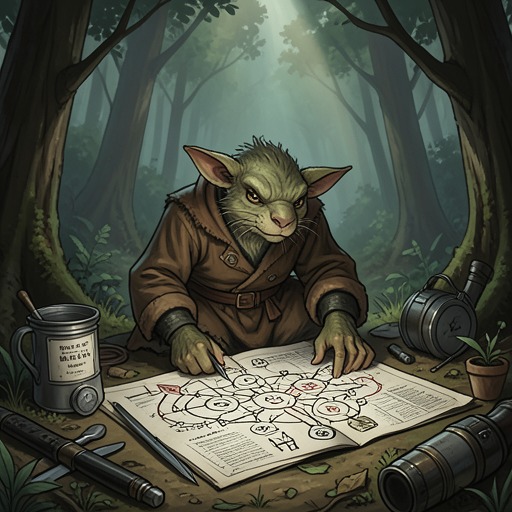
The cavern search is divided into seven groups, but the branching tunnels quickly scatter the expedition. Loth’s preparation gives the scouting party a modest information advantage. A bucket-sized barrel filled with soil and food scraps houses dozens of insect species under his control, and he marks every turn with glowbug juices so that the group can retrace its route through the darkness. Those details establish the retreat’s central logic before the fighting begins: the Party survives by treating the environment, its equipment, and Loth’s insects as part of its operational network rather than as passive background.
The bridge becomes the immediate tactical problem. Nathan is supposed to spearhead the defense while the others determine how to destroy it, but the plan cannot be completed safely. The group instead decides to return to the surface and bring Nathan back the next day with the remaining Parties, allowing everyone to rest before trying again. The proposed withdrawal is already a concession: the bridge is not secured, the supply line remains active, and the veteran must be recovered rather than supported in place.
Collapse into Retreat
The retreat begins when Loth throws glowbugs down the ledge and their light reveals smooth, rounded Kaith climbing directly up the wall. The warning converts uncertainty into immediate flight. The Party knows that being slowed on the narrow ledge would allow the Kaith to surround them one by one and add their bodies to the supplies moving toward the central hive. June runs first; Mason abandons his cultivated noble composure and scrambles for traction; Reggie’s heavy armor becomes a liability when an oversized pauldron catches on the rock and sends him teetering over the edge.
William Oh keeps the formation from losing a member at that moment. He plants his feet, slams Reggie back against the wall, and barely restores the Tank’s balance. The rescue costs time, but leaving Reggie would destroy the Party’s ability to withdraw as a unit. Loth then climbs over both of them and uses sticky glowbugs to illuminate the route, accepting the danger of exposing their position because the battle is already underway. His insects provide more than light: buzzing creatures with vicious stingers emerge from the bottom of Loth’s barrel and attack the Kaith’s eyes, forcing the monsters to flinch and scrape at their faces.
Reggie responds to the practical demands of movement by tearing away his left pauldron and throwing it behind him. The armor that was meant to protect him has become an obstruction, so he discards it without stopping. This small act mirrors the larger tactical shift: the Party abandons anything that cannot serve the escape. The withdrawal is not orderly in appearance, but each person adapts to the same imperative, turning armor, light, insects, and cliffside footing into temporary instruments of survival.
William Oh’s Counterattack
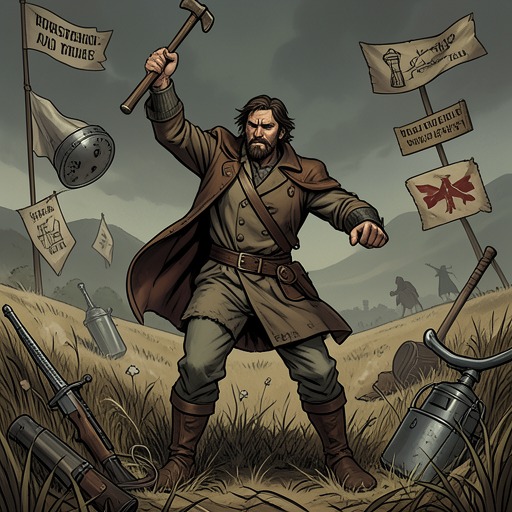
William Oh does not merely run. When a fire mote detonates behind him and briefly illuminates the chasm, he sees Kaith climbing beneath Mason and preparing to wedge themselves between the vanguard and the Nuker. He draws his tomahawk and runs along the sheer wall, trusting Aspect of the Goat to provide footing. He arcs over Reggie and Mason, jumps from the wall, and lands feet-first on the leading Kaith, driving the blade between its mammalian eyes.
The strike becomes a relic assault. As air passes through the fang holes in the tomahawk, the weapon produces an unsettling chord that rises as William Oh descends. He instinctively spends a Charge, leaving three of four Charges remaining. The sound then expands with physical force, driving the surrounding Kaith backward and sending them writhing, smoking, and falling from the wall. The attack briefly restores space to the retreat, but it does not reverse the larger situation. William Oh’s power creates an opening; it does not make the Party strong enough to hold the bridge or defeat the entire force.
His counterattack also shows the emerging shape of his combat style. He uses unusual terrain as a path, turns a relic’s acoustic effect into area control, and accepts a dangerous leap because the enemy’s position threatens the group’s escape. The maneuver is simultaneously rescue, delay, and demonstration: the lowest-margin action becomes valuable precisely because it buys the others a few seconds of movement.
Loth’s Engineering of Escape
After recovering the ledge, William Oh helps the slower members move ahead while Loth throws him a silk rope. William Oh secures it, and Loth stretches the line tight before attaching a metal trigger from his pouch. He then slides a leather box along the rope, transforming it into a trap studded with poisoned blades. The device turns the route itself into a weapon, allowing the Party to flee without needing to stop and fight every Kaith that reaches them.
The trap proves effective almost immediately. When a mass of Kaith flows past the concealed mechanism, the silk snaps forward and sends them tumbling into the darkness; some twitch as glittering metal fragments lodge in their bodies and septic shock takes hold. Loth takes satisfaction in the result, describing it as nearly a dozen enemies removed by a trap assembled in roughly five seconds. His pride is not ornamental. The trap demonstrates that preparation and mechanical leverage can compensate for the Party’s inability to win through direct strength.
Loth’s escape work continues even when it costs him personal dignity and comfort. William Oh picks him up and carries him like luggage, surprised by the weight of the kobold’s equipment. William Oh then throws him toward the suspended rope. Loth flails in midair but catches the rope and scrambles upward, keeping pace with June. A moment later, the Scout and Saboteur are above the others, clearing the way for the retreat. Reggie, meanwhile, carries both the Nuker and his own full armor up the rope without visible strain, while Mason fires from Reggie’s shoulder. The escape therefore becomes a relay of specialized capacities: Loth scouts and traps, William Oh protects and transports, Reggie supplies brute force, and Mason contributes firepower while being physically carried.
Consequences and Significance
The immediate result is a fighting withdrawal rather than a successful bridge assault. Nathan remains the veteran who is meant to hold the position, while the others return toward the surface with the intention of bringing him back with additional Parties after a night of rest. The supply-line objective is postponed, not abandoned, and the Party’s survival preserves the possibility of returning with a stronger and better-rested force.
The episode establishes a recurring contrast in the wider climb. The System later identifies clearing a Key Site as the dangerous but rewarding way to open an inter-floor Door, while established routes are slower, safer, and reliable. Likewise, the Party’s progress depends on choosing when to press forward and when to retreat. Even the fastest route between floors can involve following a bus and assisting in its Key Site operation, but Climbers who have not completed acclimation or reached the proper level risk making speed destructive rather than advantageous. The bridge retreat embodies that principle at ground level: advancement is meaningful only if the climbers remain alive to use it.
The action also foreshadows the book’s broader interest in infrastructure and logistics. The Kaith are dangerous not only because of their bodies, but because they possess a functioning network that moves food toward a central hive. The Climbers answer that network with their own: marked tunnels, controlled insects, a rope route, a relic weapon, improvised firepower, and coordinated carrying. Victory is temporarily redefined from destroying the enemy to preserving the group’s ability to return. In that sense, the retreat is not the opposite of progress. It is the method by which progress remains possible.