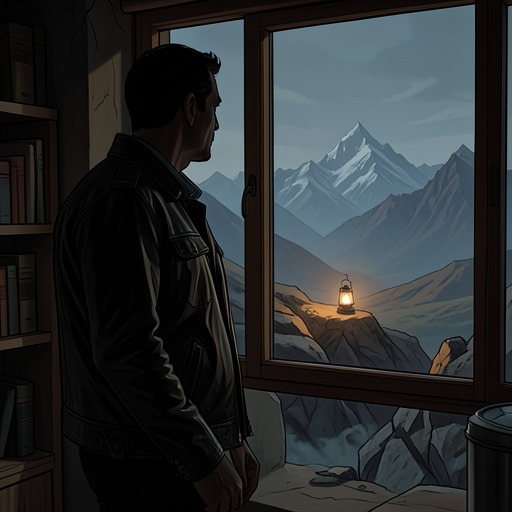
Knowledge is Pain, Power, and Purpose
The Legend of William OhKnowledge is Pain, Power, and Purpose names a central paradox in the story: understanding is not presented as simple liberation, but as an ordeal that can make continued action harder even while making action meaningful. Its decisive significance lies in the movement from painful recognition to deliberate purpose, embodied in Will’s discovery that an apparently happy life on the Seventh Floor conceals a danger that cannot safely be ignored.
Meaning and Form
The expression joins three consequences of knowledge rather than treating them as separate stages. Knowledge is pain because it removes an easier, more comforting interpretation of reality. It is power because the person who understands a hidden condition can respond to it rather than remain governed by ignorance. It is purpose because understanding supplies a direction when existence otherwise feels directionless. The phrase therefore holds together an apparent contradiction: the same insight that causes suffering also creates the possibility of meaningful choice.
The wording is especially forceful because its final term does not cancel the first. Purpose is not offered as a cure that makes knowledge painless. Instead, pain becomes part of the route by which direction is found. The expression’s structure turns cognition into an active burden: to know is to suffer the loss of illusion, acquire leverage over circumstances, and accept responsibility for what that knowledge demands.
Knowledge as a Wound
Near the end of the narrative, Will learns something sufficiently dangerous that revealing it to the suspected person could trigger the Contract and force her to try to kill him and his companions. The practical consequence of knowing is immediate restraint: secrecy becomes necessary, not because the truth is unimportant, but because disclosure could activate lethal compulsion. Knowledge thus creates danger as well as warning.
Will’s reaction makes the emotional cost explicit. He says that he wishes he had never figured it out and would rather have imagined her happy and baking nonstop on the Seventh Floor. The imagined picture of domestic happiness is comforting precisely because it avoids the concealed truth. Once that picture can no longer be believed, ignorance becomes something he can nostalgically desire, even though it would leave him less prepared to survive.
From Recognition to Purpose
Loth responds to Will’s distress by placing a hand on his back and explaining that being intelligent and knowing things can be painful, but can also provide direction in a directionless existence. Her response does not deny the pain or promise that the knowledge will lead to safety. It reframes the discovery as a source of orientation: the truth identifies what must be done when passive hope and pleasant appearances are no longer adequate.
That movement culminates in Loth’s blunt proposal to kill the Wyrd family. The proposal converts abstract understanding into a concrete objective. The danger revealed by knowledge is not left as private anguish; it becomes the basis for a decision and an action. In this scene, purpose is therefore not imposed from outside. It is produced by recognition, even when recognition is unwanted.
Narrative and Thematic Significance
The expression functions as a compact statement of the story’s moral logic. Comfort depends on not knowing; survival depends on knowing; meaningful action begins when the character accepts what knowledge makes necessary. The sequence also gives the phrase a distinctly relational form. Will experiences the discovery as a burden, while Loth helps him interpret that burden as direction, and her physical reassurance accompanies the intellectual argument.
Knowledge is consequently neither a purely heroic possession nor a purely destructive one. It exposes lethal contracts, dismantles reassuring fantasies, and forces difficult choices, but it also prevents directionless existence from remaining directionless. The expression’s power comes from preserving all three terms at once: pain is the cost of seeing clearly, power is the practical advantage of that clarity, and purpose is the obligation that follows from it.