Kobold
The Legend of William OhKobolds are a nonhuman people associated with traps, subterranean movement, improvised technology, and an unusually intimate command of insects. The book first presents them through Loth, a small, hooded figure whose obsidian-scaled muzzle and emerald-like eyes mark him as immediately alien to William Oh, but whose resourcefulness repeatedly proves more valuable than the prejudices directed at his kind. By the later stages of the story, Kobolds are not merely monsters encountered in dangerous spaces: they are organized fighters, potential allies, and participants in The Tower’s systems of recognition and service.
Identity and First Appearance
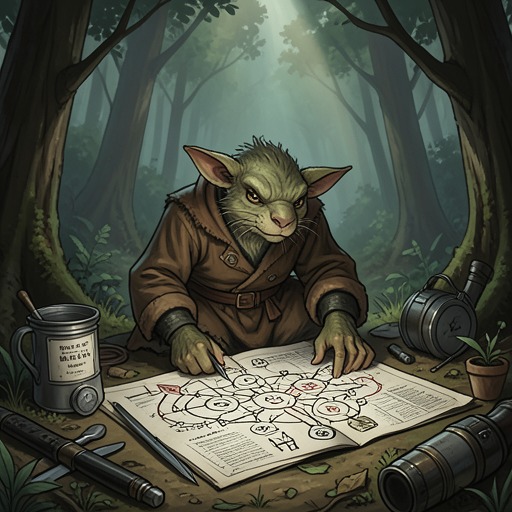
A Kobold first enters the narrative as a short figure in a leather cloak, standing beside a barrel nearly as large as its body. When the deep hood is lifted, the creature is revealed to have taloned hands, an obsidian-scaled muzzle, and eyes compared to emerald gemstones. The visual introduction emphasizes concealment and strangeness, while the barrel hints that the Kobold’s apparent smallness conceals a substantial store of equipment and living resources.
William Oh immediately identifies the figure as a Kobold and associates the species with the land on the opposite side of The Tower. His first response is geographical as much as racial: the creature appears to belong elsewhere, outside the space where the Climbers expect to encounter one of its kind. The exchange also establishes the central stereotype attached to Kobolds. William Oh assumes that they like traps; Loth corrects the assumption by explaining that Kobolds do not merely enjoy traps but live through them. The difference is important. Traps are not a hobby or a gimmick for Loth. They are a mode of habitation, defense, communication, and survival.
Loth and Kobold Ingenuity
Loth’s barrel is a miniature ecosystem as well as a field kit. A bucket-sized container of soil topped with food scraps houses dozens of insect species, all of which Loth controls with ease. He keeps feeders that consume almost anything and convert food scraps into more of themselves, making them useful as compact field rations and as nourishment for the other insects. The arrangement turns refuse into food, food into organisms, and organisms into a portable supply network.
The insects also function as medical and combat tools. Loth keeps silk-striders, wood-worms, venomous Gnatters, Pics, and ticks, including varieties that either coagulate blood or make it flow freely. Other insects carry flesh-eating bacteria. If bleeders and barbs are crushed onto a blade, even a tiny nick can become a wound serious enough to require a Healer, and to require that intervention quickly. Loth therefore carries not one weapon but a flexible biological arsenal: his supplies can feed a party, alter a wound, disable an opponent, or create a medical emergency from an almost invisible cut.
The barrel contains still more specialized uses: gillies, sweeteners, masks, firestarters, poppers, and glowbugs. Loth’s knowledge is practical rather than ornamental. Each species is selected for a task, and the collection functions as a compact vocabulary of concealment, signaling, ignition, distraction, sustenance, and sabotage. His expertise makes the Kobold body and its surroundings into an extension of the trap-maker’s workshop.
Loth can also deploy his insects with extraordinary speed. He releases a domesticated breed of silk-striders that has difficulty hunting independently but produces several excellent types of silk on command. The spiders cross into a distant tunnel and string an almost invisible strand from its roof. Loth then hangs a tiny bell from the line. By plucking the vertical strand, he tests the mechanism and produces a clear chime; the entire alarm trap takes roughly five seconds to establish. The scene gives concrete form to the Kobold principle that traps are a lived environment. A passage can be watched without a sentry, and a thread too subtle to see can become an audible warning through the smallest deliberate touch.
Stereotype and Reversal
Loth’s competence does not erase the contempt directed at Kobolds. Later, he rejects the possibility of accepting Kobolds as allies in sweeping terms, describing them as vile, dirty, nasty creatures with low intelligence and claiming that their only saving grace is an appreciation of a good trap. The statement is a revealing contradiction because Loth himself is the evidence against its premise. His intelligence is displayed through biological husbandry, medical knowledge, rapid engineering, and tactical foresight, yet the species remains available as a target for dehumanizing generalization even when one of its members is standing beside the Climbers.
The narrative repeatedly sets this prejudice against Kobold effectiveness. In one confrontation, a half-dozen Kobolds emerge from beneath tufted stools that had been arranged suspiciously neatly despite the damage already done to the room. Their hidden position confirms that the apparent furniture arrangement was itself part of a prepared ambush. When one Kobold accuses William Oh of ruining a good trap and jabs at him with a spear, the creature is not acting as a random beast but as a defender whose battlefield has been disrupted. Its anger is specifically tied to the destruction of a carefully constructed tactical plan.
This reversal also complicates the boundary between monster and person. Kobolds are initially framed through appearance, species, territory, and otherness, but their actions reveal planning, speech, specialization, loyalty, and collective coordination. The story does not make them harmless; their traps can maim, infect, or kill, and their ambushes are genuinely dangerous. Instead, it makes their danger legible as intelligence rather than reducing it to animal aggression.
Collective Action and Tower Recognition
Kobolds appear in organized groups as well as through Loth’s individual practice. During the later conflict, a swarm of roughly half a dozen Kobolds charges a position from a nearby hill, frothing at the mouth and swinging slings over their heads. Grak leads the attack with a spear and a cry of devotion to the Great One. Their movement is not merely frantic: after The Tower officially recognizes them as Loth’s minions, they benefit from multiple stacking speed advantages. The system therefore transforms their relationship to Loth into a formal status with tangible battlefield consequences.
That recognition matters politically as well as tactically. Loth’s followers are no longer simply creatures that happen to accompany a Climber. They are acknowledged by the governing mechanism of The Tower as attached agents, and their service produces measurable power. The Kobolds’ collective identity is consequently shaped by both their own loyalty and an external institution capable of validating, empowering, and classifying them.
The scene also contrasts their mobility with Loth’s damaged condition. While the group runs swiftly into combat, Loth sits amid ash, desperately searching for a bug among the remains of his supplies. The same species that is shown at its most coordinated and empowered is represented through its leader at his most physically diminished. Collective recognition does not cancel individual vulnerability; it gives Loth’s followers a way to act while he is unable to return to his former strength.
Loth’s Injury and Continuing Significance
Loth suffers severe burns, losing much of his scales and becoming visibly marked by scar tissue and fresh burns fused with his clothes and Relics. His body is described as roughly half scar tissue and half new burns, leaving him with an almost mangy appearance. The damage is not cosmetic alone. He is wrapped in a cloth swaddling around his chest, lies distressingly still at one point, and later tries to rise only to collapse in pain with an inhuman whine. His recovery requires time for his scales to regrow.
Even after the injury, Loth’s identity remains tied to appetite, insects, and practical survival. When he smells food, he growls with unusual bluntness and attempts to get up despite the pain. William Oh’s attention is directed toward Loth’s condition rather than treating the Kobold as expendable. Earlier, other Climbers had questioned whether a health potion was worth wasting on a Kobold, especially after a dispute over payment. That contrast places Loth’s survival within a larger ethical divide: to some Climbers, his species is an inconvenient cost; to William Oh, he is a companion whose life warrants rescue and care.
Loth’s eventual state does not diminish the importance of Kobolds in the story. Their bodies can be burned, their traps can be ruined, and their supplies can be destroyed, but their knowledge remains difficult to replace. The species embodies a form of intelligence that the dominant Climber culture initially misnames as filth, cunning, or low animal cleverness. Through Loth and the Kobolds who serve him, the book makes survival itself an argument against those categories: the creatures most easily dismissed are the ones who understand hidden routes, prepared spaces, living materials, and the difference between a visible threat and an unseen one.