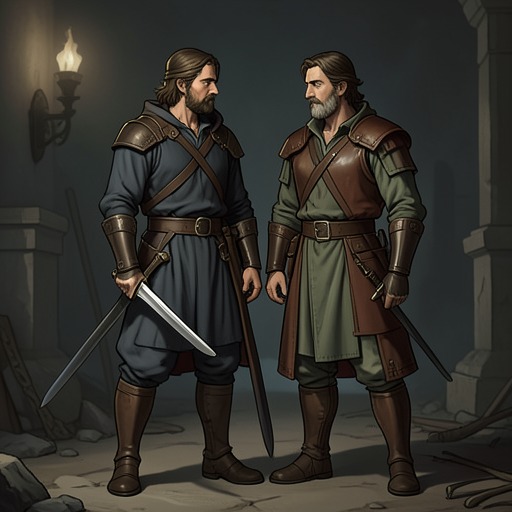
Kyle Fontaine
The Legend of William OhKyle Fontaine is introduced as the leader of an established Party of Climbers and as one of the first experienced figures to assess William Oh directly. He is not merely a powerful adventurer in the background: his scars, equipment, tactical warnings, and unsentimental judgments turn him into an early model of what survival at higher Floors requires. Through Kyle, the narrative presents climbing less as a contest of courage than as a discipline of preparation, error management, and learning quickly from wounds that would otherwise become fatal.
Identity and Introduction
Kyle first appears at Leon’s General Store with a five-person Party: Bess, Amy, Mark, and Roger. He is a large, close-shaved man in heavy armor, with scars near his eyes, and his initial glance at William Oh is swift and dismissive. The Party’s equipment establishes a hierarchy of specialized roles around him: one member carries a powerful wooden bow, Amy bears an energized wand and an ominous ring, Bess wears a wooden symbol of Granesh whose calming aura recalls Gertrude, and another member carries rings, a helmet, and a waterproof smock. Kyle’s armor and commanding presence make him recognizable as the group’s leader before he says anything.
He initially identifies himself formally as “Mr. Fontaine,” while Amy supplies his given name as Kyle. William Oh continues to call him Mr. Fontaine because he does not want to provoke the Party leader before their working relationship has begun. That small choice captures Kyle’s position: he is approachable enough to offer help, but formidable enough that familiarity must be earned rather than assumed.
Advice, Judgment, and Survival Method
Kyle gives William Oh and Ben a concrete route to a useful hunting ground. About three miles from the entrance, he says, lies a meadow containing many Wheat Gremlins, marked by a large boulder. He instructs them to use the boulder and the entrance as landmarks rather than navigating by the sun, because the sun moves. The advice is practical rather than heroic: it translates Kyle’s experience into repeatable procedures that can keep inexperienced Climbers from becoming lost before the monsters even become the main danger.
Kyle also offers to hear how they fare and to provide further pointers if they meet again. His interest is partly communal and partly operational; knowing whether a hunting spot remains productive from year to year has value for every Party. In this sense, his mentorship is not sentimental. He treats information about terrain, prey, and changing conditions as a resource that must circulate among Climbers.
When William Oh worries that Kyle’s group may be trying to exploit him, Kyle answers with brutal directness. He says that paranoia serves a Climber well, but insists that William is not worth the effort of taking advantage of: even the ring on Kyle’s finger is worth a dozen of him. The remark wounds William’s pride, yet it also clarifies the immediate social reality. Kyle is neither pretending that the two boys are equals nor concealing the gap in their power. His bluntness becomes a form of protection because it removes the need for William to misread the danger.
Scars as Tactical Lessons
Kyle later explains why strong defense is indispensable for Climbers above the Fifth Floor. He points to his own scars as a record of mistakes converted into rules. He once dropped his sword, so he now keeps it attached by a lanyard. He once neglected his armor fittings and exposed part of his neck, so he now remains still for as long as the fitter requires. A broken shield strap left a jagged seam of scar tissue across his midsection, which he presents as bad luck but also as another reminder that equipment failure can decide whether a Climber survives.
These injuries give physical form to Kyle’s central lesson: experience is not the absence of mistakes, but the construction of safeguards after mistakes occur. His advice directly challenges the romantic image of advancement as fearless improvisation. Defense gives Climbers room to make mistakes and learn from them; without that margin, a dropped weapon, a loose fitting, or a failed strap becomes a final error. Kyle’s scars therefore function as both biography and instruction manual.
Connections with William Oh and Ben
Ben responds to Kyle’s advice by introducing himself and William Oh, explicitly noting that William has no Class. Kyle answers without treating the lack of a Class as a reason to refuse them information. He later encounters the pair again while they are discussing survival and confirms that they are right about the need to endure long enough to learn. His intervention turns a casual meeting into a recurring connection between inexperienced Climbers and a veteran Party.
Ben soon begins hunting with Kyle’s team. When two of Kyle’s members are injured, the remaining group temporarily spends time in the Hunting Grounds while those members recover. Kyle’s Party gives Ben advice and helps him secure valuable kills, and Ben invites William Oh to join for as long as the arrangement lasts. William’s envy of Ben’s access to Kyle’s group is visible, but he suppresses it rather than allowing resentment to dictate his conduct. The later handshake with Kyle, Bess, and Roger marks William’s cautious entry into the relationship: Kyle says they have heard much about him from Ben, including some good reports, while William remains wary of how much has been said.
Kyle’s influence extends beyond hunting. When a Will-o’-wisp Sacrifice begins leaking through its cork and the group lacks the proper tools to preserve it, Kyle tells William to take his Trial immediately rather than wait until returning to town. The recommendation is governed by the material limits of the Sacrifice, not by ceremony or encouragement. Kyle recognizes that delay would waste a rare opportunity, and his practical judgment helps push William toward the next decisive stage of advancement.
Tactical Leadership and Narrative Role
Kyle’s Party represents the professional infrastructure surrounding the Climb. Its members are not simply a crowd of stronger fighters; their equipment implies differentiated functions, and Kyle’s leadership is expressed through preparation, field knowledge, and the management of risk. Later operations in the wider climbing system reinforce the importance of this outlook. Advancement requires choosing between slow, safe established routes and dangerous but rewarding Key Site clearances, while higher Floors eventually eliminate established routes altogether. Kyle’s defensive philosophy anticipates that system: progress depends on creating enough margin to survive error, not on assuming that strength alone will solve every problem.
His role also provides a contrast with impulsive or inexperienced Climbers. Kyle does not promise that the path will be safe, and he does not flatter William Oh into believing that he has already become formidable. Instead, he identifies the limits of William’s current power, supplies usable knowledge, and treats wounds as evidence from which better procedures must be built. Even his humor is grounded in hierarchy and risk: after dismissing William’s fear of exploitation, he pats him with a calloused hand and leads his group away for a drink, perhaps to find Ganishans in town for The Hunt.
Kyle is therefore an early mentor figure, though an unsentimental one. He does not accompany William Oh through every later danger, and the evidence does not establish a completed personal transformation or final fate for him. His lasting significance lies in the survival ethic he embodies: a Climber’s competence is measured not only by offensive power, but by whether weapons remain attached, armor is properly fitted, shields hold, routes are understood, injuries are managed, and knowledge is passed on before the next mistake becomes irreversible.