Loth
The Legend of William OhLoth is a kobold Saboteur whose unusual blend of generosity, technical ingenuity, and battlefield ruthlessness makes him indispensable to William Oh's Party. He first appears as a small, hooded figure with a barrel nearly as large as himself, but the apparent oddity of his form quickly gives way to practical competence: he commands a living supply of insects, improvises weapons and equipment from whatever the environment offers, and repeatedly turns dangerous terrain into an advantage. His partnership with William Oh grows from a cautious exchange of food into a durable alliance tested by exploration, pursuit, catastrophe, and physical injury.
Identity and Introduction
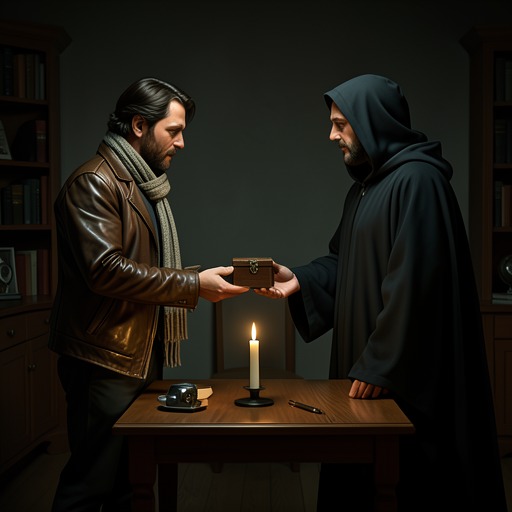
Loth is initially concealed beneath a deep leather hood. When ordered to lift it, he reveals taloned hands, an obsidian scaled muzzle, and eyes compared to emerald gemstones. The striking appearance establishes him as visibly nonhuman, but the scene does not leave him at the level of a monster or curiosity. He immediately offers William Oh a wriggling grub, an awkward but sincere gesture of hospitality. Loth explains that William Oh is the first human to accept his gift of friendship and tentatively proposes the human custom of clasping hands. His introduction therefore joins alienation and sociability: he is separated from the humans by body and custom, yet actively seeks a bridge between them.
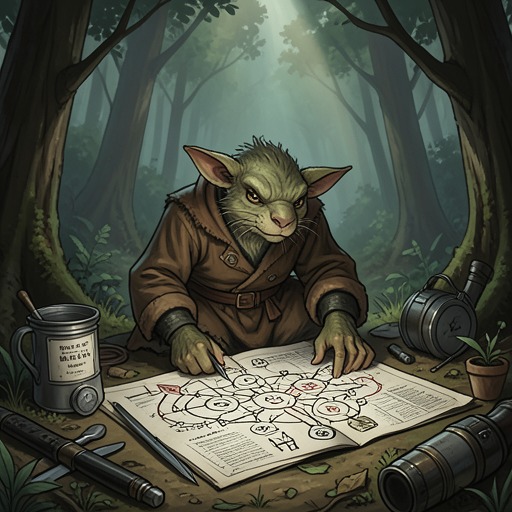
The barrel beside him is not merely baggage. It contains soil, food scraps, and dozens of insect species that Loth controls with ease. His mobile colony produces both nourishment and tactical materials. Feeders consume refuse and convert it into more of themselves, providing field rations while also feeding the other insects. Loth keeps silk-striders, wood-worms, venomous Gnatters, Pics, ticks, bleeders, and barbs, each with a distinct practical use. Some coagulate blood, others make it flow freely, and the barbs carry flesh-eating bacteria; combined on a blade, they can turn a tiny nick into a wound serious enough to require a Healer quickly. His character is consequently defined through an applied knowledge of small, easily overlooked life-forms. What looks like a bucket-sized barrel of waste is, in his hands, a portable arsenal, pantry, and biological workshop.
Partnership with William Oh
Loth and William Oh become partners during the search for a Kaith supply line. The party divides into seven groups while scouting the branching tunnels, and William Oh recognizes that his own climbing ability makes him better suited than the others to descend into the dangerous spaces. Loth supports that decision rather than treating the expedition as a contest of individual heroics. When a gap separates the climbers, he throws a rope across it so that William Oh can continue, and William Oh in turn releases the Sting Ring from Dimensional Storage while preparing for the next stage of the descent. Their cooperation is practical and immediate: one supplies mobility and climbing expertise, while the other supplies tools, reconnaissance, and the means to keep the group connected.
The same sequence presents Loth as more than a supplier of insects. He moves through the cavern system independently, climbs up beneath a ledge, and cuts taut silk from the floor with a belt knife. When the party rushes past him, he asks where his teammate is, revealing that he thinks in terms of mutual responsibility rather than simply personal survival. His concern is especially notable because the cavern operation repeatedly fragments the larger group. The tunnels encourage separation, darkness limits communication, and each crossing creates the possibility that someone will be left behind. Loth's attention to the missing teammate gives his relationship with William Oh a protective dimension.
Loth's communication style also helps shape the partnership. He is capable of apologizing for William Oh's poor education while insisting that William Oh is clever, framing the apology as a personal remedy for his companion's oafishness. The remark is both tactful and faintly comic: Loth acts as translator and social buffer when William Oh's bluntness risks offending others. His usefulness therefore extends beyond combat and exploration. He manages the interpersonal consequences of traveling with a leader whose intelligence is real but whose manners and presentation are unreliable.
Fieldcraft and Tactical Intelligence
Loth's methods depend on converting overlooked materials into organized capabilities. The insect barrel turns scraps into renewable provisions and stores specialized biological effects that can alter the outcome of a fight. His knowledge is not abstract natural history; it is operational knowledge, arranged around wounds, blood flow, infection, food, concealment, and movement. In a setting where supplies are limited and every expedition can become an attrition test, this makes Loth a force multiplier. He reduces waste, extends the party's endurance, and gives ordinary objects consequences disproportionate to their size.
His approach also contrasts with the formal language of the System. The party receives quests, selects abilities, and advances through visible game-like prompts, but Loth's competence arises from experimentation with living matter and terrain. He does not need every advantage to arrive as a cleanly labeled reward. A barrel of soil, a discarded food scrap, a silk line, or a grub offered in friendship can become part of a larger tactical system once he recognizes its use. This makes him an especially clear example of how the world rewards adaptation as much as nominal power.
Loth's apparent self-description is deliberately unstable. When asked about kobolds, he rejects the identity in exaggeratedly insulting terms, calling them vile, dirty, nasty creatures with room-temperature intelligence whose only saving grace is an appreciation of a good trap. He then clarifies that the kobolds call him Loth the Luminary. The exchange separates the ordinary category imposed on his species from the exceptional identity he claims for himself. He is a kobold in appearance and origin, but he presents himself as something more purposeful: a luminary, a saboteur, and eventually a figure whose knowledge helps the party confront threats far larger than any single member.
That tension between diminutive appearance and outsized capability recurs throughout his actions. He can appear beside a barrel of grubs, speak in an almost apologetic register, and still understand how a minor wound can become fatal. He can offer a handclasp as a sign of friendship while maintaining an arsenal of venomous and flesh-eating organisms. Loth's distinctiveness lies not in choosing between kindness and danger, but in carrying both at once. His generosity is real, yet it never makes him naïve about what bodies, tools, and environments can do to one another.
Survival, Catastrophe, and Recovery
Loth’s value becomes clearest when ordinary plans collapse into emergencies. During the party’s movement through the ashlands, he remains attentive to immediate bodily needs rather than treating endurance as an abstract virtue. When William Oh returns exhausted after carrying Brianna, Loth pushes a waterskin into his hand and orders him to drink. The gesture is small, but it expresses the practical form his loyalty takes: he notices depletion, supplies what is necessary, and acts before discussion can become another burden. His care is not sentimentalized; it is urgent, physical, and embedded in the party’s survival routine.
That practical loyalty is tested far more severely when Oilton explodes while Loth and William Oh are discussing Build strategy. The disaster leaves Loth badly burned. His scales are stripped away over large areas, fresh burns fuse with his clothing and Relics, and his body is described as almost equally divided between scar tissue and new injury. Even in that condition, he continues searching through the ash for a bug, an instinctive return to the small living resources that normally sustain his methods. His attachment to the insect colony is therefore not ornamental eccentricity. In the aftermath of catastrophe, it remains part of the behavior through which he tries to preserve himself and retain usefulness.
The injury does not end his contribution. Loth reaches level fifteen before his eyes roll back and he collapses into the ash, turning advancement into a grim counterpoint to physical damage. The System’s notification of two available Ability Upgrades further places his recovery within the world’s progression mechanics: danger produces advancement, but advancement does not cancel pain. William Oh later unwraps Loth from a cloth swaddling and speaks of the Saboteur’s need for time to regrow his scales. Loth sleeps beside him with the dark skin beneath the burned patches exposed, making his recovery visible as a biological process rather than a convenient reset between encounters.
This aftermath deepens the partnership established in the caverns. Earlier, Loth had asked where his teammate was when the group rushed past him; after the explosion, William Oh is the one who tends to Loth and explains his condition to others. Responsibility consequently moves in both directions. Loth’s rope, insects, field rations, and waterskin preserve William Oh’s ability to act, while William Oh’s rescue and care preserve Loth when his own resilience is insufficient. Their alliance is not founded on identical strengths but on reciprocal compensation, with each becoming most important when the other is physically or socially unable to manage alone.
Loth as Interpreter and Strategist
Loth also serves as an interpreter of situations that exceed the party’s immediate understanding. When the group confronts the growing Tangled threat, he considers the scale of the problem rather than treating each encounter as an isolated fight. He reports that the Jibleya place the number of Tangled stalking the city at thirteen thousand, up from just below nine thousand only three days earlier. The figures transform the threat from a collection of dangerous creatures into a rapidly expanding population. Loth’s knowledge gives the crisis a measurable rate of growth, and that measurement changes the strategic question from whether the party can kill individual Tangled to whether it can interrupt the process producing so many of them.
His reasoning remains skeptical even when others propose seemingly decisive solutions. When Travis asks how the swarm could be killed afterward, Loth’s strategic context is defined by the same problem: solving one stage of a crisis may create another. The Tangled’s collapse in pain is therefore not treated as a final victory in itself. Loth’s attention stays fixed on consequences, containment, and the possibility that an apparently successful intervention will merely redistribute danger. His intelligence is consequential rather than ornamental; it tracks what an action will release, preserve, or multiply.
The same interpretive role appears in his response to the injured Tangled encountered later. After comparing it with previous Tangled that the party killed, Loth judges that the creature has not yet been tortured to the point of insanity and argues that the group should intervene. The judgment distinguishes between a monster as an enemy and a suffering being whose condition has been produced by violence. Loth does not abandon tactical thinking, but his classification of the creature includes its degree of torment. Compassion, in his hands, is another form of knowledge: before deciding what must be destroyed, he determines what has been done to the thing in front of him.
His final recorded recommendation is correspondingly severe and purposeful. After the party’s experiences with the Tangled crisis and the wider devastation around Oilton, Loth proposes killing the Wyrd family. The proposal marks a movement from local improvisation toward targeted political violence. He has begun as the keeper of a barrel-sized ecosystem, a maker of traps, and a cautious emissary between species; he now helps identify the human or dynastic source that must be confronted if the party is to address the structure behind the immediate horrors. The trajectory does not erase his earlier gentleness. Instead, it shows how the same habits of observation, attribution, and consequence that make him a careful field companion can lead him toward an uncompromising strategic objective.
Survival, Catastrophe, and Recovery
Loth’s value becomes clearest when ordinary plans collapse into emergencies. During the party’s movement through the ashlands, he remains attentive to immediate bodily needs rather than treating endurance as an abstract virtue. When William Oh returns exhausted after carrying Brianna, Loth pushes his waterskin into William Oh’s hand and orders him to drink. The gesture is small, but it expresses the practical form his loyalty takes: he notices depletion, supplies what is necessary, and acts before discussion can become another burden. His care is not sentimentalized; it is urgent, physical, and embedded in the party’s survival routine.
That practical loyalty is tested far more severely when Oilton explodes while Loth and William Oh are discussing Build strategy. The disaster leaves Loth badly burned. His scales are stripped away over large areas, fresh burns fuse with his clothing and Relics, and his body is described as almost equally divided between scar tissue and new injury. Even in that condition, he continues searching through the ash for a bug, an instinctive return to the small living resources that normally sustain his methods. His attachment to the insect colony is therefore not ornamental eccentricity. In the aftermath of catastrophe, it remains part of the behavior through which he tries to preserve himself and retain usefulness.
The injury does not end his contribution. Loth reaches level fifteen before his eyes roll back and he collapses into the ash, turning advancement into a grim counterpoint to physical damage. The System’s notification of two available Ability Upgrades further places his recovery within the world’s progression mechanics: danger produces advancement, but advancement does not cancel pain. William Oh later unwraps Loth from a cloth swaddling and speaks of the Saboteur’s need for time to regrow his scales. Loth sleeps beside him with the dark skin beneath the burned patches exposed, making his recovery visible as a biological process rather than a convenient reset between encounters.
This aftermath deepens the partnership established in the caverns. Earlier, Loth had asked where his teammate was when the group rushed past him; after the explosion, William Oh is the one who tends to Loth and explains his condition to others. Responsibility consequently moves in both directions. Loth’s rope, insects, field rations, and waterskin preserve William Oh’s ability to act, while William Oh’s rescue and care preserve Loth when his own resilience is insufficient. Their alliance is not founded on identical strengths but on reciprocal compensation, with each becoming most important when the other is physically or socially unable to manage alone.
Strategic Judgment and Narrative Significance
Loth’s usefulness ultimately extends beyond traps, provisions, and emergency care into the interpretation of threats whose scale exceeds any single encounter. When the group confronts the expanding Tangled crisis, he reports that the Jibleya count thirteen thousand Tangled stalking the city, an increase from just below nine thousand only three days earlier. The figures give the danger a measurable rate of growth. What might otherwise appear to be a series of isolated monster attacks becomes a multiplying system, forcing the party to consider the source and consequences of the swarm rather than merely the next creature within reach.
That same habit of consequence shapes Loth’s response when Travis questions how the swarm could be killed afterward. The concern is not simply whether an immediate tactic will work, but whether its success will create another disaster. When a Tangled later collapses in pain, Loth compares its condition with the creatures the party has already killed and concludes that this one has not yet been tortured into insanity. He argues that the group should intervene, distinguishing a suffering victim from an enemy defined only by its species. His compassion is not detached from his tactical intelligence; it depends on accurate diagnosis of what has happened to the creature and what the party’s intervention might prevent.
After the catastrophe surrounding Oilton, Loth’s attention turns from symptoms to culpability. His recommendation to kill the Wyrd family marks a sharp escalation from local improvisation to a targeted strategic objective. The same character who began by offering William Oh a grub and cultivating a barrel-sized ecosystem now identifies a family as the force that must be confronted. His development does not cancel his gentleness or his instinct to preserve injured life. Instead, it reveals the harder edge of the same method: observe carefully, trace consequences, determine responsibility, and act against the source rather than merely treating the visible wound.