Maksu
The Legend of William OhMaksu are the principal obstacle in William Oh’s first Class Trial, a numerous blue-skinned humanoid tribe occupying the canyon around the portal that leads back to the Hunting Grounds. Their presence transforms what might have been a simple escape into a prolonged contest of observation, improvisation, and attrition. Although the Trial presents them as enemies to overcome, William Oh succeeds not by meeting their numbers directly but by exploiting their habits, terrain, and dependence on caravan raiding.
Identity, Appearance, and Organization
Maksu are small, angry, blue-skinned humanoids with extended muzzles and pronounced canines. They carry short spears and slings, giving them both close-range and projectile weapons. Their physical capabilities include an exceptional talent for climbing, a trait that deprives William Oh of the easy home-field advantage he initially expects from the canyon’s cliffs and narrow footholds.
The tribe is large enough to make a direct dash for the portal absurd. William Oh estimates that roughly three hundred Maksu occupy the village, with warriors milling around the exit and prepared to attack anyone attempting to reach it. Their numbers are not merely incidental: they create a living perimeter around the Trial’s objective and force William Oh to treat every movement as a risk of detection.
The Maksu have also built a shrine around the portal. The structure is badly assembled, but a faint yellow glow leaks through its seams, and the tribe appears to worship the portal as a divine object. This religious arrangement gives the exit more than military importance. The portal is simultaneously a sacred center, a guarded strategic position, and the physical threshold on which the Trial’s qualification depends.
Leadership and Threat
The Maksu are led by Sezz’kenal, described by the Trial’s announcement as a vicious raider of caravans who has acquired a taste for human flesh. His reputation makes the tribe’s military activity intelligible: the Maksu are not a passive settlement waiting around the portal, but a raiding society whose leader regularly draws warriors away in search of caravans.
That habit becomes the central weakness in their defense. William Oh reasons that the tribe’s numbers around the portal must fluctuate whenever Sezz’kenal leads a raiding party. If the leader is away, the camp’s population and combat strength should fall; if he returns, the village may become too heavily defended to approach. The Maksu therefore function as both a physical threat and a predictable system. Their aggression creates the openings that William Oh needs.
Sezz’kenal also serves as the final personal expression of the tribe’s danger. William Oh does not merely slip past an anonymous guard force. When he reaches the shrine, the leader attacks him with a faintly glowing, straight-handled hatchet and tries to bite his arm. The confrontation confirms that the portal is defended by an active champion rather than only by the surrounding crowd.
Camp Surveillance and Caravan Raiding
William Oh spends three days observing the Maksu camp before an opportunity appears. A lone Maksu out hunting wanders below his position, allowing him to drop a head-sized rock from the ledge. The act begins a gradual reduction of the camp’s effective strength and demonstrates the method that defines the Trial: William Oh converts patience, height, and improvised weapons into advantages against a superior force.
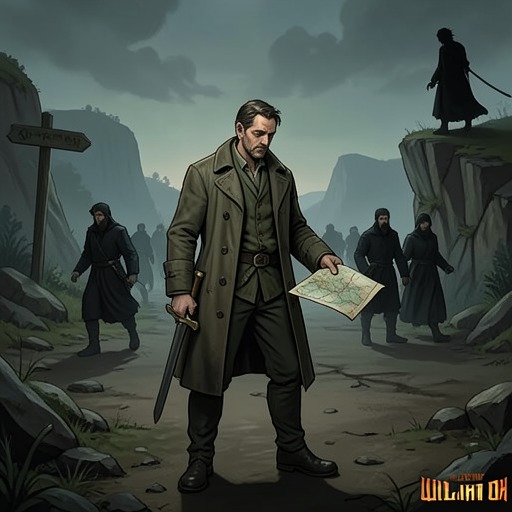
Nearly a week later, the Maksu form a war party and leave to hunt a caravan. Their departure presents William Oh with two possible strategies. He could enter the village at night and walk directly through the portal while most combat-ready warriors were absent, or he could follow the raiders and use the attack itself to reduce their numbers and perhaps gain experience. He chooses the riskier second option.
William Oh stalks the raiding party from a distance, following the trail its numbers have pounded into the dusty desert floor. From the hill above the ambush site, he can see every blue warrior while the caravan road below remains screened by boulders and depressions. The Maksu have chosen the terrain well, concealing themselves from travelers; William Oh’s elevated position reverses that advantage and exposes the entire ambush to him.
The attack fails when the caravan detects the ambush. The Maksu throw their spears too late, and the caravan’s defensive Abilities absorb much of the assault, leaving it largely unscathed. The raiders then charge down the hillside, waving their weapons and baring their fangs. William Oh, unable to fight as a conventional two-handed warrior, loads a nearby rock into a sling one-handed. His response is not a heroic charge but a practical conversion of whatever the terrain provides into ammunition.
The Ability William Oh’s allies appear to expect from the hillside does not manifest. Instead, his hail of stones strikes several of the rearmost warriors before the Maksu understand that the engagement is unwinnable. Once their attack collapses, the caravan finishes off the remaining raiders. William Oh then places a Maksu tunic on a spear and waves it over his head as a makeshift surrender signal, enabling him to approach the caravan without being mistaken for another attacker.
The Return to the Portal
After the caravan encounter, William Oh descends into the canyon, crosses the river, and climbs the opposite side. By morning he is overlooking the village from a new angle, opposite the route used by the raiding party. The Maksu have anticipated movement along the obvious trail and are waiting there with slings ready to bombard his face, but most of their warriors, including reserve units, remain across the river in the rough terrain where the caravan attack occurred.
The new position gives William Oh a narrow temporal advantage. The rising sun is behind him, leaving his side of the canyon in shadow while the warriors are illuminated. The village itself remains dark for another hour, and there is no visible movement. Rather than treating the camp as an impenetrable mass, he reads its light, geography, troop distribution, and daily rhythm as a set of exploitable conditions.
William Oh reaches the shrine and enters through its undersized doorway as quietly as possible. A flicker of firelight on steel warns him only moments before the attack. Sezz’kenal’s glowing hatchet nicks his forearm, and William Oh catches the wooden shaft on his truncated wrist. When Sezz’kenal lunges to bite him, William Oh punches the creature in the snout, breaking one of its slender teeth and driving it backward, though the blow also cuts his knuckles.
The two combatants freeze briefly in shock at the sudden reversal. William Oh recovers first. He strikes Sezz’kenal with the elbow of his wounded arm, tears the tomahawk from the leader’s grasp, and buries it in the creature’s skull. Sezz’kenal collapses inside the shrine, and the hatchet slips free with a wet pop as shouting and hurried footsteps gather outside.
Narrative Function and Significance
The Maksu give the Trial a concrete form: the portal is visible, but access to it is controlled by a population too large for straightforward combat. The tribe’s three-hundred-member presence, shrine, weapons, climbing ability, and fluctuating raiding parties make escape a logistical puzzle rather than a single fight. William Oh’s victory depends on waiting three days for an isolated target, waiting nearly another week for the main war party to depart, tracking the raiders, exploiting the failed ambush, and approaching the village through the shadowed side of the canyon.
Their defeat also clarifies what William Oh’s Resourceful Climber identity means in practice. He uses rocks, bootstring-based equipment, elevation, concealment, timing, enemy clothing, and the Maksu’s own appetite for caravan warfare. The Trial’s requirement is simply to return to the Hunting Grounds, not explicitly to kill every defender, yet the tribe’s presence makes violence difficult to avoid. William Oh ultimately passes through the portal only after killing Sezz’kenal, turning the tribe’s sacred guard post into the site of his qualification for The Climb.
Maksu thus operate as both antagonistic people and a living tactical environment. Their organization creates pressure, their habits create openings, and their leader embodies the final threshold between William Oh and escape. The tribe’s numerical superiority never disappears; what changes is William Oh’s understanding of how to survive against it.