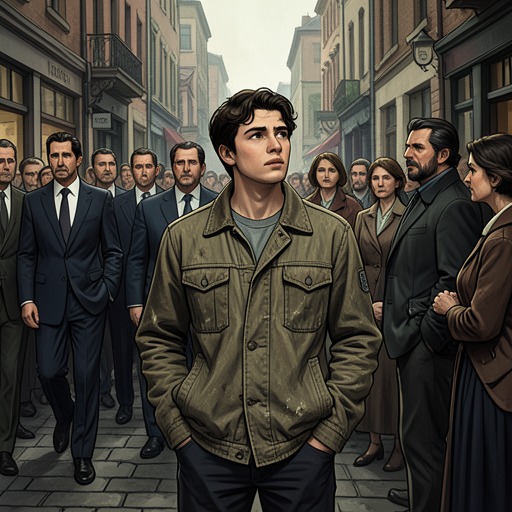
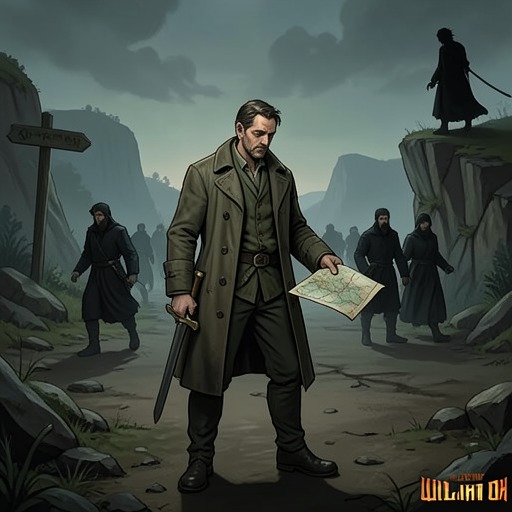
Maksu Caravan Counter-Ambush
The Legend of William OhMaksu Caravan Counter-Ambush is the moment when William Oh converts a dangerous Class Trial into an improvised rescue operation and proves the practical value of the Resourceful Climber archetype. Instead of treating the Trial as a private race toward escape, he accepts the risk of protecting an innocent caravan, reshapes the battlefield through stealth and timing, and ends the engagement by striking the Maksu leader, Sezz’kenal, before the leader can use his Ability.
The Choice Behind the Counter-Ambush
Nearly a week after completing a sling from scavenged materials, William Oh watched the Maksu form a war party and go caravan hunting. Their blue column, stacked three deep, wound up the canyon wall in overwhelming numbers. With most of the Maksu’s combat-ready troops away, William Oh had a clear opportunity to sneak into the camp at night and walk through the portal, completing his Trial. The Trial offered no special reward for exceeding its basic requirement beyond bragging rights, levels, and Relics, so escape was the safer and more efficient decision.
The caravan altered that calculation. William Oh recognized that innocent people were about to enter the raiders’ ambush, while defeating the Maksu could provide experience and Relics that would strengthen his chances of passing. He therefore chose a reverse ambush rather than an uneventful escape. Even if the rescue failed, he expected that he might kill several raiders and retreat with an additional level. The decision is important because it joins moral responsibility to practical advancement: William Oh does not abandon the Trial’s rewards, but he refuses to pursue them by ignoring people placed in immediate danger.
William Oh Turns the Terrain Against the Raiders
William Oh climbed the canyon wall and followed the Maksu raiding party from far behind, remaining outside their sight until he reached the chosen ambush site. From the crest of the hill, he could see every blue warrior. The caravan road below, however, concealed the raiders behind boulders and dips in the land. The Maksu had arranged themselves for a conventional attack, loosening their arms and setting their spears in a row so that they could throw them one after another. Some carried shortswords and steel spearheads manufactured for a larger species, underscoring both their equipment and their confidence in the attack.
The most dangerous part of William Oh’s plan was deliberately approaching them before the caravan arrived. If the Maksu noticed him too early, they could chase him while the caravan withdrew into a defensive formation, leaving William Oh exposed without the advantage of surprise. He selected the raider farthest from the others and climbed down behind it as quietly as possible. His Aspect of the Goat helped him: the crunchy ground flattened and solidified beneath his feet, quieting his steps as a side effect of improving his footing.
When he was close enough, William Oh picked up a large rock and smashed the isolated Maksu in the back of the head. The raider collapsed and twitched. William Oh immediately dropped beside it and remained hidden, protecting the plan from a glance or a suspicious movement by the other warriors. He then took the fallen raider’s dagger and moved cautiously around the concealing boulder, keeping his body pressed to the dirt while the rest of the Maksu remained within a stone’s throw.
The Ambush Is Reversed
As the caravan approached, William Oh turned the dagger toward it and used its polished surface to catch the sunlight. The signal worked at once. The caravan guards shouted, pointed toward his position, and arranged themselves into a defensive line. The Maksu’s concealment was exposed before they could begin their attack, and their spears came only a few seconds too late. Defensive Abilities absorbed much of the assault, leaving the caravan largely unscathed.
The blue raiders then rose and charged down the hillside, waving their weapons and baring their impressive fangs. William Oh stood as well, grabbed another rock, and laboriously loaded it into his sling one-handed. The process required him to place the pouch on the ground, put the rock inside, and lift the whole weapon, a cumbersome method that nevertheless turned his limited equipment into battlefield power.
His priority was the Maksu leader. At the rear of the assault, Sezz’kenal wore an ornate headdress and chanted while a wavering haze of energy gathered around him. He stood beyond the caravan’s return-fire range and appeared to be preparing an Ability capable of turning the battle in the Maksu’s favor. William Oh released the sling before that preparation could be completed. The stone struck Sezz’kenal in the back of the head. The energy haze vanished, and the leader sank bonelessly to the ground.
The counter-ambush therefore succeeds through sequence rather than superior force. William Oh first removes an isolated raider, then reveals the hidden attackers to the caravan, then interrupts the leader before his Ability can change the engagement. The result is a reversal of the Maksu’s intended structure: their concealed spear line is exposed, their opening volley loses force, and their command figure is eliminated at the moment he is trying to establish control.
Rewards and Immediate Consequences
The System announced that William Oh had reached level 2 as a Resourceful Climber. The advancement confirms that the rescue and the combat were not merely a moral detour from the Trial; they materially improved his position within it. By choosing the more dangerous path, William Oh gained the experience he had hoped for while also preventing the caravan from being devastated by the Maksu raid.
Afterward, a caravan guard asked William Oh how many Maksu he had killed. William Oh answered that he had killed the warrior with the headdress and four others. The guard chewed his lip, opened his purse, and threw William Oh one gold coin and four silver coins. William Oh dropped the knife he was holding in order to catch the payment in midair. The guard explained that the money was for William Oh’s help and that whatever had been carried by the warrior with the headdress belonged to him. The merchants were sheltering on the opposite side, while the guards intended to make camp and assess the situation.
The payment and the right to claim the leader’s belongings give the event a second form of payoff. William Oh receives formal compensation from the rescued caravan, but he also retains the combat spoils that could strengthen his future Climbing. The encounter thus establishes a recurring logic of the Tower: survival, advancement, and material reward can overlap, but only when a Climber is prepared to improvise under pressure.
Place in William Oh’s Progression
The counter-ambush marks an early demonstration of William Oh’s characteristic method. He does not win by matching the Maksu in numbers or by relying on a conventional weapon. He combines a handmade sling, a scavenged dagger, a rock, the terrain, sunlight, patience, and the Aspect of the Goat’s altered footing. Each modest resource becomes decisive because he uses it at the right moment and in relation to the others.
The event also foreshadows the broader logic of William Oh’s later work with Loth. Subsequent missions depend on reconnaissance, route marking, rope, escape hatches, defensive positions, inter-floor access, and engineered destruction rather than simple frontal strength. In this earlier battle, that tactical identity is already visible in miniature: William Oh observes the enemy’s route, identifies the command structure, manipulates information between attackers and defenders, and strikes the point whose removal changes the whole fight. The Maksu Caravan Counter-Ambush is consequently both a successful rescue and an early proof that William Oh’s greatest weapon is the ability to turn limited means into unexpected options.