Maksu Caravan Raid
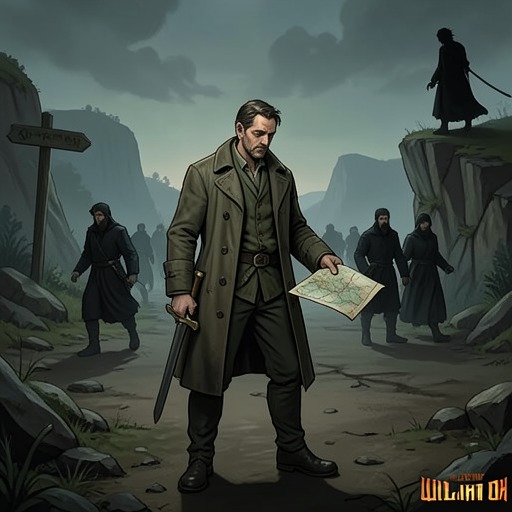
The Legend of William OhThe Maksu Caravan Raid is William Oh’s first major display of battlefield initiative and practical cunning. What begins as an opportunity to escape the Maksu camp becomes an intervention in a caravan ambush: William infiltrates the raiders’ position, reveals their concealment, kills the leader Sezz’kenal with a rock launched from a one-handed sling, and receives payment from the grateful caravan guards. The event matters because William does not win through conventional strength. He wins by reading terrain, exploiting surprise, and turning whatever lies at hand into a weapon.
Causes and Tactical Setting
The raid follows nearly a week of preparation in the Maksu camp. William has been completing a sling by hand, using bootstring and his teeth to anchor the tension while working toward a much larger objective. When the Maksu form a war party and leave to hunt a caravan, their departure creates the opening he has been waiting for: with most of their combat-ready troops absent, he could potentially enter the camp at night, reach the portal, and finish his Trial. The prospect of gaining an additional level complicates that escape plan, however, and William chooses to follow the raiders instead.
He trails the war party at a safe distance along the path its numbers have beaten into the dusty desert floor. From the crest of a hill, he can see the entire blue column, while the road below conceals the Maksu behind boulders and uneven ground. The terrain has therefore been arranged into an ambush site before William arrives: the raiders are hidden above the road, and an approaching caravan is funneled beneath them. William’s reconnaissance gives him a perspective the caravan lacks, allowing him to understand both the trap and the attackers’ disposition before the first spear is thrown.
The Ambush Is Exposed
A plume of dust marks the caravan’s approach across the arid wasteland. The Maksu prepare methodically, loosening their arms and laying their spears in a row so that they can throw one after another. Some carry shortswords and steel spearheads made for a larger species, emphasizing the difference between their own bodies and the weapons they have acquired. William does not immediately attack. Instead, he uses the shiniest portion of a dagger to catch the sunlight and direct a flash toward the caravan.
The signal works at once. The caravan guards shout, point toward William’s position, and arrange themselves into a defensive line. The Maksu’s concealment is ruined, and their spears arrive too late to achieve the devastating surprise on which the ambush depended. Defensive Abilities absorb much of the attack, leaving the caravan largely unscathed. William’s contribution is small in physical scale but decisive in tactical effect: a reflected glint converts a concealed massacre into an alerted engagement.
William’s Strike Against Sezz’kenal
Once the ambush is exposed, the blue raiders rise and stream down the hillside, waving their weapons and baring their fangs. William rises as well, but his response remains improvised rather than heroic in the conventional sense. Fighting one-handed, he takes a nearby rock, loads it into the sling with the pouch resting on the ground, and lifts the whole arrangement into position. His immediate concern is not the nearest warrior but the Maksu leader.
Sezz’kenal is positioned at the rear of the assault, identifiable by an ornate headdress and a chant that accompanies a wobbling haze of energy around him. He remains beyond the caravan’s return-fire range and appears to be preparing an Ability capable of shifting the battle in the Maksu’s favor. William’s attack interrupts that preparation. The stone strikes Sezz’kenal in the back of the head, the energy haze disappears, and the leader collapses bonelessly to the ground. The blow is physically simple, but its target makes it strategically disproportionate: William removes the commander before the Ability can manifest.
The consequences spread immediately through the assault. The Ability the Maksu expect from the hillside never appears. William continues firing rocks, picking off several warriors at the rear before the raiders understand that they cannot win. By that point, the caravan has survived the initial attack and can finish the remaining Maksu. William then places one of their tunics on a spear and waves it overhead, using the improvised white flag to signal that the immediate danger has ended.
Payment and Material Consequences
The caravan guard asks William how many Maksu he killed. William reports the leader with the headdress and four others. The guard responds with direct compensation, tossing him one gold coin and four silver. William drops his knife to catch the payment in midair, a small gesture that captures the raid’s practical logic: danger is converted into currency the instant the opportunity appears.
The guard also tells him that whatever is found on Sezz’kenal belongs to him. The merchants are sheltering on the far side of the road, and the caravan intends to make camp and assess the situation. William’s reward is therefore not limited to the coins. He receives access to the fallen leader’s equipment or possessions and an invitation to spend his earnings with the merchants. The raid creates a short-term economic gain while also potentially improving his equipment, reinforcing the link between combat success and progression.
That material reward stands in sharp contrast to William’s earlier economic calculations. He has already paid twenty silver for a Spirit Turtle Sacrifice, an expense that consumed more than half the money earned from selling a tongue because he lacked the means to preserve and retail the material himself. The caravan raid offers a different model of survival: rather than slowly converting gathered resources through a disadvantageous market, William earns through a high-risk act whose value is recognized immediately by witnesses. His later progression displays the same accounting mentality through Charges, purchases, and level-based decisions, but the raid is one of the clearest early demonstrations of it in action.
Strategic and Narrative Significance
The raid crystallizes William’s emerging identity as a Resourceful Climber. His later interface records four out of ten Charges and the Primary Abilities Aspect of the Goat and Phantom Hand, but this victory depends just as much on skills that cannot be reduced to a menu: patience, surveillance, terrain reading, deception, and improvisation. The sling is assembled from available materials, the dagger becomes a signaling device, the rock becomes a projectile, and a dead enemy’s tunic becomes a surrender flag. Each object changes function according to the immediate need.
The event also foreshadows the larger military logic of William’s journey. Later missions emphasize supply lines, bridges, fortified positions, established routes, and dangerous shortcuts. The System explains that reaching the 2nd Floor can be done through slow, safe established routes or through the quick, dangerous, rewarding clearance of a Key Site. The caravan raid anticipates that second approach in miniature. William chooses danger over the safer route, but he does not seek danger for its own sake; he selects a position where information and timing can make a hazardous action profitable.
Its final reversal is equally important. William begins by considering the raid as a chance to escape the Maksu camp, then follows the war party because an extra level may help him complete his Trial, and ends by participating in the caravan’s defense and collecting a tangible bounty. The result is not a clean victory achieved by overpowering the enemy. It is a change in value produced by intervention: a hidden ambush becomes an exposed battle, the Maksu’s anticipated Ability becomes nothing, and William’s vulnerability becomes leverage. In that sense, the raid establishes the central pattern of his advancement—survival first, profit second, and power built from whatever the situation leaves within reach.