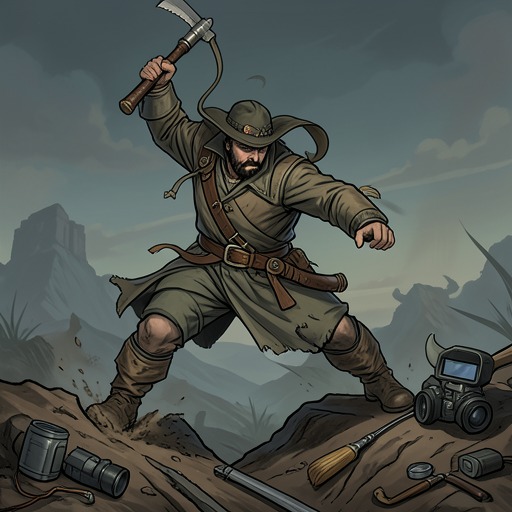
Maksu Leader’s Tomahawk
The Legend of William OhThe Maksu Leader’s Tomahawk is a Relic weapon whose discovery changes William Oh’s relationship with combat equipment. Seized during a close-quarters escape from a shrine, it first appears to be a strange enemy hatchet; after Leon examines its construction, it becomes an instrument whose concealed channels and charged resonance can cripple groups of Kaith. The weapon’s importance lies not merely in its killing power, but in the way its physical design, uncertain origin, and partially decoded Abilities reward experimentation under pressure.
Discovery in the Shrine
The tomahawk enters William Oh’s possession during his escape from the Class Trial. A flicker of firelight on steel gives him only a moment’s warning before the Maksu leader’s faintly glowing hatchet cuts his forearm. William catches the wooden shaft with his truncated wrist, then fights the attacker at arm’s length while protecting himself with his good hand. When the Maksu leader begins summoning sickly green energy toward his chest, William instinctively strikes the forming spell aside with his Phantom Hand. That interruption creates the opening for him to wrench the tomahawk away and drive it into the creature’s skull.
The weapon’s first narrative function is therefore practical and immediate: it is both the threat William must survive and the means by which he survives. Its resistance to leaving his grasp after the killing gives the moment a suggestive material emphasis, as though the weapon has passed from the defeated Maksu leader into William’s uncertain but increasingly resourceful hands.
Construction and Concealed Function
At Leon’s General Store, William asks whether a lanyard can be fitted to the weapon. The request reflects his amputated hand and the danger of losing an object that must be controlled with a single remaining hand, while also showing that he intends to keep using it despite his hostility toward Kyle Fontaine and the immediate pressures surrounding him. Leon identifies it as a possible Relic and studies its unusual form rather than treating it as an ordinary axe.
The tomahawk has a straight wooden handle slightly longer than William’s forearm. Its grip is carved to resemble a rattlesnake’s tail, and the rear hammer contains a cup with a hole leading into the weapon’s interior. A snake with an unhinged jaw forms the base of the blade, while the blade’s sides contain additional openings that appear to have once held fangs. The faintly ominous light the weapon emitted while the Maksu leader wielded it is William’s first reason to suspect that it belongs to the Relic category.
Leon’s inspection turns grotesque physical residue into functional knowledge. He finds that the fang-holes are clogged with rotting meat, crusted blood, and dirt, using a hooked metal tool and a swab to clear them. He also reveals a small opening at the bottom of the handle through which the user must inhale. Once the mouthpiece and side channels are cleaned, the tomahawk’s design stops looking decorative and begins to imply an operation based on airflow, resonance, or both. The object becomes conspicuous precisely because it is no longer transparent as a simple weapon: its material structure demands to be understood.
The Kaith Bridge Battle
The tomahawk’s concealed power is revealed during the fighting retreat across the Kaith Bridge. William uses Aspect of the Goat to run along a sheer cliff wall above Reggie and Mason, then leaps over them to outflank a Kaith Nuker and protect the vanguard. As air flows through the weapon’s fang-holes, it produces an unsettling chord that rises to a crescendo while William descends. He lands feet-first on the lead Kaith and buries the blade between its eyes.
William then spends one Charge on the downward sweep. The system records three of four Charges remaining and immediately identifies the event as Relic use, beginning to decode the weapon’s Abilities. The tomahawk’s sound is not merely atmospheric: after the Charge is expended, its haunting chord pulses outward with physical force. Nearby Kaith recoil, writhe in pain, and fall from the wall trailing smoke from their eyes and mandibles. The weapon thus combines a direct killing strike with an area effect capable of disrupting multiple enemies, making it especially valuable in a battle where William is moving vertically, protecting allies, and fighting while physically disadvantaged.
The revelation is interrupted before the system can give a complete identification, displaying only the beginning of the name, “Tomahawk of—”. William’s attempt to use the weapon also carries immediate risk. The Kaith he strikes falls from the wall, taking William with it. Its power creates an opening and a new danger at the same instant: the tomahawk helps him break the enemy formation, but its use does not remove the physical hazards of the battlefield.
Relic, Rule, and Adaptation
The weapon’s development follows the broader logic of the System. A failed sacrifice of a thumb-sized piece of pemmican leaves nothing behind and produces no Class Seed, while the later system instruction requires William to choose his Primary Abilities for the Resourceful Climber Class. Against that background, the tomahawk represents a different route to capability. It is not generated by William’s sacrifice, nor is its function immediately granted through a clean interface. Its value emerges through acquisition, inspection, cleaning, bodily adaptation, and a dangerous field test.
That process makes the weapon an extension of William’s particular method of advancement. He cannot rely on ordinary assumptions about equipment, especially after losing a hand; he asks for a lanyard, studies the weapon’s unusual grip, and accepts Leon’s practical investigation. In combat, he trusts the tomahawk while running across a sheer wall, then commits a Charge only after its resonance begins to reveal what it can do. The System supplies the categories and the decoding prompt, but the decisive knowledge comes from William’s willingness to experiment while the weapon remains only partly understood.
Narrative Significance
The Maksu Leader’s Tomahawk turns an enemy’s attempted execution into a resource for William Oh’s continued ascent. Its history is violent, its openings are filled with remnants of previous use, and its power is activated through breath, motion, sound, and Charge expenditure rather than through appearance alone. The weapon therefore embodies the book’s recurring tension between human intention and a world of pre-existing mechanisms: William chooses when and how to wield it, but the object’s design determines what kinds of action are possible.
Its partial naming also preserves uncertainty. The tomahawk is recognized as a Relic and its Abilities begin to decode, yet the system cuts off before explaining the full title or all of its rules. That incompleteness prevents the weapon from becoming a fully mastered reward. It remains a dangerous, material mystery whose usefulness is proven before its meaning is settled. In that form, it marks William’s progression from surviving with whatever is at hand to converting unfamiliar power into deliberate tactical advantage.