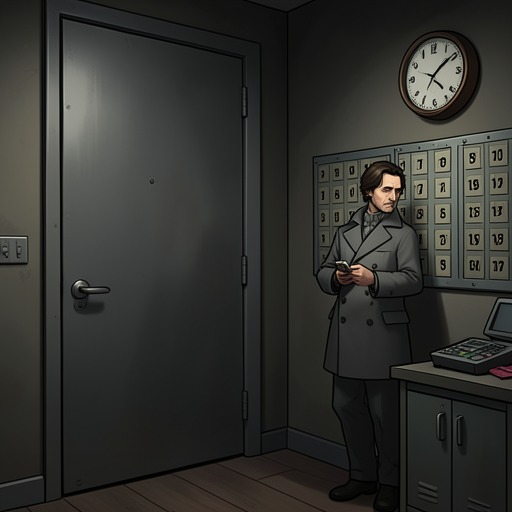
Miasma Acclimation Rule
The Legend of William OhThe Miasma Acclimation Rule is the Tower’s mandatory adaptation requirement for Climbers who move between floors. After an ascent or descent, travelers are expected to remain on the new floor until the stated acclimation period expires; ignoring that interval can produce catastrophic illness and death. The rule therefore makes vertical progress a biological ordeal as well as a geographic one, forcing William Oh and Loth to treat time, shelter, and route selection as essential components of survival.
Definition and Operation
Welcome messages on the Second Floor and Third Floor display the rule as a formal system instruction rather than advice from another Climber. On the Second Floor, the required Miasma Acclimation period is two days. The warning expressly advises against ascending or descending before that period has elapsed and lists fever, bulging bloodshot eyes, coughing, pustules, necrosis of the extremities, parasitic twin growths, and Death among the possible consequences. The same warning is repeated immediately afterward, making the prohibition difficult to mistake for a minor recommendation.
The rule is tied to the floor itself. Upon reaching the Second Floor, William Oh is also informed that a Stronghold lies to the north and a Key Site requiring clearance lies to the east, but those destinations do not erase the waiting period. The system presents useful strategic information at the same moment that it restricts immediate action: William can know where opportunity lies while remaining physically unready to pursue it.
The Second-Floor Crossing
William Oh and Loth encounter the rule after climbing a cliff and reaching the Second Floor. William has hauled himself upward with one hand while Loth disappears over the cliff edge, and the system’s arrival message interrupts the physical struggle with an administrative countdown: two days of acclimation. The contrast defines the rule’s function. The climb itself is an immediate test of strength and technique, while the acclimation period imposes a slower, unavoidable cost after the obstacle has been overcome.
William’s reflection that his parents took years to make the trip, because descending required the same kind of time as ascending, shows how the rule alters the meaning of travel through The Tower. Floors are not merely stacked regions that can be traversed whenever a traveler possesses enough skill. Each transition carries a delay, and the delay applies in both directions. Loth’s response to the cold and his preparation of a tiny fire reinforce the practical consequence: the new floor must become a temporary place of habitation before it can become a platform for further movement.
The Third-Floor Requirement
The same system appears when William Oh and Loth enter the Third Floor. The transition brings hot air, ash, caustic fumes, and a dim blood-red sun, immediately establishing an environment more hostile than the Second Floor. The system then specifies a three-day Miasma Acclimation period, again warns against ascending or descending prematurely, and names fever, bulging bloodshot eyes, coughing, pustules, necrosis of the extremities, parasitic twin growths, and Death as possible side effects.
The Third-Floor message also identifies a Stronghold to the east and a Key Site to the north. As on the Second Floor, this information creates a tension between orientation and limitation. William and Loth can see the structure of the floor’s opportunities, but they cannot safely use the floor as a transit corridor until their bodies have endured the required interval. The rule makes the Tower’s geography strategically legible while keeping it operationally inaccessible for a prescribed time.
Strategic Use and Circumvention
The acclimation period becomes especially important when William and Loth are trapped in the Third Floor’s wider crisis. Loth proposes finding a source of water, establishing a camp within sight of a Key Site, gaining experience by fighting nearby creatures, and waiting until acclimation is complete. Once the period expires, they could join a bus traveling toward the Fourth Floor and bypass the worst of the danger rather than crossing the entire floor on foot.
This plan demonstrates that the rule does not merely delay the plot; it determines the shape of viable strategy. Water is necessary because the party may need to remain stationary. A nearby Key Site provides a controlled source of experience while they wait. A bus offers a means of converting elapsed acclimation time into upward progress. The waiting period consequently encourages a combination of shelter, grinding, and contracted transportation, while making reckless movement both medically dangerous and tactically wasteful.
The contrast with ordinary climbing is sharp. William and Loth are not simply choosing whether to fight through the Third Floor. They must decide whether to spend the acclimation interval exposed to environmental and human threats, or to attempt movement before their bodies are ready and risk the rule’s grotesque consequences. The rule turns patience into a survival skill, but it also makes every safe delay expensive in a world where remaining in place can attract enemies.
Consequences and Significance
By the time William Oh and Loth prepare to clear a Key Site and reach the Third Floor, their acclimation timer has long since expired and they are nearly level 10. Their readiness to proceed is therefore measured not only by level or equipment but also by the completion of the biological timer. The rule establishes a threshold beneath the more visible thresholds of combat and experience: a Climber may be strong enough to advance and still be unable to do so safely.
The Miasma Acclimation Rule also belongs to the Tower’s broader system of institutionalized risk. Other arrangements distribute danger through contracts, priests, Strongholds, and buses, but acclimation places the cost directly in the body. Its warning is both precise and absurdly extreme, moving from familiar sickness to parasitic twin growths and Death. That range makes the Tower’s environment feel governed by a hostile logic that can be documented without being made safe.
Its deepest narrative effect is to make knowledge consequential. William and Loth can plan around the timer, but they cannot negotiate with it. They can choose a camp, a Key Site, or a bus; they cannot choose to skip adaptation without accepting potentially fatal consequences. Vertical advancement therefore becomes a cycle of ascent, illness risk, enforced stillness, preparation, and only then renewed motion—the rule’s quiet discipline beneath every spectacular act of climbing.