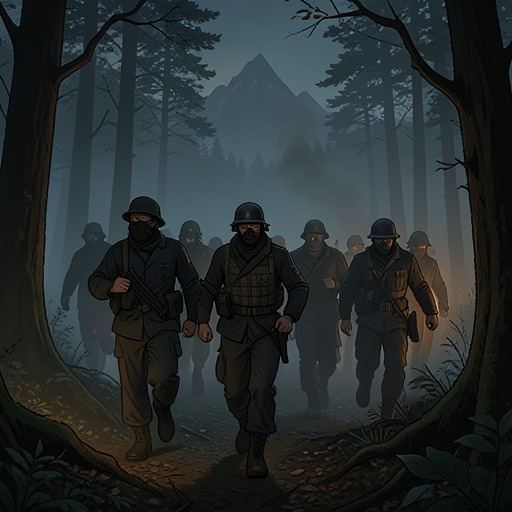
Nathan
The Legend of William OhNathan is the veteran Climber responsible for directing the new recruits during the Quest to destroy the Kaith supply lines. His decisive significance lies in the gap between the expedition’s apparent disorder and the structure he imposes on it: he is not merely an instructor who explains the assignment, but the field commander who turns inexperienced Climbers into a usable force, accepts the most dangerous position himself, and keeps the operation from collapsing when William Oh disappears into the cavern.
Identity and Introduction
Nathan first appears as a grizzled veteran looming over William Oh after the younger Climber is thrown into the cavern system. His greeting is brusque and disorienting, and he immediately offers William a hand before demanding that he join the line of new Climbers. The combination establishes Nathan’s practical authority: he has no interest in ceremonial introductions, yet he is attentive enough to assess whether a recruit is capable of recovering and returning to duty.
He identifies himself as the group’s babysitter for the Quest, a deliberately undignified title that captures his role better than a formal rank would. Nathan is responsible for people who have arrived with little shared experience and limited understanding of the terrain. His authority is therefore expressed through speed, commands, and immediate classification rather than speeches about leadership.
The Quest and Its Rules
Nathan explains that the nearby hole leads into an extensive cave system used by the Kaith to move food toward front-line battles against higher-level Climbers. The objective is specifically to find and destroy those supply lines, not to engage the Kaith warriors in a direct fight. This distinction gives the Quest its operational logic: the recruits are being asked to disrupt logistics, not win a conventional battle against the force guarding the front.
He also divides the new arrivals according to their intended development. Climbers who want to advance a civilian Class are told to step forward, after which roughly a dozen people are assigned to establish camp, bake bread, or perform comparable support work. The remaining, more combat-oriented Climbers continue toward the caves. Nathan’s decision recognizes that survival depends on more than fighting ability. Food, shelter, preparation, and the preservation of a base are part of the military objective, even when they occur away from the enemy.
Command Under Pressure
Nathan is designated as the spearhead at the Kaith Bridge, holding the position while the others determine how to destroy it. When the bridge operation fails to conclude cleanly, the surviving group’s responsibility becomes a fighting retreat: they must return to the surface, bring Nathan back the following day, and regroup with the other Parties while everyone is rested. Nathan’s position is thus both tactical and sacrificial. He remains where the danger is concentrated so that the rest of the group can withdraw and prepare a stronger return.
The retreat becomes more urgent when William is stung and falls into the darkness. Mason states that Kaith venom causes paralysis rather than death, creating a narrow possibility that Nathan can still retrieve him if the group reaches Nathan quickly enough. The statement also clarifies Nathan’s importance: he is not simply the person in charge of the camp, but the one Climber whose position and ability may make a rescue possible amid the advancing Kaith.
William eventually escapes through an emergency route and reaches the cavern rim, where Nathan is standing watch to prevent Kaith backlash from reaching the civilian camp. Nathan immediately notices William’s battered condition and asks whether he has anything to report. The exchange is brief, but it confirms the priorities of his command. He does not waste time on astonishment or consolation; a recruit who has returned from an apparently fatal disappearance is first treated as a source of operational information.
Discipline and Camp Organization
When Mason, June, Reggie, and Loth reach the surface, they find the camp in constructive chaos. Climbers are rapidly assembling for another excursion under Nathan’s direction. His supervision is heard through a barrage of practical corrections about lines, harnesses, water, and weapons. The details reveal the standard he imposes: equipment must fit correctly, water must be carried, and a blade must be clean enough for immediate use. Nathan treats preparation as a matter of life and death rather than personal neatness.
He orders the four returning Climbers to guard the camp while the fresh Climbers accompany him to the newly reported supply lines. The division serves two purposes. It preserves a defensive force at the surface, and it prevents exhausted veterans of the first scouting attempt from immediately returning underground. Nathan explicitly tells them to rest while warning them not to lower their guard, balancing recovery against the possibility of another attack.
The source of the new intelligence is revealed to be a dramatically displayed figure seated in a camp chair while young women fuss over him. Nathan’s method of obtaining or exploiting that information is not explained, but his response is clear: he converts it into an immediate expedition. The contrast between the theatrical informant and Nathan’s hard logistical command underscores the veteran’s function as the person who turns rumor into an actionable plan.
Leadership and Narrative Role
Nathan occupies the mentor and threshold-guardian positions at once. He introduces William to the Quest’s rules, identifies the difference between civilian and combat work, and directs the recruit toward the dangerous environment beyond the camp. Yet he is not a comfortable guide who keeps danger at a distance. By holding the bridge himself and remaining at the cavern rim to protect civilians, he teaches through exposure to risk and through the example of assuming responsibility.
His characterization is built from recurring contrasts. He is called a babysitter, but the role demands battlefield decisions. He is blunt and impatient, but his commands preserve water, equipment, rest, and defensive coverage. He pushes inexperienced Climbers harshly because the cave system does not forgive casual preparation. In a story where advancement, levels, and Classes can encourage reckless ambition, Nathan represents the older discipline that makes advancement survivable.
Nathan’s visible arc in the supplied episodes is not a personal transformation but an expansion of responsibility. He begins by organizing a line of recruits, then directs the division of labor, holds a bridge during a failed operation, becomes central to the possibility of William’s recovery, and finally prepares a larger return expedition. His ending within these scenes leaves him active rather than resolved: still guarding the camp, still directing fresh Climbers, and still functioning as the practical hinge between dangerous exploration and organized survival.